Tokenizing private equity, what decision makers need to know
By Jeremy Ryan, Founder & CEO · October 2026
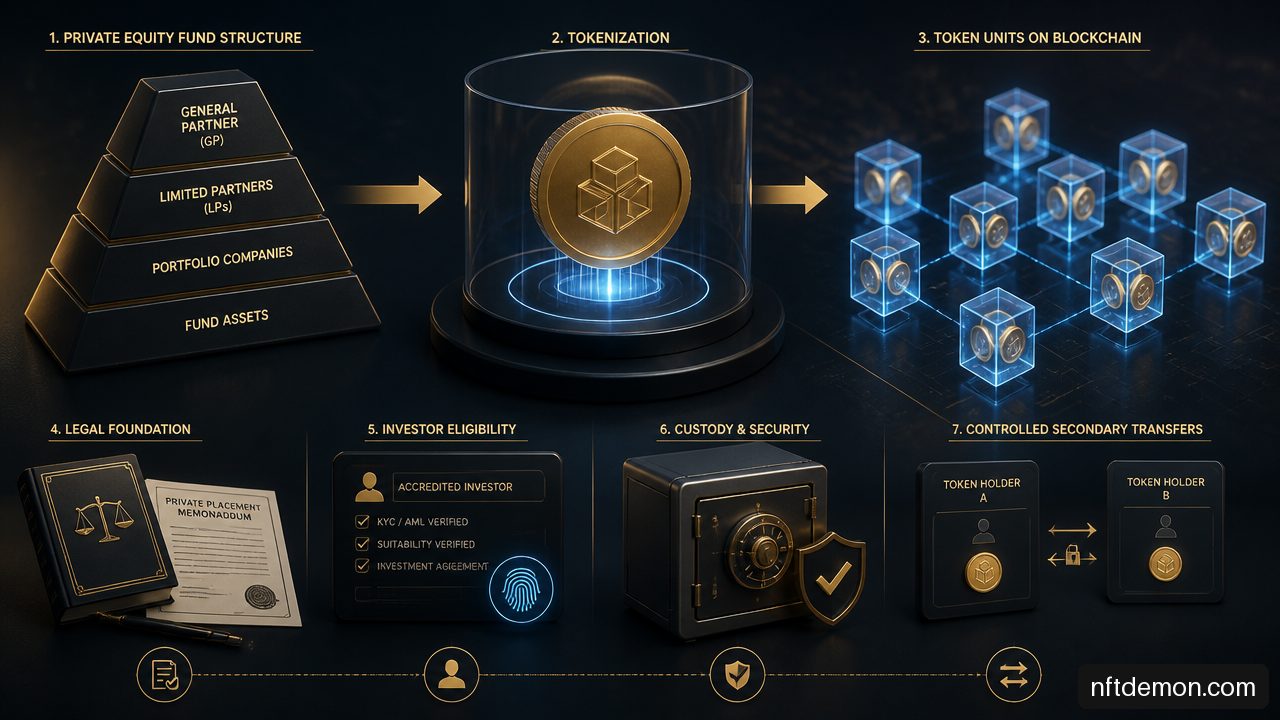
Tokenizing private equity can modernize how fund interests and private-company shares are issued, recorded, transferred, and serviced. It does not, however, turn an illiquid asset into a liquid one by technical force. The legal rights, investor restrictions, valuation process, fund administration, and buyer demand still determine the outcome.
For decision makers, the useful question is not whether blockchain can represent an ownership interest. It can. The question is whether a tokenized structure solves a specific distribution, administration, transfer, or investor-access problem without creating a larger compliance and operating burden.
- What Tokenizing Private Equity Actually Means
- The Legal And Operational Stack Behind A Token
- Liquidity, Confidentiality, And Implementation Decisions
- Key Takeaways
- Frequently Asked Questions
- Sources
What Tokenizing Private Equity Actually Means
A Token Is Not Automatically Legal Ownership
At its core, tokenizing private equity means representing an interest in a private-equity fund, feeder fund, special-purpose vehicle, or private company through a blockchain-based digital token. The token may represent a limited-partner interest, a beneficial interest in a feeder vehicle, direct company equity, or a contractual claim linked to an underlying asset.
That distinction is not a technical footnote. It determines what the investor owns, who recognizes that ownership, how voting or information rights work, and what happens during a transfer.
Deloitte describes fund tokenization as using code or a digital contract to represent fund ownership, regulatory status, transaction history, and underlying-asset characteristics. That description is useful because it frames the token as part of a broader operating record rather than a speculative digital wrapper. See Deloitte’s discussion of digital contracts representing fund ownership and regulatory status.
I would separate tokenization into three layers before approving any initiative:
• Legal layer: The fund documents, shareholder register, subscription agreement, governing law, and transfer rules that establish enforceable investor rights.
• Economic layer: The investor’s claim on distributions, proceeds, fees, losses, capital calls, and any voting or advisory rights.
• Technical layer: The blockchain token, wallet, compliance controls, custody arrangement, and reporting interfaces used to administer the position.
If these layers do not align, a blockchain balance may show that an investor holds 1,000 tokens while the authoritative legal register recognizes something different. That is an avoidable dispute, not an innovation outcome.
Fund Interests And Direct Company Shares Are Different Products
Private-equity tokenization is often discussed as if every token represents equity in an operating company. In practice, tokenized fund interests and tokenized private-company shares have materially different mechanics.
| Structure | What The Token May Represent | Core Operating Challenge | Typical Transfer Constraint |
|---|---|---|---|
| Tokenized fund interest | An LP interest, feeder-fund unit, or beneficial interest | Capital calls, distributions, NAV reporting, fee allocation | Fund agreement, investor eligibility, GP approval |
| Tokenized private-company share | Direct equity or a beneficial claim on equity | Shareholder register, governance rights, company disclosures | Securities restrictions, board approval, shareholder agreements |
| Tokenized SPV interest | An interest in a vehicle holding a private asset | Vehicle governance and asset-level reporting | SPV documents and investor qualification rules |
A feeder fund can be a practical starting point because it may allow a manager to create a tokenized access vehicle without changing the underlying flagship fund. Zama reports that Hamilton Lane tokenized a feeder fund in 2022 using Securitize, ERC-1400 tokens, and KYC-based transfer restrictions. The underlying lesson is straightforward: compliance rules need to be designed into the token structure from the beginning, not bolted on after issuance.
Fractional Ownership Changes Access, Not Suitability
Fractional ownership may reduce minimum investment sizes and make a fund interest easier to divide. That can broaden the addressable investor base, particularly where a conventional fund minimum is too large for otherwise eligible investors.
Still, smaller units do not make every investor suitable. A private-equity investment may remain long term, difficult to value between reporting dates, and subject to substantial transfer restrictions. Fractionalization can improve access mechanics while leaving the investment’s risk, illiquidity, and legal eligibility unchanged.
A smaller token denomination is not the same thing as a lower-risk investment or a public-market security.
This is why I would treat investor segmentation as a product-design question. An institutional channel, accredited-investor channel, and broader retail-access channel may require different exemptions, disclosures, servicing models, and transfer controls.
The Legal And Operational Stack Behind A Token
The Authoritative Register Must Be Defined Up Front
The first governance question is deceptively simple: who is legally recorded as the owner?
Possible answers include the fund’s transfer agent, the fund administrator, a corporate secretary, a regulated nominee, or an issuer-maintained register that reconciles with blockchain records. A token can be the authoritative record only where the governing documents, applicable law, and operating processes support that role. In other structures, the token is a synchronized record or transfer instruction, while the official register remains off chain.
I would require a written hierarchy of records covering these scenarios:
- A wallet balance differs from the administrator’s investor ledger.
- A court order, sanctions screening result, or fraud investigation requires a transfer freeze.
- An investor loses wallet credentials.
- A token is transferred to an ineligible recipient.
- A smart-contract upgrade, key compromise, or vendor outage occurs.
Without an agreed hierarchy, operational staff may be forced to decide ownership questions in real time. That is precisely the kind of ambiguity private-market infrastructure should remove.
Securities Compliance Needs To Travel With The Token
A tokenized private-equity interest remains a security or security-linked instrument when the underlying arrangement meets the relevant legal tests. Representing it on blockchain infrastructure does not erase securities-law requirements.
In the United States, private offerings are frequently structured around exemptions such as Regulation D, while Regulation A+ is sometimes considered for offerings seeking broader participation. The appropriate path depends on the issuer, investor base, offering size, resale restrictions, disclosure obligations, and jurisdictional facts. It should be determined with securities counsel rather than selected because a platform advertises a particular template.
Transfer restrictions must also operate in practice. A compliance-aware token standard, including ERC-1400-style designs, may support rules such as allowlists, jurisdictional restrictions, investor-category checks, holding periods, forced transfers, or transfer freezes. But a smart contract only enforces the rules that are accurately configured and consistently updated.
The architecture should connect investor onboarding, KYC and AML screening, accreditation verification where required, sanctions controls, wallet allowlisting, and post-transfer monitoring. This is where enterprise blockchain architecture in regulated industries becomes more relevant than generic token issuance advice.
Fund Operations Do Not Disappear On Chain
Private equity has irregular and highly specific cash flows. Investors commit capital, receive capital calls at different times, receive distributions when realizations occur, and are allocated expenses, management fees, carried interest, and tax information under detailed fund terms.
A token can identify an eligible holder and record a transfer. It does not automatically calculate every allocation correctly. Zama notes that tokenization can simplify investor onboarding and fund operations while creating potential channels for secondary transfers, but those benefits depend on the design of the wider service stack. Its analysis of onboarding, fund operations, and potential secondary transfers makes the point clearly.
A realistic operating model usually includes the following participants:
• General partner or issuer: Defines economics, governance, disclosures, and eligibility rules.
• Fund administrator: Calculates NAV, capital-account balances, allocations, notices, and investor reporting.
• Transfer agent or registry operator: Maintains legal ownership records and processes approved transfers.
• Compliance provider: Performs identity verification, screening, investor qualification, and monitoring.
• Digital-asset custodian or wallet provider: Safeguards keys or provides controlled investor access.
• Smart-contract operator: Maintains token logic, permissioning, upgrades, and incident controls.
• Secondary venue or broker: Supports compliant matching, settlement, and possibly reporting for transfers.
The reconciliation boundary should be explicit. For example, the administrator may calculate carried interest and performance allocations off chain, then publish a validated entitlement to the token system for distribution processing. That is not a failure of tokenization. It is an acknowledgment that complex fund accounting often remains dependent on established accounting controls.
Liquidity, Confidentiality, And Implementation Decisions
Transferability Is Not Liquidity
Tokenizing private equity can make a transfer easier to process. It does not guarantee a willing buyer, a reliable market price, or immediate settlement at a fair value.
Genuine liquidity requires several conditions to exist at the same time:
• A sufficiently large pool of eligible buyers and sellers.
• A compliant transfer or trading venue.
• Current disclosure and valuation information.
• A transfer process acceptable to the GP, administrator, and legal framework.
• Clear settlement, custody, and tax handling.
• Enough trading interest to support price discovery rather than isolated transactions.
Consider a $100 million fund with quarterly NAV reporting and a 10-year term. Dividing interests into $10,000 token units may create smaller potential trade sizes, but it does not solve the buyer’s need for current portfolio information or the seller’s need for a price. If the fund permits only quarterly transfer windows and requires GP approval, the token may improve the workflow inside that window while still being economically illiquid between windows.
That is why I would define success in operational terms before launching: lower transfer-processing time, fewer reconciliation breaks, broader eligible distribution, or more transparent investor records. “Liquidity” should be a measured market objective, not a marketing assumption.
Confidentiality Must Be Designed, Not Promised
Private equity depends on information that should not be exposed to every network participant: investor identities, capital commitments, portfolio-company metrics, valuation marks, and negotiated fund terms. A fully transparent public ledger can conflict with those realities.
A confidentiality-preserving design may keep sensitive data off chain, store only hashes or references on chain, limit access through permissioned infrastructure, and disclose investor or portfolio information through controlled data rooms. The key is to prove integrity without publishing the underlying confidential record.
This decision affects platform selection. A public blockchain may provide broad interoperability and established tooling, while a permissioned or hybrid network can offer stronger control over participant access and data visibility. Neither option is automatically superior. The right answer depends on regulatory expectations, investor needs, integration requirements, and the intended transfer model.
For a structured evaluation of those trade-offs, review blockchain platform selection for financial institutions. The platform should follow the operating model, not dictate it.

A Practical Go Or No-Go Framework
Tokenization is most defensible when it solves a visible operational or distribution problem. I would assess a proposed structure against six decision criteria.
| Decision Criterion | A Strong Fit For Tokenization | A Weak Fit Or Warning Sign |
|---|---|---|
| Investor base | Digitally capable, clearly eligible investors | Investors unwilling or unable to use digital custody tools |
| Transfer frequency | Expected periodic transfers or controlled secondary activity | Buy-and-hold fund with almost no anticipated transfers |
| Administration readiness | Administrator can integrate registry, reporting, and reconciliation workflows | Manual processes cannot reliably support exceptions |
| Valuation cadence | Defined NAV process and disciplined reporting timetable | Unclear valuation governance or delayed reporting |
| Confidentiality model | Sensitive data can remain controlled while records remain auditable | Architecture requires exposing investor or portfolio data |
| Legal structure | Documents can define token rights and authoritative records | Existing agreements prohibit or complicate digital transfers |
A sensible implementation sequence is usually narrower than a full-fund conversion:
- Define the legal instrument and investor rights before selecting a chain.
- Map every lifecycle event, including issuance, capital calls, distributions, transfer requests, wallet recovery, and redemption or wind-down.
- Select the registry, administrator, custody, compliance, and smart-contract responsibilities.
- Pilot with a limited investor cohort and real servicing processes rather than a presentation-only proof of concept.
- Test exceptions: ineligible transfers, investor death, lost credentials, sanctions hits, valuation corrections, and contract upgrades.
- Scale only after reconciliations, investor communications, and audit evidence work consistently.
The most difficult work is often integration, not issuance. Token balances must align with fund accounting, CRM records, payment systems, investor portals, reporting pipelines, and compliance data. That is the practical case for integrating blockchain with existing enterprise systems before committing to a production rollout.
Key Takeaways
• Tokenizing private equity is a legal, operational, and technical redesign. The token itself is only one component of the ownership and servicing model.
• A token must map precisely to enforceable rights. Decision makers should establish whether the blockchain record, transfer agent, administrator, or another register is authoritative.
• Fractional ownership can broaden access, but it does not remove investor-suitability requirements or private-market risk.
• Liquidity requires market structure. Eligible counterparties, transfer approvals, valuation transparency, and a compliant venue matter more than token divisibility alone.
• Private-equity operations remain complex. Capital calls, NAV calculations, performance fees, carried interest, and reporting may continue to rely on off-chain systems and controlled reconciliations.
• Confidentiality is a design requirement. A credible architecture exposes enough information to support integrity and auditability without disclosing sensitive investor or portfolio data.
Frequently Asked Questions
Direct Answers For Fund Sponsors And Investors
What Does A Tokenized Private-Equity Token Actually Represent?
It may represent a fund interest, a feeder-fund unit, direct private-company equity, an SPV interest, or a contractual claim tied to an underlying asset. The offering documents and governing register, not the token label, determine the holder’s legal and economic rights.
How Is A Tokenized Fund Interest Different From A Normal LP Interest?
The economics may be substantially the same. The difference is usually in how ownership is recorded, how investor eligibility is checked, how transfer requests are processed, and how the interest can be serviced through digital infrastructure. A tokenized LP interest still follows the fund agreement.
Can Tokenization Make Private Equity Liquid?
It can make compliant transfers easier to administer and may support secondary-market access. It cannot create active buyers, frequent pricing, or continuous trading by itself. A tokenized interest may remain illiquid if transfers are limited, valuations are infrequent, or eligible demand is thin.
Can Non-Accredited Investors Buy Tokenized Private Equity In The United States?
Sometimes, depending on the offering structure and applicable exemption, but not simply because the interest is tokenized. Regulation D offerings commonly limit participation to accredited investors, while other routes may impose different disclosure, qualification, and compliance requirements. Legal analysis should be specific to the offering.
How Are Capital Calls, Distributions, And Carried Interest Handled?
The fund administrator generally remains central. Token records can identify holders and support notices or payment workflows, but capital-account calculations, allocations, fees, and carried interest often require off-chain accounting controls. The token system should reconcile to those validated records.
What Happens If An Investor Loses Access To A Wallet?
The answer should be defined before issuance. A controlled recovery process may involve identity verification, a transfer freeze, legal review, registry updates, and reissuance to a replacement wallet. Designs that offer no recovery process may be unsuitable for many institutional and regulated use cases.
How Can Confidential Investor And Portfolio Data Stay Private?
Sensitive data can remain off chain or in permissioned systems, while the blockchain stores restricted records, cryptographic proofs, references, or approved transfer states. The architecture should limit data exposure while retaining a reliable audit trail.
Sources
• zama.org — https://www.zama.org/post/private-equity-tokenization-mapping-the-opportunities-and-solving-confidentiality
• deloitte.com — https://www.deloitte.com/lu/en/Industries/investment-management/blogs/breaking-down-barriers-with-new-building-blocks.html
NFT Demon Holdings helps enterprises scope, evaluate, and build blockchain programs — start with a free evaluation call.
Talk through your use case
Free evaluation call — objective, constraints, and fit, before any proposal.