Selecting private permissioned vs public L2 blockchains
By Jeremy Ryan, Founder & CEO · September 2026

To understand how to select between private permissioned and public L2 blockchains for enterprise deployment, I recommend starting with a practical question: does the business need shared control among known parties, or does it need access to an open settlement and liquidity ecosystem? That answer is more useful than comparing transaction-per-second claims in isolation.
A private permissioned blockchain can be the right system for a confidential workflow among identified institutions. A public Layer 2, or L2, can be the better system when assets, payments, customers, wallets, or external counterparties must connect to a public blockchain economy. Neither option is automatically more enterprise-ready. The stronger architecture is the one that puts the right controls at the right layer.
Start With The Business Control Model
The first decision is not whether public chains are innovative or private chains are secure. It is whether the workflow requires shared state or merely a shared process.
Shared state means several organizations need to rely on the same authoritative record: ownership, collateral status, payment status, asset restrictions, or a regulated audit trail. Shared process means each organization can retain its own systems of record while exchanging signed events, approvals, and proofs. Many enterprise projects mistakenly use a blockchain for a shared process that could be handled with conventional integration, secure messaging, or a workflow engine.
A blockchain becomes more defensible when independent parties need to reconcile a changing record without granting one participant unilateral control over it.
When A Private Permissioned Blockchain Fits
I would generally favor a private permissioned blockchain when the participants are known, access must be restricted, and counterparties need a common operational record without making transaction activity publicly visible.
Visa describes private blockchains as closed networks where participation and validation are limited to authorized entities. Its enterprise blockchain overview of restricted validator networks reinforces a critical architectural point: identity governance is not an add-on. It is the operating model.
A private permissioned model is usually strongest for:
• Interbank or insurer workflows involving named institutions
• Supply chain coordination where pricing, volumes, and counterparties are commercially sensitive
• Government, health, defense, or critical infrastructure workflows with strict participant approval requirements
• Internal treasury, reconciliation, or audit processes where public liquidity adds little value
• Consortium systems in which members need negotiated rules for admission, voting, and operational cost sharing
For example, imagine five manufacturers coordinating warranty claims with a small group of approved suppliers. They may need a shared record of claim status and replacement authorization, but they do not need anonymous wallet participation or public token liquidity. A permissioned network can enforce role-based access, isolate sensitive views, and keep validation within the consortium.
That control comes at a cost. Someone must administer identities, operate infrastructure, handle certificates or keys, approve software upgrades, and resolve disputes. The technical network may be straightforward; the governance model may not be.
When A Public L2 Fits
A public L2 is generally more compelling when the enterprise needs external settlement, broad wallet compatibility, public asset transfer, ecosystem composability, or access to established liquidity venues. Most public L2 designs lower transaction costs and improve throughput by processing transactions away from a public base layer, then posting data or proofs for settlement.
The meaningful enterprise benefit is not merely cheaper transactions. It is that public L2s can let an organization connect to an existing environment of wallets, exchanges, custodians, developers, market makers, stablecoins, and token standards.
Choose a public L2 when the deployment depends on:
• Customer-owned wallets rather than enterprise-issued credentials alone
• Asset transfers beyond a closed group of approved institutions
• Settlement on a public blockchain with independently verifiable history
• Integration with public token, stablecoin, decentralized finance, or digital identity ecosystems
• A resilience requirement that makes a single operator or consortium gatekeeper undesirable
For regulated asset issuance, the deciding factor is often whether the asset must circulate outside the originating institution. A tokenized fund share that stays within a single administrator’s approved investor network may work well in a permissioned environment. A tokenized instrument intended for controlled distribution through multiple custodians, exchanges, and qualified wallets may justify public L2 settlement, provided transfer restrictions, investor eligibility, and compliance controls are designed into the asset lifecycle.
Fair warning: public does not mean confidential. Transaction values, addresses, timing, and interaction patterns may expose useful metadata even when names are not directly visible. Encryption does not solve this by itself if sensitive information is written to an immutable public ledger.
Key Takeaways
• Choose a private permissioned blockchain when confidentiality, known participants, and negotiated governance outweigh external liquidity.
• Choose a public L2 when public settlement, wallet reach, interoperability, and ecosystem access create measurable business value.
• Do not confuse public access with permissionless operation. A regulated design can combine public connectivity with controlled participation.
• Treat identity, key custody, upgrade authority, and exit rights as core selection criteria, not implementation details.
For a broader strategic framework, review how to choose between public and permissioned blockchains before narrowing the technical platform shortlist.
Compare The Enterprise Control Points
The cleanest way to compare architectures is to identify who controls each important function. A chain selection decision becomes clearer when leadership can see where authority sits, what is independently verifiable, and what happens if a participant leaves.
A Practical Decision Matrix
| Control Point | Private Permissioned Blockchain | Public L2 Blockchain | Enterprise Implication |
|---|---|---|---|
| Participant identity | Centrally or consortium managed | Public access is possible, with compliance controls added at application or token layers | Private networks simplify admission; public L2s require stronger wallet and policy design |
| Read privacy | Can limit visibility by participant or channel | Public transaction metadata is often visible unless architecture minimizes exposure | Sensitive commercial data should usually remain off chain |
| Write authority | Restricted to approved organizations | May be open, controlled by smart contract logic, or mediated by application rules | Public systems need abuse controls and policy enforcement |
| Settlement | Controlled by network rules and operators | Anchored to a public base chain in many L2 designs | Public settlement can improve independent verification |
| Governance | Consortium or sponsor governed | Protocol governance and provider choices constrain control | Private governance is flexible but administratively demanding |
| Exit rights | Dependent on data portability and consortium agreements | Often benefits from open standards and public state availability | Both models require a documented migration plan |
The most useful distinction is this: private networks optimize authority; public L2s optimize external verifiability and connectivity. A decision maker should not accept “decentralized” as a complete answer to either requirement.
Defining The Public Settlement Threshold
There is no universal numeric threshold for when public settlement is worth the privacy tradeoff. The threshold is operational, not ideological. I would consider public settlement justified when at least one of the following is true:
• The asset must transfer across organizations that are not all willing to join one consortium
• Independent verification by customers, auditors, regulators, or market participants is a direct business requirement
• Liquidity depends on interoperable wallets, custodians, marketplaces, or public financial infrastructure
• The cost of maintaining private integrations exceeds the value of controlling every participant and validator
• A single sponsor’s ability to censor, reorder, or halt activity would create unacceptable continuity risk
Consider a loyalty program. If points are redeemable only through a company’s own channels, a public L2 may add complexity without creating meaningful value. If the program is intended to support customer wallets, partner redemption, secondary transfer where permitted, and third-party applications, public infrastructure may be justified.
The business case should state the external benefit plainly: reduced settlement friction, wider distribution, auditable issuance, or new counterparties. “Blockchain visibility” is not enough.
Public Permissioned Designs Deserve Attention
The choice is not always binary. Digital Asset Holdings’ regulated finance network evaluation notes that regulated enterprises may need public permissioned network properties rather than a fully permissionless model.
This category matters because it separates several decisions that are often bundled together:
• Whether network infrastructure is broadly reachable
• Whether validators are approved
• Whether asset holders must pass eligibility checks
• Whether transaction details are visible to all participants
• Whether settlement can be verified outside the immediate consortium
A public permissioned approach may be appropriate when institutions need interoperable reach but cannot allow unrestricted validation, unrestricted transfers, or unrestricted access to confidential transaction details.
Design Around Data Classification And Settlement
The most expensive blockchain mistakes often begin with an incomplete data model. Before selecting a network, classify every data element by confidentiality, retention requirement, legal sensitivity, update frequency, and audit need.
Use An On Chain And Off Chain Split
A disciplined architecture rarely places complete enterprise records on chain. Instead, it stores the minimum proof or state needed for verification and keeps sensitive records in controlled systems.
| Data Class | Recommended Treatment | Reasoning |
|---|---|---|
| Public asset identifier | On chain | Enables transfer, ownership verification, and interoperability |
| Transaction proof or document hash | On chain | Establishes integrity without exposing the full document |
| Customer identity, contract terms, health data, pricing | Off chain in governed systems | Protects confidentiality and supports access control or correction workflows |
| Encrypted reference or selective disclosure credential | On chain only when necessary | Can support verification, but metadata and future cryptographic risks still require review |
| Compliance decision and supporting evidence | Split model | Record the decision state on chain; retain detailed evidence in controlled repositories |
A hash is not automatically anonymous. If the underlying record is predictable, publicly available elsewhere, or can be guessed from a small set of possibilities, the hash may still disclose information. For this reason, teams should treat hashes as integrity tools, not universal privacy tools.
Separate Execution Privacy From Final Settlement
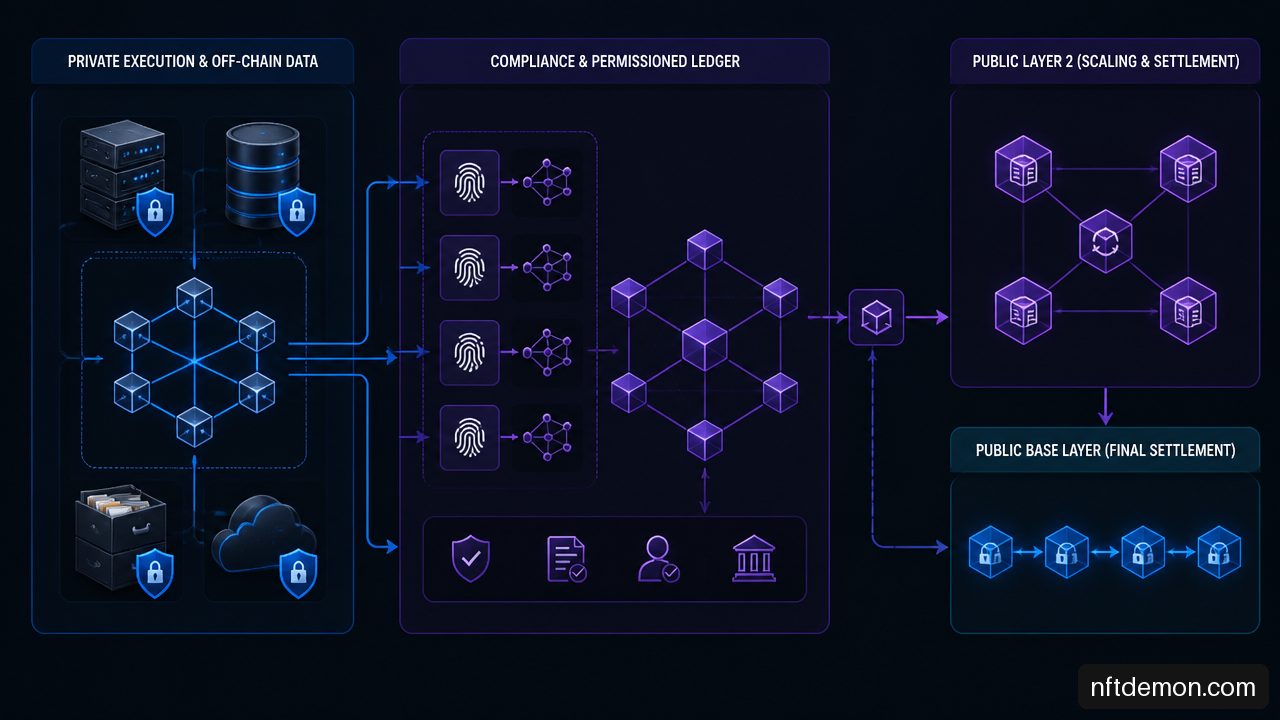
An enterprise can keep execution private while using a public network for anchoring or settlement. Helius explains that a permissioned Solana environment can use public mainnet for settlement, interoperability, or anchoring. That permissioned network and public settlement model illustrates a useful pattern: private execution and public finality do not have to be the same layer.
In practice, a private environment may process confidential workflow events among authorized institutions. At selected intervals, it can anchor a cryptographic commitment to a public chain. External parties can then verify that a state existed at a certain point without seeing the underlying commercial details.
This can work well for:
• Audit timestamping
• Batch settlement between institutions
• Proof of reserve or inventory attestations
• Controlled token issuance with public lifecycle verification
• Cross-network reconciliation
The tradeoff is complexity. Teams must define what happens if private state and public commitments diverge, whether a public commitment can be reversed, and which ledger governs a dispute. Those answers belong in operating rules before deployment.
Compliance Requires Evidence, Not Just Access Control
A permissioned network can make it easier to restrict who sees or writes data, but it does not automatically satisfy retention, reporting, sanction screening, record correction, or regulatory inspection obligations. A public L2 can provide durable auditability, but it may expose more metadata than the organization can accept.
The difficult tension is between regulator-verifiable evidence and counterparty confidentiality. A practical design may use selective disclosure, encrypted off chain evidence, role-based access, and verifiable references to on chain events. The regulator receives a complete evidentiary view under authorized conditions; ordinary participants see only the state they are entitled to see.
For detailed design patterns in heavily supervised environments, see enterprise blockchain architecture for regulated industries.
Assess Governance, Resilience, And Exit Rights
Blockchain selection is an operating model decision. The chain may be technically capable, but the deployment can still fail if no one has clear responsibility for keys, sequencing, upgrades, incident response, and participant removal.
Examine Validator And Sequencer Trust
In a private permissioned network, the validator set is deliberately known. That can improve accountability, but it also creates concentration risk. If one dominant member controls onboarding, validation, software releases, and dispute resolution, the network may function more like a shared database with extra operational steps.
In public L2 systems, the sequencer orders transactions. Depending on the design, a sequencer may be operated by one organization, multiple operators, or a more distributed mechanism. Decision makers should ask direct questions:
-
Who can pause or censor transaction ordering?
-
Who can upgrade the smart contracts or bridge logic?
-
What happens if the sequencer is unavailable?
-
Can users submit transactions through an alternative path?
-
When is a transaction economically and technically final?
Settlement finality matters because an L2 transaction may appear complete before the underlying public base layer has provided the strongest available assurance. The acceptable finality window depends on the workflow. A low-value customer reward can tolerate more uncertainty than a securities transfer or high-value treasury movement.
Consortium Governance Is Not Free
Oracle notes that enterprise deployments can operate privately or as consortium-style networks with authorized participants. Its enterprise blockchain deployment options support an important planning principle: the hosting model and the permission model should be evaluated separately.
A private network can be hosted on premises, in a cloud environment, or through a managed provider. None of those hosting choices answers who controls the network. Consortium governance should define at least:
• Membership eligibility and removal conditions
• Voting rights and quorum rules
• Validator responsibilities and cost allocation
• Software upgrade approval procedures
• Key recovery and emergency access controls
• Dispute resolution and data retention duties
• Procedures for insolvency, acquisition, or participant departure
Without these terms, an enterprise may launch a technically sound network that becomes difficult to operate when participants disagree. Protocol governance on a public L2 can reduce the need to negotiate every rule among consortium members, but it also limits an enterprise’s ability to customize the system.
Build The Exit Path Before Launch
An architecture is not future-proof merely because it uses a popular framework. It is future-proof when the organization can preserve records, move assets, rotate keys, change providers, and adapt policy controls without rebuilding the entire business process.
I recommend documenting an exit plan with the same seriousness as an incident response plan. It should include:
-
A canonical export format for ledger state, documents, and audit events
-
A method to verify exported data against historical ledger commitments
-
Smart contract upgrade and migration authority
-
Procedures for moving tokens or representations between networks
-
A plan for retaining evidence after a network is retired
-
A customer and counterparty communication process if addresses, wallets, or settlement rules change
Hybrid infrastructure can make this easier. SettleMint documents that enterprise infrastructure can include permissioned networks and public L2s together in hybrid designs. Its hybrid blockchain infrastructure approach reflects the broader architectural reality: network selection can be modular rather than permanent.
That does not mean hybrid is automatically safer. It introduces bridges, synchronization logic, more keys, more monitoring, and more potential failure points. Use it when each layer has a clear job, not as a vague compromise.
For procurement and technical due diligence, how enterprises compare blockchain platforms for production can help structure the platform review beyond feature checklists.
FAQ: Enterprise Blockchain Selection
How Do I Decide Between A Private Permissioned Blockchain And A Public L2?
Start with participant control, confidentiality, settlement requirements, and external ecosystem value. Choose private permissioned infrastructure when known organizations need controlled shared state. Choose a public L2 when public settlement, wallet compatibility, liquidity, or independent verification are central to the business model.
When Should An Enterprise Choose A Public L2 Instead Of A Private Chain?
Choose a public L2 when the deployment gains measurable value from reaching external wallets, custodians, markets, partners, or public digital asset infrastructure. It is less suitable when transaction metadata itself is highly sensitive and no public settlement benefit offsets that exposure.
How Much Transaction Confidentiality Does A Public L2 Provide?
Usually less than enterprises assume. Addresses may be pseudonymous, but transaction timing, balances, contract interactions, and behavioral patterns can remain visible. Sensitive customer, pricing, contractual, and operational data should generally stay off chain or be protected through a carefully designed selective disclosure model.
Can A Public L2 Meet Enterprise Compliance Requirements?
Potentially, but compliance must be implemented through identity checks, transfer rules, sanctions controls, custody processes, monitoring, record retention, and evidence handling. A public L2 does not provide compliance automatically. The suitability depends on the jurisdiction, asset type, counterparties, and the organization’s ability to control the application layer.
What Matters More: Cost, Throughput, Or Settlement Finality?
The answer depends on the consequence of an error. High-value financial transfers often prioritize finality and auditability. Consumer-facing activity may prioritize cost and throughput. A system handling both may need separate transaction classes, limits, or settlement schedules rather than one universal rule.
Is A Hybrid Architecture Better Than Either Extreme?
It can be, when confidential execution and public verification or settlement are both necessary. For example, a consortium can process private business events while periodically anchoring proofs to a public chain. Avoid hybrid designs when the additional bridge, reconciliation, and governance complexity exceeds the benefit of public connectivity.
How Do Identity And Key Management Change The Choice?
They change it substantially. Private networks require participant identity administration and often organizational key recovery processes. Public L2 deployments require secure wallet custody, contract permissions, user recovery policies, and clear responsibility for privileged administrative keys. Weak key governance can negate the benefits of either model.
Sources And References
-
Oracle — Blockchain Enterprise Edition: https://www.oracle.com/blockchain/blockchain-platform-enterprise-edition/
-
Visa — A comprehensive overview of enterprise blockchain: https://www.visa.com/en-us/thought-leadership/innovation/enterprise-blockchain
-
Digital Asset Holdings — Blockchain Network Evaluation for Regulated Finance: https://www.canton.network/hubfs/Blockchain%20Network%20Evaluation%20for%20Regulated%20Finance,%20eBook,%20Mar%202024-1.pdf
-
Helius — Building Permissioned Blockchains with Solana: https://www.helius.dev/blog/solana-permissioned-blockchains
-
SettleMint — Network manager: https://console.settlemint.com/documentation/blockchain-platform/platform-components/blockchain-infrastructure/network-manager
NFT Demon Holdings helps enterprises scope, evaluate, and build blockchain programs — start with a free evaluation call.
Talk through your use case
Free evaluation call — objective, constraints, and fit, before any proposal.