Questions to ask a post-quantum cybersecurity consulting firm
By Jeremy Ryan, Founder & CEO · November 2026

Choosing a post-quantum cybersecurity consultancy is not primarily an algorithm-selection exercise. It is a decision about whether a firm can find hidden cryptography, rank real exposure, coordinate vendors, test production changes, and leave your organization more crypto-agile than it was before. The right questions to ask a post-quantum cybersecurity consulting firm reveal whether it can do that work or simply explain why quantum computing matters.
A credible engagement should produce evidence you can use: an asset-level cryptographic inventory, a prioritized migration roadmap, tested implementation options, supplier findings, and a residual-risk record for systems that cannot yet move. I would treat a proposal without those artifacts as incomplete, no matter how polished the presentation looks.
- Set the Scope Before You Evaluate Firms
- Test Discovery and Risk Assessment Capability
- Question the Technical Migration Method
- Demand Deliverables, Governance, and Evidence
- Frequently Asked Questions
Set the Scope Before You Evaluate Firms
Post-quantum cryptography, or PQC, concerns cryptographic protocols intended to remain secure against both classical and quantum-capable attacks. For decision-makers, the immediate question is simpler: which systems would create unacceptable exposure if their current public-key cryptography became breakable?
The answer is rarely limited to one firewall, certificate authority, or application. It may include customer portals, machine-to-machine APIs, VPNs, identity services, backups, source-code repositories, signed firmware, cloud integrations, payment flows, crypto wallets, and archived records with long confidentiality lives.
Ask What Business Decision the Engagement Will Support
Begin with this question:
What decision will your assessment enable us to make within the first 60 to 90 days?
A strong answer should identify decisions, not just activities. For example, the firm should help determine which assets need urgent protection against harvest-now-decrypt-later exposure, which suppliers need formal inquiries, which platforms can support hybrid cryptography, and what budget or staffing constraints should influence sequencing.
The National Institute of Standards and Technology frames PQC transition as a phased organizational migration rather than a one-time algorithm replacement. Its NCCoE guidance on phased post-quantum migration also connects prioritization to harvest-now-decrypt-later risk and organizational planning.
I would ask a consulting firm to state, in writing, whether its scope covers the following:
• Public-key encryption and key exchange
• Digital signatures and signing workflows
• Certificates, authentication, and identity infrastructure
• Key management systems, hardware security modules, and secrets management
• Third-party software, SaaS platforms, cloud services, and managed-security tooling
• Legacy, embedded, operational technology, and vendor-locked systems
• Long-lived sensitive data that may be collected now and decrypted later
Ask Which Framework Will Govern the Work
A firm should be able to explain its methodology without hiding behind vague proprietary language. Ask:
Which cybersecurity frameworks, cryptographic standards, and migration phases will guide the work, and where can we see the resulting artifacts?
The engagement should connect PQC work to your existing enterprise risk management process, architecture governance, change control, incident response, vendor management, and compliance obligations. A standalone “quantum project” often loses momentum because it does not connect to the teams that own applications, certificates, networks, procurement, and data classification.
A useful methodology usually progresses through identification, risk assessment, prioritization, treatment planning, pilot testing, migration, and ongoing maintenance. SGInnovate’s guidance on identifying deployed cryptography and planning migration stages supports this sequence and highlights the role of cryptographic bills of materials and crypto-agility.
Key Takeaways
• Do not hire a firm merely to explain PQC algorithms. Hire one to reduce defined business and security risks.
• Require a phased plan tied to risk assessment, system ownership, budget, supplier dependencies, and operational constraints.
• Treat signature migration separately from encryption and key exchange. Code signing, firmware signing, document signing, and identity systems may have different owners and migration blockers.
• Ask for evidence-producing deliverables, not only workshops, architecture diagrams, or executive presentations.
Test Discovery and Risk Assessment Capability
Discovery is where weak post-quantum engagements become expensive. A consultant cannot prioritize what it cannot see, and cryptography is commonly distributed across application code, TLS libraries, certificates, cloud settings, network devices, firmware, APIs, HSMs, mobile apps, and supplier-operated services.
Ask What the Cryptographic Inventory Will Contain
The most useful question is not, “Will you create an inventory?” It is:
What fields will be included for every cryptographic asset, and how will those fields drive a migration decision?
Ask for an asset-level inventory or cryptographic bill of materials that includes, at minimum:
| Required Field | Why It Matters |
|---|---|
| Asset name, environment, and business owner | Establishes accountability and separates production exposure from lower-risk systems. |
| Application, device, service, or vendor dependency | Shows where cryptography actually operates and who controls remediation. |
| Algorithm, protocol, library, and version | Identifies RSA, elliptic-curve cryptography, TLS dependencies, and embedded implementations. |
| Certificate, key, HSM, or key-management dependency | Exposes lifecycle and hardware constraints that can delay replacement. |
| Data type, confidentiality lifetime, and exposure | Supports harvest-now-decrypt-later prioritization. |
| Migration treatment and target date | Converts discovery into action: migrate, isolate, replace, accept risk, or monitor. |
| Evidence source and confidence level | Makes uncertainty visible instead of pretending discovery is complete. |
That final field matters. No consultant can honestly promise instant, perfect visibility in a large estate. The better question is whether the firm can quantify blind spots and propose a plan to reduce them.
Ask How Discovery Completeness Will Be Validated
Ask directly:
How will you test whether the inventory missed undocumented cryptography in firmware, vendor products, APIs, embedded devices, cloud services, or inherited applications?
A credible response should combine multiple discovery methods. Those may include configuration reviews, certificate and network telemetry, code and dependency scanning, interviews with system owners, cloud architecture reviews, procurement records, supplier questionnaires, and validation against known application and network inventories.
Consider an industrial device that uses a vendor-maintained firmware image. A network scan may show only a management interface. The real cryptographic dependency may be embedded in firmware signing, update validation, or a vendor cloud agent. If the firm only scans network ports, that dependency can remain invisible until the migration program is already underway.
I would require the consultancy to identify known unknowns, report confidence levels, and describe the residual blind spots left after discovery. That makes the inventory auditable and prevents an executive dashboard from creating false certainty.
Ask How Risk Will Be Prioritized
A migration order should not follow the loudest stakeholder or the easiest application. Ask:
What written prioritization model will you use, and can we challenge the score for each asset?
The model should combine several dimensions:
• Confidentiality lifetime and harvest-now-decrypt-later exposure
• External exposure and attacker accessibility
• Business criticality and safety impact
• Cryptographic dependency complexity
• Certificate, key, and HSM replacement effort
• Supplier readiness and contractual control
• Migration cost, outage risk, and available engineering capacity
For instance, an externally accessible customer API carrying records that must remain confidential for a decade may deserve earlier treatment than an internal tool with short-lived, low-sensitivity data. The priority can change, however, if the API depends on a cloud platform that does not yet support the required configuration. A capable firm identifies this constraint early and proposes an interim control rather than publishing an unrealistic deadline.
For broader vendor due diligence, use a structured process to evaluate quantum vendor claims before accepting a roadmap as proof of readiness.
Question the Technical Migration Method
A consultancy should be technically fluent enough to discuss protocols, operational constraints, and failure modes in plain language. You are not buying algorithm names. You are buying a safe transition across systems that must continue to authenticate, exchange data, validate updates, and recover from failed changes.
Ask How Hybrid Cryptography Will Be Tested
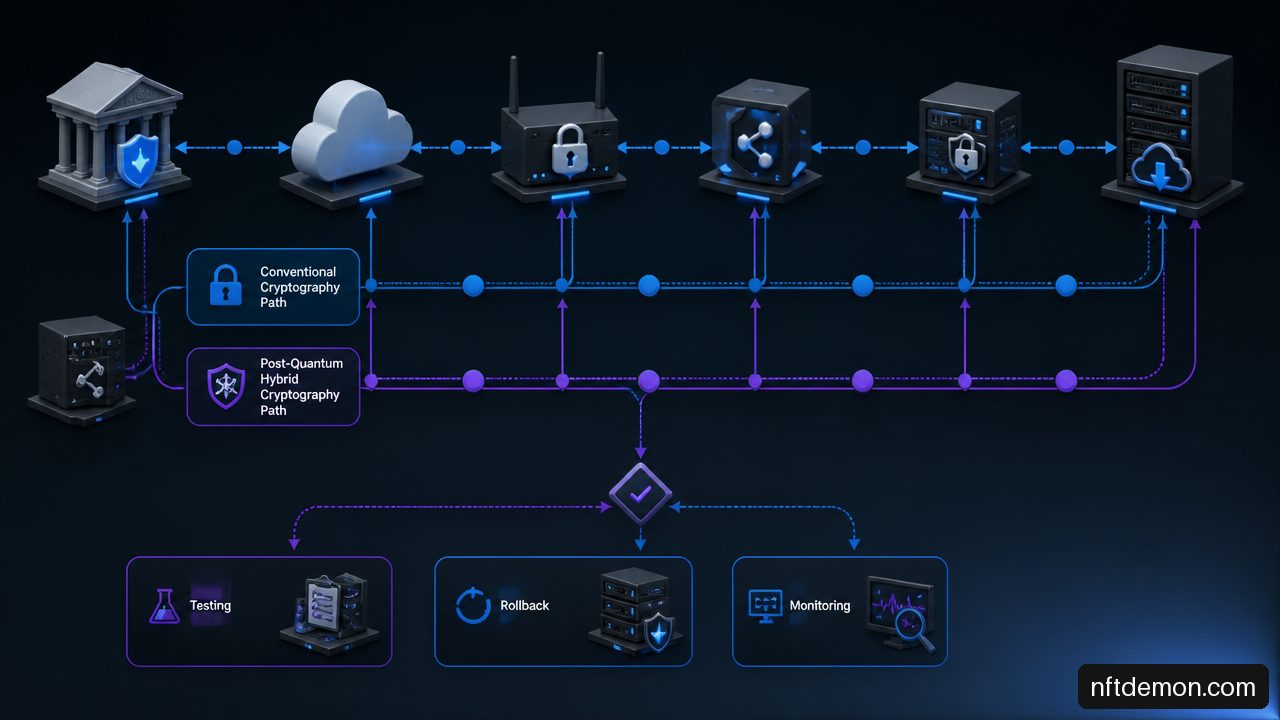
Hybrid cryptography combines conventional and post-quantum mechanisms during a transition. It can be a sensible option where ecosystem support is still uneven, but “use hybrid” is not a complete design.
Ask:
Which systems should use hybrid cryptography, what exactly will you test, and what is the rollback plan?
The firm should address interoperability, handshake behavior, message-size expansion, latency, bandwidth consumption, certificate-chain behavior, proxying, logging, monitoring, and rollback. A hybrid TLS deployment may work in a lab but fail when an inspection appliance terminates and re-establishes TLS on two separate connection legs.
Post-Quantum.com’s provider-readiness questions for TLS termination and hybrid ML-KEM specifically point to the need to verify services that inspect, proxy, or terminate TLS traffic, as well as HSMs, CBOM output, software signing, and provider roadmaps.
A useful pilot should establish measurable acceptance criteria before deployment. For example:
• Required applications complete authentication successfully.
• TLS inspection and load-balancing paths preserve the intended protections.
• Latency remains within the agreed service threshold.
• Failed negotiation produces observable alerts rather than silent downgrade behavior.
• Conventional fallback and rollback procedures work under controlled conditions.
• Operational teams can identify which algorithm configuration is active.
Ask How Signature Migration Will Be Handled
Many PQC conversations focus on key exchange. That is only half the problem. Signatures are central to software trust, firmware updates, document integrity, certificates, identity systems, transaction authorization, and code release pipelines.
Ask the consulting firm:
How will you inventory and migrate code signing, firmware signing, document signing, certificate signing, and machine identity workflows?
ML-DSA is relevant to post-quantum digital signatures, while ML-KEM is relevant to key establishment. The distinction affects your implementation plan. A VPN upgrade may concentrate on key exchange, while a device fleet may face its larger challenge in securely validating signed firmware updates.
A firm should map signing roots, intermediates, timestamping dependencies, validation libraries, offline verification devices, and update distribution systems. If a product has a ten-year field life and cannot receive a cryptographic update, the migration treatment may be replacement, isolation, compensating controls, or formally accepted residual risk. There is no universal answer; the firm should make the trade-off explicit.
Ask About Certificates, Authentication, and Specialized Technologies
Ask:
When do certificates and authentication workflows need to transition, and why do you recommend or reject specialized technologies such as QRNG or QKD?
Palo Alto Networks’ post-quantum planning guidance supports evaluating certificate and authentication timing and determining whether quantum random-number generation or quantum key distribution is actually required.
Fair warning: specialized quantum-security products may have a valid role in limited high-assurance situations, but they should not distract from the core work of inventory, algorithm transition, certificate lifecycle management, and crypto-agile architecture. Ask the consultant to explain the business requirement that necessitates each technology, the integration burden, and the alternatives considered.
For a deeper technical foundation, review how quantum resistant crypto affects applications, wallets, exchanges, identity systems, and enterprise cryptographic protocols.
Demand Deliverables, Governance, and Evidence
A post-quantum program is credible when it produces decisions, owners, milestones, and proof. The statement of work should make those requirements visible before the engagement starts.
Ask What You Will Receive in the First Phase
Ask:
What deliverables will we own after the assessment phase, in what format, and how can internal teams maintain them?
A practical first phase should normally produce:
• A cryptographic inventory or CBOM with ownership, dependencies, confidence ratings, and asset treatment
• A risk-ranked backlog linked to business impact and confidentiality lifetime
• A target architecture for crypto-agility, including key, certificate, and signature considerations
• A supplier assurance register with evidence status and escalation actions
• A pilot plan with acceptance criteria, operational metrics, and rollback controls
• A residual-risk register for systems that cannot be migrated immediately
cryptovision’s post-quantum migration guide supports treating inventory creation, risk assessment, organizational impact, hybrid transition planning, and migration execution as connected project components.
Ask How Suppliers Will Be Held Accountable
A vendor roadmap is not the same as supplier assurance. Ask:
What dated evidence will you obtain from our suppliers, and how will it become usable in procurement, renewal, and risk decisions?
The firm should distinguish between a marketing statement and evidence such as product versions, supported algorithms, configuration instructions, test results, target support dates, deprecation schedules, support commitments, and contractual remedies.
This is especially important for cloud services, managed detection tools, identity providers, certificate authorities, VPN platforms, HSMs, custodians, exchanges, and wallet infrastructure. A supplier may claim PQC readiness while supporting only a limited protocol, region, deployment mode, or future release.
Ask How Completion and Crypto-Agility Will Be Measured
Crypto-agility should be more than a slide containing arrows between algorithms. Ask:
What specific tests will prove that we can replace cryptographic mechanisms without extensive redesign?
A mature answer should define measurable outcomes such as configuration-based algorithm selection, centralized certificate and key rotation, documented ownership, monitoring of algorithm usage, tested rollback, dependency tracking, and change-control procedures.
| Weak Completion Claim | Stronger Completion Evidence |
|---|---|
| “The environment is quantum-safe.” | Asset treatments, tested configurations, residual risks, and named owners are documented. |
| “We support crypto-agility.” | Algorithms can be changed through governed configuration or limited component updates. |
| “Vendors are ready.” | Product-specific evidence, dates, limitations, and contract actions are recorded. |
| “The pilot succeeded.” | Acceptance tests, performance results, interoperability findings, and rollback outcomes are retained. |
I would also ask for a transparent cost and capacity model. It should separate consulting work from internal engineering labor, testing environments, certificate replacement, HSM changes, vendor licensing, bandwidth impact, performance tuning, monitoring, and ongoing operations. No reliable universal price range exists because estates vary widely. A global certificate replacement effort and a small API modernization program are not comparable projects.
If you need help defining a practical scope before issuing an RFP, a quantum readiness advisory can help translate quantum risk into architecture, procurement, and implementation decisions.
Frequently Asked Questions
What Should a Post-Quantum Cybersecurity Consulting Firm Deliver First?
The first deliverables should be a scoped discovery plan, an initial cryptographic inventory, a clear prioritization model, and a roadmap for validating inventory completeness. Do not accept a generic maturity score as the main output. You need evidence tied to assets, owners, protocols, data sensitivity, dependencies, and treatment decisions.
How Will the Firm Find Cryptography Our Teams Do Not Know About?
Ask for a multi-method discovery approach. It should combine technical scanning, certificate and network analysis, code and dependency review, cloud configuration review, supplier evidence, architecture documentation, and owner interviews. Require confidence ratings and a documented list of unresolved blind spots, particularly for firmware, acquired systems, SaaS products, and operational technology.
Should the Firm Recommend Hybrid Cryptography?
Possibly, but only where it fits the application, protocol, vendor support, and threat model. Hybrid designs can reduce transition risk, yet they also create interoperability and operational testing requirements. Ask the firm to identify where hybrid deployment is appropriate, which endpoints must support it, and how it will test performance, inspection paths, fallback behavior, and rollback.
How Should the Firm Handle Systems That Cannot Support PQC?
The consultant should assign a documented treatment: isolate the system, add compensating controls, replace it, constrain the data it handles, accept risk for a time-bound period, or monitor it under an exception process. The residual-risk register should name an owner, explain the exposure, set a review date, and record the decision authority.
What Evidence Should We Require From Cloud and Technology Vendors?
Require product-specific, dated evidence rather than broad claims. Useful evidence includes supported protocols, algorithm support, rollout dates, configuration documentation, test reports, limitations, support commitments, and remediation paths. The firm should convert those findings into procurement requirements and renewal actions where possible.
How Do We Compare a PQC Specialist With a Broad Cybersecurity Firm?
Compare the proposed artifacts and technical depth, not only brand recognition. A specialist may offer deeper cryptographic, protocol, signing, HSM, and migration expertise. A broader firm may integrate more easily with existing enterprise risk, compliance, and operations programs. The right choice depends on whether your main constraint is cryptographic implementation depth, program scale, or both.
What Are Warning Signs That a Firm Is Selling Algorithms Instead of Solving Migration Risk?
Warning signs include an immediate recommendation for a single product, no plan for cryptographic discovery, no treatment of signatures or certificate lifecycles, vague vendor-readiness claims, no pilot acceptance criteria, and no residual-risk process for unupgradeable systems. Another concern is a proposal that promises “quantum safe” status without defining what remains outside scope.
Sources/References
• NIST National Cybersecurity Center of Excellence + Frequently Asked Questions about Post-Quantum Cryptography — https://pages.nist.gov/nccoe-migration-post-quantum-cryptography/FAQ/
• Post-Quantum.com + PQC for MSSPs and Consultancies: Opportunity and Risk — https://postquantum.com/post-quantum/pqc-mssps-security-consultancies/
• SGInnovate + 3 Questions Every IT Team Should Ask Before Starting a Post-Quantum Migration — https://www.sginnovate.com/blog/3-questions-every-it-team-should-ask-starting-post-quantum-migration
• cryptovision + Post-Quantum migration guide — https://www.cryptovision.com/wp-content/uploads/2024/05/Post-Quantum-Guide-EN.pdf
• Palo Alto Networks + Post-Quantum Migration Planning and Preparation — https://docs.paloaltonetworks.com/network-security/quantum-security/administration/quantum-security-concepts/post-quantum-migration-planning-and-preparation
NFT Demon Holdings helps enterprises scope, evaluate, and build blockchain programs — start with a free evaluation call.
Talk through your use case
Free evaluation call — objective, constraints, and fit, before any proposal.