Proof of reserve verification protocols for tokenized institutional assets
By Jeremy Ryan, Founder & CEO · October 2026

Proof of reserve verification protocols for tokenized institutional backed assets should do more than display a reserve balance beside a token supply number. A credible protocol must establish what assets exist, who controls them, whether they are available to support token holders, how their value is determined, and what happens when verification fails.
For institutional decision makers, the real question is not whether a dashboard says a token is backed. It is whether the issuer can produce an evidence trail that survives operational stress, legal review, auditor scrutiny, redemption pressure, and a custodian data failure.
• What A Reserve Protocol Must Prove
• Building The Evidence And Data Lineage
• Connecting Verification To Minting And Redemption
What A Reserve Protocol Must Prove
Proof Of Reserves Is A Control System, Not A Marketing Claim
At its narrowest, proof of reserves establishes that reported reserve assets exist at a particular point in time and can be compared with tokens outstanding. That is useful, but it is incomplete for an institutional product.
A tokenized Treasury fund, money market instrument, gold claim, or private-credit position has several distinct layers of truth. The blockchain can provide a highly visible record of token issuance and transfer. It cannot independently verify an offchain custody record, a valuation policy, or a legal claim against an insolvency estate.
I would treat a reserve protocol as a coordinated control system across five questions:
| Verification Question | Evidence Required | Why It Matters |
|---|---|---|
| Does the asset exist? | Custody statement, vault record, fund register, or account evidence | Prevents unsupported issuance based on nonexistent assets |
| Is the asset controlled? | Custodian confirmation, account authority evidence, authorized signatory controls | Distinguishes a reported balance from an asset the issuer can access |
| Is the asset available? | Lien searches, segregation records, pledge disclosures, legal review | A balance may exist but be pledged, restricted, or subject to competing claims |
| Does it cover issued tokens? | Reserve quantity or value reconciled with token supply | Detects overissuance and failed burn processes |
| Can holders enforce their claim? | Offering documents, custody agreements, trust or agency structure | Determines whether token backing has practical legal meaning |
This distinction is not academic. A reserve balance could be accurate while the account is encumbered, exposed to rehypothecation, or held under terms that do not give token holders a direct or enforceable claim. Proof of reserves does not, by itself, prove the absence of hidden liabilities, liens, legal defects, or competing claims.
That limitation should change how institutional buyers interpret the label. Proof of reserve is evidence of a defined condition. It is not a substitute for legal diligence, a financial statement audit, or a full solvency assessment.
Separate Proof Of Assets, Liabilities, And Ownership
These concepts are frequently blended together, which creates avoidable risk.
Proof of assets concerns whether identified reserve assets exist and are controlled. Proof of liabilities concerns obligations owed to token holders and other creditors. Proof of ownership concerns the legal rights attached to an asset and whether those rights remain enforceable during insolvency, fraud, or counterparty failure.
A 1:1 reserve ratio can be misleading if liabilities are understated. Consider an issuer with $100 million in reserve assets and $100 million in tokens outstanding. At first glance, the ratio is 100%. If the issuer also owes $15 million under a collateral pledge or financing arrangement, the economic and legal availability of that reserve pool may be different from the headline ratio.
Merkle-tree methods can help preserve confidentiality when proving that balances or liabilities were included in a dataset. They are useful for selective verification, especially where institutional account information cannot be published openly. Still, a Merkle proof shows inclusion in a committed dataset. It does not establish that the dataset is complete, correctly classified, or legally enforceable.
Quantity And Value Need Different Rules
Reserve verification should match the asset class.
For tokenized gold, commodities, or warehouse receipts, the central test may be quantity: bar serial numbers, weights, vault inventory, and circulating token units. Coinpaprika describes commodity verification practices that can include vault inspection, bar serial-number checks, weight-list reconciliation, and comparison with circulating token quantity.
For tokenized Treasury products, funds, and credit instruments, quantity alone is insufficient. The protocol should test asset value, pricing source, valuation timestamp, accrued interest, settlement status, cash balances, fees, and the net asset value methodology. A portfolio may hold the required number of securities but still have a reserve-value shortfall after a price move, an unsettled trade, or a valuation correction.
A reserve protocol should state whether it verifies units, value, legal availability, or all three. If it does not, the reported ratio may be easy to misunderstand.
Building The Evidence And Data Lineage
Start With The Source Of Truth
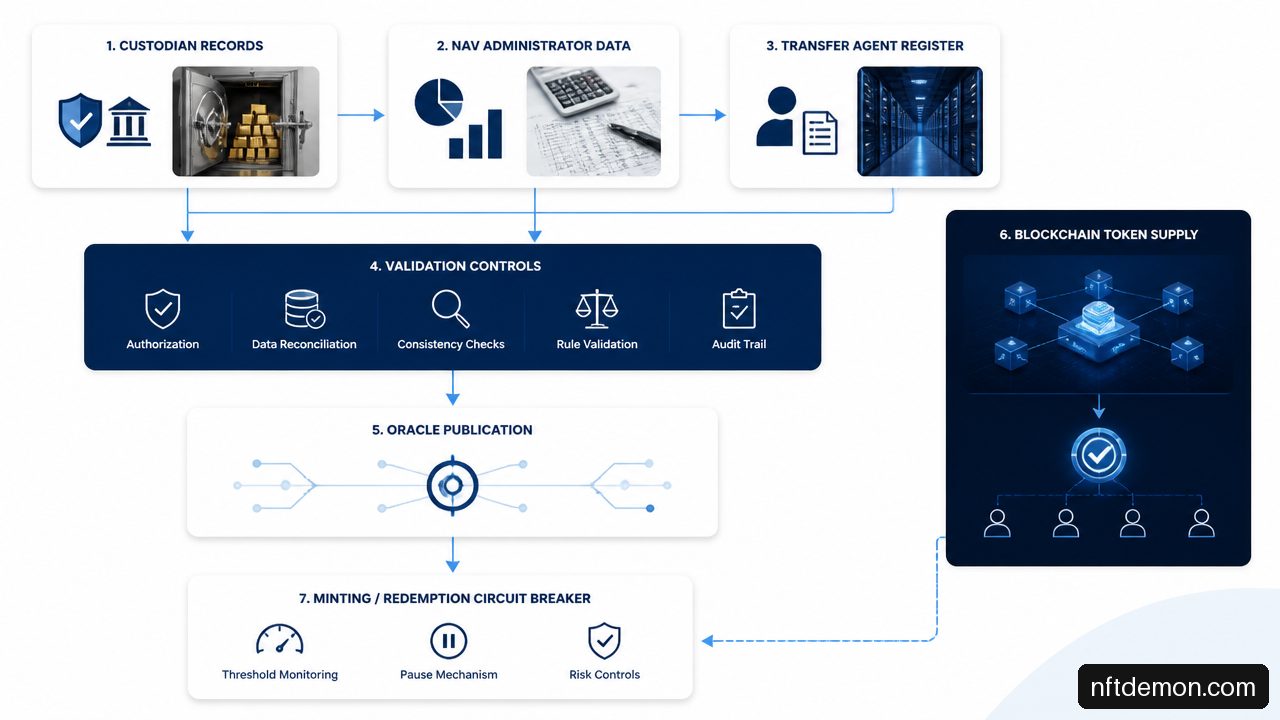
The protocol should begin with a named source-of-truth record for every assertion. That record might be a regulated custodian ledger, a transfer-agent register, a vault inventory system, a NAV administrator’s calculation file, or a blockchain address under independently verified control.
Chronicle Labs describes a model in which reserve information can originate from custodians, NAV administrators, or authorized agents and be validated before on-chain publication. That is the right starting point: source identity matters before data transport begins.
An oracle can preserve data integrity during transmission. It cannot make a flawed, incomplete, or unauthorized source record true. If a custodian feed excludes pledged assets or an administrator applies an outdated NAV, an onchain publication may be tamper-evident yet still be substantively wrong.
A robust data-lineage record should capture:
Source identity: the legal entity, system, account, and authorized data owner.
Extraction details: query logic, report identifier, timestamp, and reporting currency or unit.
Transformations: valuation calculations, currency conversion, netting, aggregation, and exclusions.
Approvals: automated validation results and human approvals for exceptions.
Publication evidence: oracle signatures, transaction IDs, contract address, and final onchain value.
Reconciliation results: differences between reserve records, token supply, transfer-agent records, and redemption activity.
This may sound procedural. It is also where failures become diagnosable. Without lineage, a team can see that a reserve ratio changed but cannot determine whether the cause was a market price, a late settlement, a data extraction error, or unauthorized token issuance.
Reconcile More Than Total Supply
Public totalSupply is necessary, but it is rarely the
entire liability picture. Institutional tokens may have permissioned
transfers, restricted positions, omnibus holdings, pending burns,
crosschain representations, frozen accounts, or tokens that are
economically canceled but not yet destroyed onchain.
The issuer should reconcile at least four ledgers:
| Ledger | Primary Question | Typical Reconciliation Risk |
|---|---|---|
| Token contract | How many tokens are technically outstanding? | Crosschain duplication or delayed burns |
| Transfer-agent register | Who is recognized as the holder? | Omnibus account and transfer restriction mismatches |
| Reserve record | What assets are held and available? | Stale custody data or undisclosed encumbrances |
| Subscription and redemption ledger | What issuance or redemption is pending? | Timing gaps between cash settlement and token events |
MetaMask’s guidance on tokenized real-world assets recommends examining independent reserve evidence, token supply, smart contracts, and minting and redemption behavior. For an institutional protocol, that review should extend to the legal register and pending operational states rather than stopping at the contract supply.
A practical example: an investor submits a $10 million redemption
request near the valuation cutoff. If the tokens are frozen pending
settlement but remain in totalSupply, the protocol needs a
documented rule for whether they count as outstanding. Either approach
can be valid. Silence is not.
Choose Frequency Based On Risk, Not Hype
“Real time” is often presented as the ideal. It is not always the correct control objective.
Verification frequency should reflect issuance velocity, asset liquidity, valuation volatility, settlement cycle, and the consequences of a shortfall. A tokenized overnight cash product with intraday minting may warrant intraday or event-driven checks. A private credit fund valued monthly cannot become genuinely real-time merely because an oracle posts a number every few minutes.
A reasonable operating model may use:
• Event-driven verification before minting, after material redemptions, and after collateral movements.
• Intraday checks for high-volume cash-equivalent products with active issuance.
• Daily reconciliation for liquid securities where valuation and settlement records are available each business day.
• Periodic independent attestation for confirmation of control, methodology, and exceptions that automated feeds cannot reliably assess.
The right cadence is the fastest interval at which the underlying source data is both available and meaningful. Faster publication of stale or estimated data is not better transparency.
Connecting Verification To Minting And Redemption
Define Verification States Before A Failure
A reserve feed should not output only a ratio. It should publish an operational state that systems, operators, and investors can understand.
I recommend defining at least four states:
| State | Example Condition | Minting Rule | Redemption Rule |
|---|---|---|---|
| Verified | Reserves meet threshold and data is current | Permit within approved limits | Process normally |
| Warning | Ratio near threshold or valuation under review | Restrict large or nonstandard issuance | Process with enhanced review |
| Stale | Data exceeds approved age limit | Pause new minting | Allow only policy-defined redemptions or manual review |
| Exception | Shortfall, data disagreement, legal-control concern | Block minting | Apply contingency and governance procedures |
This is where reserve verification becomes a financial-stability control rather than a transparency widget. Chainlink describes how reserve data can connect to smart-contract logic for automated collateral monitoring and protective actions, including constraints that can affect minting, redemption, or circuit-breaker behavior.
Automation has limits. A contract can pause issuance when a signed data feed is stale. It cannot independently determine whether a legal claim is valid or whether a manual valuation adjustment is justified. That requires governance.
Build A Controlled Exception Process
A mature protocol needs explicit rules for stale feeds, unavailable custodians, source disagreement, and manual overrides. These circumstances should be anticipated, not improvised during a market event.
The exception process should identify:
• The maximum acceptable age of each reserve data field.
• The quorum required when multiple sources or oracle operators are used.
• The party authorized to declare a data-quality incident.
• The evidence required for a manual override.
• The approval threshold and time limit for that override.
• The investor notice, incident record, and post-incident reconciliation requirements.
Consider a tokenized Treasury product whose custodian feed fails at 11:00 a.m. while subscription orders continue. A weak protocol continues minting based on the last reported balance. A stronger protocol marks the feed stale, blocks incremental issuance after a defined grace period, and retains an auditable record of who approved any emergency action. The stronger approach may create short-term operational friction. It also prevents a convenience decision from becoming unverified overissuance.
Match The Architecture To The Product
The blockchain platform and contract design determine which controls can be enforced automatically, which controls remain offchain, and how costly reconciliation will become. Platform selection should follow the asset’s legal transfer model, privacy requirements, transaction volume, interoperability needs, and governance structure. The same principles apply when evaluating blockchain platform selection for financial institutions and governments.
A permissioned token may support transfer restrictions and identity checks directly in the contract. A public token may offer wider composability but require more careful handling of restricted accounts and offchain investor records. Neither model eliminates reserve risk.
The implementation path should also be realistic. A reserve protocol is not ready because a prototype can read a CSV file and post a ratio. It is ready when source controls, exception states, access rights, smart-contract permissions, monitoring, and reconciliation evidence work together. That is the difference between a blockchain proof of concept that reaches production and a persuasive demonstration with no operating model.
Security deserves equal attention. Oracle keys, custodian API credentials, contract upgrade permissions, emergency pause roles, and administrative multisignature policies are part of the reserve-control perimeter. For design decisions involving those dependencies, enterprise blockchain architecture security scalability is a useful companion framework.
Key Takeaways
• Proof of reserves is necessary but incomplete. It can demonstrate a reserve-to-supply relationship, but it does not independently prove solvency, legal ownership, or the absence of liens and competing claims.
• Data lineage is a first-class control. Every onchain assertion should be traceable to a source record, extraction time, transformation method, approver, and publication event.
• Asset class determines verification logic. Commodity tokens need quantity and inventory controls; tokenized funds and Treasury products also need valuation, NAV, pricing, and settlement controls.
• Frequency should be risk-based. Use event-driven, intraday, daily, or periodic checks according to the quality and relevance of underlying data, not marketing pressure for real-time reporting.
• Minting and redemption must respond to verification status. A feed with no operational consequence is disclosure, not a complete risk control.
• Failure procedures matter before failure occurs. Stale data, custodian outages, oracle disagreement, and overrides need predefined rules, authority limits, and evidence retention.
Frequently Asked Questions
What Does Proof Of Reserves Mean For A Tokenized Institutional Asset?
It means the issuer has a process for evidencing reserve assets and comparing them with issued tokens. For institutional use, the protocol should also address control of the assets, encumbrance status, valuation methodology, data freshness, and legal enforceability. A reported reserve balance alone is a narrow form of assurance.
How Is Reserve Verification Different From A Financial Statement Audit?
Reserve verification tests specified reserve conditions, often at frequent intervals, and may feed automated contract controls. A financial statement audit examines financial statements under an audit framework and has a broader but typically periodic scope. Neither automatically replaces the other. An audit may not provide continuous token-supply reconciliation, while a reserve feed may not assess the issuer’s full financial position.
Does Proof Of Reserves Prove Token Holders Legally Own The Underlying Assets?
No. It can evidence asset existence or control, but legal ownership depends on the offering terms, custody arrangement, governing law, trust or agency structure, and insolvency treatment. Investors should request the documents that define their claim, not infer legal rights from a reserve dashboard.
How Can An Issuer Show That Reserves Are Not Encumbered Or Rehypothecated?
There is no universal technical proof for this. The protocol should combine custodian representations, account segregation evidence, legal review, periodic independent assurance, disclosure of security interests, and escalation rules for changes in custody terms. For example, a vault balance should not be treated as freely available if it is collateral for unrelated financing.
What Should Happen If A Custodian Feed Becomes Stale Or Unavailable?
The protocol should enter a predefined stale-data state after the permitted age threshold. New minting should generally pause unless a documented, time-limited override is approved. Redemption handling depends on product liquidity and legal commitments, but it should follow published contingency rules rather than ad hoc operational judgment.
Should Reserve Data Be Published Directly Onchain?
Usually, publish the information needed for transparency and automated controls, while retaining confidential source records offchain with controlled access. Onchain publication is effective for reserve ratios, timestamps, status codes, and signed attestations. Detailed institutional holdings, investor information, and legal documents may require privacy-preserving disclosure mechanisms.
What Evidence Should An Institutional Investor Request?
Request the reserve methodology, source-of-truth definitions, latest attestation or assurance report, custody and legal-control documentation, token-supply reconciliation policy, valuation methodology, mint and burn rules, stale-data thresholds, override governance, and incident history. If any of these are unavailable, the reserve ratio should be treated as a limited disclosure rather than complete assurance.
Can An Oracle Independently Prove An Offchain Reserve Fact?
No. An oracle can authenticate, aggregate, and publish information from defined sources. Its reliability depends on source controls, validation rules, operator governance, and dispute handling. The protocol must therefore assess both the transport mechanism and the institution making the underlying assertion.
Sources And References
• Chainlink — Proof of Reserve
• Chronicle Labs — Proof of Asset
• MetaMask — How to Verify Tokenized Real-World Assets
NFT Demon Holdings helps enterprises scope, evaluate, and build blockchain programs — start with a free evaluation call.
Talk through your use case
Free evaluation call — objective, constraints, and fit, before any proposal.