Predictive maintenance for blockchain infrastructure
By Jeremy Ryan, Founder & CEO · October 2026

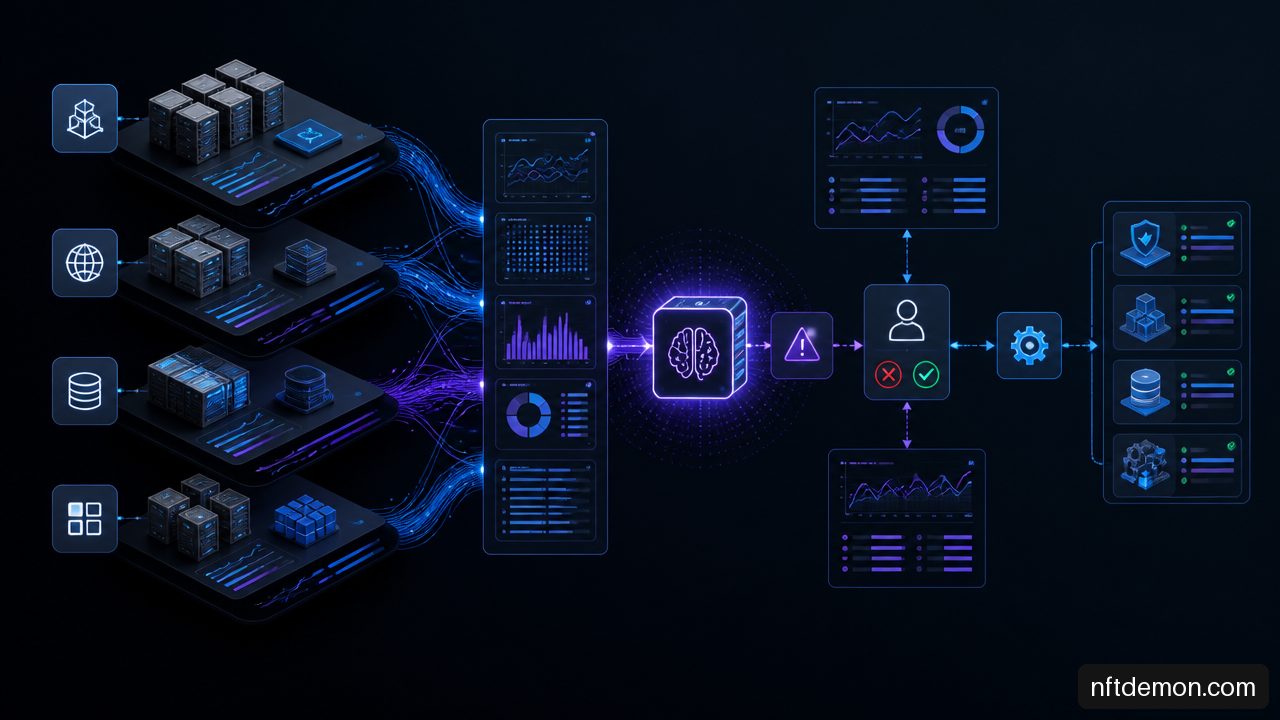
Predictive maintenance for blockchain infrastructure means identifying degradation before it becomes a missed validator duty, stale RPC response, synchronization failure, or customer facing outage. For decision makers, the goal is not to add another dashboard. It is to turn operational telemetry into earlier, safer decisions about capacity, failover, remediation, and risk.
Blockchain systems complicate ordinary infrastructure maintenance because a server can appear healthy while the node is operationally failing. CPU may be normal while peer connectivity collapses. Disk capacity may remain available while I/O latency slows state processing. A validator may stay online while missing consensus duties. We therefore need to measure infrastructure health and protocol health together.
• What Predictive Maintenance Must Measure
• Match Maintenance Models To Node Roles
• Build A Decision Ready Observability System
• Use Prediction Without Creating Consensus Risk
What Predictive Maintenance Must Measure
Predictive maintenance is most useful when it forecasts a specific operational consequence, not merely an unusual metric. For blockchain infrastructure, that consequence may be an SLO breach, a missed block, a validator duty failure, an RPC error surge, an indexing backlog, or an inability to recover quickly after a restart.
A useful operating definition is this: predictive maintenance combines time stamped evidence, a failure model, and a preapproved intervention that can occur before service quality crosses an unacceptable threshold. If one of those elements is missing, the organization may still have monitoring, but not a dependable predictive maintenance capability.
A framework described in IJETRM’s research on AI driven maintenance for blockchain nodes combines real time telemetry, system metrics, logs, transaction data, block propagation delay, and consensus participation indicators. That combination matters. Host telemetry answers whether the machine is under pressure; protocol telemetry answers whether that pressure is affecting the chain service that the machine exists to provide.
Separate Symptoms From Causes
A common operational mistake is to treat a protocol symptom as the root cause. Synchronization lag, for example, is a symptom. Its cause might be slow disk reads, database corruption, a malformed client configuration, inadequate peers, a provider network event, or simply a normal chain reorganization.
We recommend organizing signals into three layers:
| Layer | What It Answers | Example Signals | Typical Decision |
|---|---|---|---|
| Host and platform | Is the machine or cloud environment constrained? | CPU saturation, memory pressure, disk I/O wait, filesystem capacity, packet loss | Resize, repair storage, move workload, investigate provider issue |
| Client and data | Is the blockchain software processing state correctly? | Process restarts, database errors, execution queue depth, checkpoint age, indexing lag | Restart a noncritical component, repair database, fail over service |
| Protocol and service | Is the node participating or serving users as expected? | Block height lag, peer count, propagation delay, missed duties, RPC latency and errors | Change routing, inspect peer topology, protect validator availability |
This separation reduces noisy escalations. Consider an RPC fleet where p95 response time rises while CPU remains moderate. A simplistic model may classify this as an application issue. A better investigation asks whether execution client backlog, upstream peer quality, state database latency, or a transaction workload shift is driving the delay. The remediation differs in each case.
Consensus Signals Are Leading Indicators
Generic infrastructure metrics remain necessary, but they are not sufficient. Block production rate and consensus timing can indicate emerging blockchain infrastructure problems before ordinary host monitoring becomes alarming, as outlined in WJAETS’ analysis of self healing cloud infrastructure for blockchain.
For validators, the important question is not “is the process alive?” It is “is the validator completing the duties expected of it, within the protocol’s timing constraints?” A live process with stale clock time, degraded peers, or an unhealthy execution client can still create material operational exposure.
The best early warning signal is often a relationship between metrics, not one metric in isolation: rising disk latency paired with growing execution delay and widening synchronization lag is more actionable than any single alert.
Key Takeaways
• Treat missed duties, stale state, and user facing latency as outcomes to predict, not as the first alerts operators receive.
• Join host, client, and protocol telemetry before training or deploying a machine learning model.
• Define an explicit maintenance action for every high severity prediction; a warning without an owner or safe response does not improve uptime.
• Start with transparent rules and capacity forecasts, then add anomaly detection where baselines are complex or labels are scarce.
Match Maintenance Models To Node Roles
“Blockchain node” is too broad for maintenance planning. Validators, RPC nodes, archive nodes, indexers, and full nodes fail differently and impose different business consequences. A predictive system should reflect the node’s economic and service role.
Validators Need Duty Centered Predictions
Validators are sensitive to short disruptions. The relevant model outcome is not simply “host failure within 24 hours.” It may be “increased probability of missing an upcoming duty because peer quality, clock drift, client responsiveness, and resource contention are deteriorating.”
Avoid fully automated restarts for a live validator merely because an anomaly score rises. Restarting a node can remove a marginally healthy participant from consensus at exactly the wrong time. Safer responses include escalating the alert, validating a standby path, confirming execution and consensus client agreement, or shifting nonessential workload away from the validator host.
For high availability designs, failover deserves careful controls. Two active signing paths can introduce risks that are more serious than a short outage, depending on the protocol and signing architecture. Prediction should therefore trigger a controlled decision process, not blind automation.
RPC Nodes Need Service Quality Forecasts
RPC nodes should be judged by the client experience they deliver: latency, error rate, rate limit behavior, state freshness, and successful request completion. A healthy node that is several blocks behind the network head may be unsuitable for applications that depend on current balances, liquidations, or transaction simulation.
An effective forecast for RPC infrastructure often combines saturation trends with queue growth and chain freshness. If request volume is growing, queue depth is rising, and the node’s head lags increasingly behind network peers, the sensible action may be to add capacity or rebalance traffic before users see errors.
This is where operational controls for blockchain deployment matter. Capacity policy, routing policy, incident ownership, and change management should be established before an alert becomes urgent.
Archive Nodes And Indexers Have Different Failure Curves
Archive nodes frequently face predictable storage growth and database performance risks. Forecasting usable disk capacity is valuable, but raw free space is not enough. Teams should project growth using the actual retention strategy, chain activity, pruning configuration, compaction behavior, and the time required to expand or migrate storage.
A storage expansion that takes six hours is not safe if the forecast indicates disk exhaustion in four hours. The model must account for remediation lead time.
Indexers introduce a separate failure mode: they may remain online while lagging the source chain. For an analytics platform, an indexer that is 30 minutes behind may be operationally equivalent to an outage even when the underlying full node is synchronized. Track ingestion lag, decode errors, retry queues, database write latency, and the gap between indexed height and canonical chain height.
Bitcoin operations illustrate the value of role aware signals. Chainscore Labs’ Bitcoin Node Health Sentinel describes monitoring synchronization height, peer connections, CPU, memory, and resource exhaustion risks including disk, memory, and bandwidth constraints. These signals are useful precisely because they connect ordinary infrastructure conditions to node availability and chain synchronization.
Build A Failure Taxonomy Before Buying More AI
A failure taxonomy turns vague incident records into training and decision data. It should classify the observed symptom, suspected cause, confirmed cause, business impact, intervention, and recovery time.
A practical taxonomy can begin with these categories:
- Capacity exhaustion: disk, memory, CPU, file descriptors, database growth, or network bandwidth.
- Connectivity degradation: peer isolation, packet loss, DNS failure, provider networking issue, or poor peer topology.
- Client and data faults: execution client error, consensus client error, state database corruption, failed upgrade, or incompatible configuration.
- Protocol service degradation: missed duties, propagation delay, synchronization lag, stale RPC reads, or indexing backlog.
- Control plane failure: secrets access issue, signer unavailability, orchestration fault, observability pipeline outage, or incorrect automation.
This does not need to be perfect on day one. It needs to be consistent enough that future data can answer: Which signals usually preceded this failure, and what action actually reduced impact?
Build A Decision Ready Observability System
Most organizations should not begin with a complex machine learning model. Begin by making incident evidence usable. Predictive models inherit every inconsistency in timestamping, telemetry retention, labels, and deployment records.
Create An Observability Schema That Joins Events
Every metric, log, trace, deployment, maintenance event, and service outcome should use synchronized timestamps and durable identifiers for environment, chain, node role, region, client version, and instance. The system should also record chain head data and expected validator duties where appropriate.
A minimal event record could include:
• Timestamp and clock source
• Chain, network, client version, and node role
• Host resource measures and provider status
• Client process and database indicators
• Peer count, synchronization lag, propagation measures, and consensus outcome
• Deployment, upgrade, configuration, or topology changes
• Incident classification, intervention, and recovery result
Without change events, anomaly detection becomes misleading. A scheduled client upgrade can create a telemetry profile that looks anomalous compared with the previous version. That is not necessarily failure. It is concept drift: the relationship between metrics and normal behavior has changed.
Use The Simplest Reliable Detection Method First
Thresholds, SLO burn rate alerts, trend forecasting, and anomaly detection serve different purposes. They should not be treated as competing ideologies.
| Method | Best Use | Avoid When | Example |
|---|---|---|---|
| Static thresholds | Clear hard limits | Workload varies sharply by time or event | Disk remaining below a defined emergency reserve |
| Burn rate alerts | Customer facing reliability objectives | The SLO is poorly defined | RPC error budget is being consumed too quickly |
| Capacity forecasting | Gradual, measurable growth | Failure is sudden and nontrend based | Archive storage projected to exhaust before expansion can complete |
| Anomaly detection | Complex multimetric behavior | Training data is unstable or poorly instrumented | Unusual relationship between peer loss, propagation delay, and execution backlog |
| Supervised prediction | Repeated, well labeled failure modes | Labels are sparse, ambiguous, or biased | Identifying patterns preceding a recurring database saturation event |
For many teams, the first win is storage and capacity forecasting, not sophisticated failure classification. It produces understandable decisions: add storage by a certain date, redistribute traffic, or revise retention. Machine learning earns its complexity only when it improves lead time or reduces noise beyond those simpler controls.
Measure Prediction Lead Time And False Positives
A warning is useful only if it arrives early enough for a safe action. Define prediction lead time as the interval between a warning and the anticipated failure or service objective breach. Then compare it with the action time required.
Suppose an archive node needs eight hours to provision, synchronize, validate, and place replacement capacity into service. A warning that arrives two hours before disk exhaustion is technically predictive but operationally inadequate. Conversely, a validator alert issued 24 hours early may not justify disruptive intervention if it produces frequent false positives.
There are no generally validated industry benchmarks for precision, recall, lead time, or acceptable false positive rates in blockchain infrastructure prediction. We should set local targets based on service criticality and remediation cost. A public RPC fleet can tolerate more investigation alerts than a validator estate where unnecessary restarts create protocol exposure.
This planning should also inform questions to ask about blockchain deployment and maintenance, especially around ownership, recovery objectives, log retention, upgrade discipline, and testing of failover procedures.
Use Prediction Without Creating Consensus Risk
Predictive maintenance becomes dangerous when it has authority to make changes without adequate guardrails. A model can correctly identify abnormal conditions yet recommend the wrong action. That distinction is decisive for decentralized networks.
Establish Safe Automation Boundaries
A safe automation boundary defines which responses may execute automatically and which require human approval. The stricter the consensus and signing implications, the narrower this boundary should be.
| Automation Level | Suitable Actions | Actions Requiring Stronger Controls |
|---|---|---|
| Automatic | Open ticket, page on call staff, collect diagnostics, increase telemetry sampling, shift read only RPC traffic | Any action that changes validator signing or removes a sole production node |
| Guarded automation | Restart a stateless indexer, rotate unhealthy RPC backend, expand storage within budget, quarantine malformed traffic | Restarting a consensus participant without redundancy and validation |
| Human approved | Fail over validator infrastructure, repair state databases, change peer policy, roll back client version | Any action that could create duplicate signing, long resynchronization, or correlated fleet failure |
The rule is simple: automate reversible, low blast radius actions first. Require approval for actions with consensus, key custody, or irreversible data implications.
Prevent Correlated Failures
The most sophisticated model can still create a fleet outage if every node receives the same instruction at once. Maintenance orchestration should use canaries, concurrency limits, topology awareness, and rollback criteria.
For example, if an anomaly model flags elevated memory use after a client release, do not restart every RPC node simultaneously. Restart or replace one noncritical instance, compare its health against a control group, and expand only if protocol and service signals improve. For validators, the threshold for fleet action should be even higher.
Protocol upgrades, hard forks, changed transaction mixes, and new peer populations all cause concept drift. During these periods, models should move into a heightened review mode. Freeze automated remediation rules that rely on old baselines, increase operator visibility, and relabel the postchange period before treating it as normal training data.
Preserve Evidence Without Confusing The Use Case
Distributed ledgers can preserve synchronized maintenance histories and support maintenance related smart contract workflows, as described by Prometheus Group’s discussion of blockchain in enterprise maintenance. That can help with auditability for maintenance records, approvals, and asset history.
But a ledger is not automatically the best store for high volume observability data. Metrics and logs need fast queries, retention controls, access restrictions, and economical storage. Use immutable evidence selectively for approvals, maintenance attestations, configuration provenance, or critical incident records. Keep high frequency telemetry in systems designed for operational analysis.
The same architecture choice applies to broader enterprise blockchain architecture security and scalability: the control system must be resilient, secure, and scalable enough to remain useful during the incident it is meant to diagnose.
Frequently Asked Questions
What Does Predictive Maintenance Mean For Blockchain Infrastructure?
It means using historical and real time operational evidence to forecast a node failure, service degradation, or consensus participation problem before it breaches an operational objective. The practical output should be an actionable warning tied to a defined intervention, owner, and timeframe.
Which Blockchain Components Should Be Monitored First?
Start with components whose failure creates the largest business or protocol impact: validators, public or revenue critical RPC endpoints, archive storage, signing dependencies, and indexing pipelines. Prioritize by consequence, recovery time, and whether redundancy actually exists.
How Is Predictive Maintenance Different For Validators, RPC Nodes, Archive Nodes, And Indexers?
Validators require duty timing and consensus participation signals. RPC nodes require service latency, error rate, and state freshness. Archive nodes need storage growth and database performance forecasts. Indexers need ingestion health and indexed height relative to canonical chain height. Treating all of them as generic servers hides these differences.
Can Block Propagation Delay Predict Network Problems?
It can be a useful signal, especially when paired with peer loss, increased latency, or degraded consensus timing. On its own, propagation delay does not prove a local fault. It may reflect a broader network event, transient congestion, or changing block characteristics. Use it as part of a correlated signal set.
How Can Synchronization Lag Be Distinguished From A Normal Reorganization?
Compare lag duration, peer observations, client logs, canonical chain changes, and whether the node converges without intervention. A brief divergence that resolves alongside a known reorganization differs from lag that steadily widens while peers decline and disk or client errors increase.
How Much Historical Data Is Needed For A Failure Prediction Model?
There is no reliable universal minimum. The needed history depends on workload variability, upgrade frequency, and the recurrence of labeled incidents. Start by collecting complete data across normal operations, planned changes, and incidents. If failures are rare or labels are weak, anomaly detection and transparent forecasting may be more defensible than supervised prediction.
When Is It Safe To Automate Node Restarts Or Failover?
Automate only when the action is reversible, tested, low impact, and protected by redundancy. Stateless indexers and load balanced RPC backends are more suitable candidates than active validators. For validators, approval gates and signer safeguards are generally prudent because an incorrect automation action can create larger consensus or custody risks than the original alert.
How Should Teams Evaluate A Predictive Maintenance Program?
Evaluate it against operational outcomes: warning lead time, alert precision, intervention success rate, avoided service breaches, recovery time, and operator burden. Also measure whether the model behaves safely during upgrades and unusual chain conditions. A model that finds anomalies but creates constant pages or unsafe restarts is not improving reliability.
Sources
• IJETRM — AI-Driven Predictive Maintenance of Blockchain Nodes in High-Throughput Payment Networks: https://ijetrm.com/issues/files/Dec-2023-05-1764941447-JUNE202327.pdf
• WJAETS — Building Self-Healing and Resilient Cloud Infrastructure for Blockchain: https://wjaets.com/sites/default/files/fulltext_pdf/WJAETS-2025-0272.pdf
• Chainscore Labs — Bitcoin Node Health Sentinel: https://chainscorelabs.com/services/bitcoin-and-lightning/bitcoin-node-monitoring-systems/bitcoin-node-health-sentinel
• Prometheus Group — What Does Blockchain Technology Have to Do with Enterprise Maintenance Activities?: https://www.prometheusgroup.com/resources/posts/what-does-blockchain-technology-have-to-do-with-enterprise-maintenance-activities
NFT Demon Holdings helps enterprises scope, evaluate, and build blockchain programs — start with a free evaluation call.
Talk through your use case
Free evaluation call — objective, constraints, and fit, before any proposal.