Interoperability protocols for tokenized assets, a decision guide
By Jeremy Ryan, Founder & CEO · October 2026
Interoperability protocols for tokenized assets determine whether a digital bond, fund share, stablecoin, carbon credit, or tokenized security can operate beyond the ledger where it was issued. The core question is not simply whether a token can move. It is whether the asset’s supply, ownership record, transfer restrictions, settlement status, and legal operating rules remain coherent after it does.
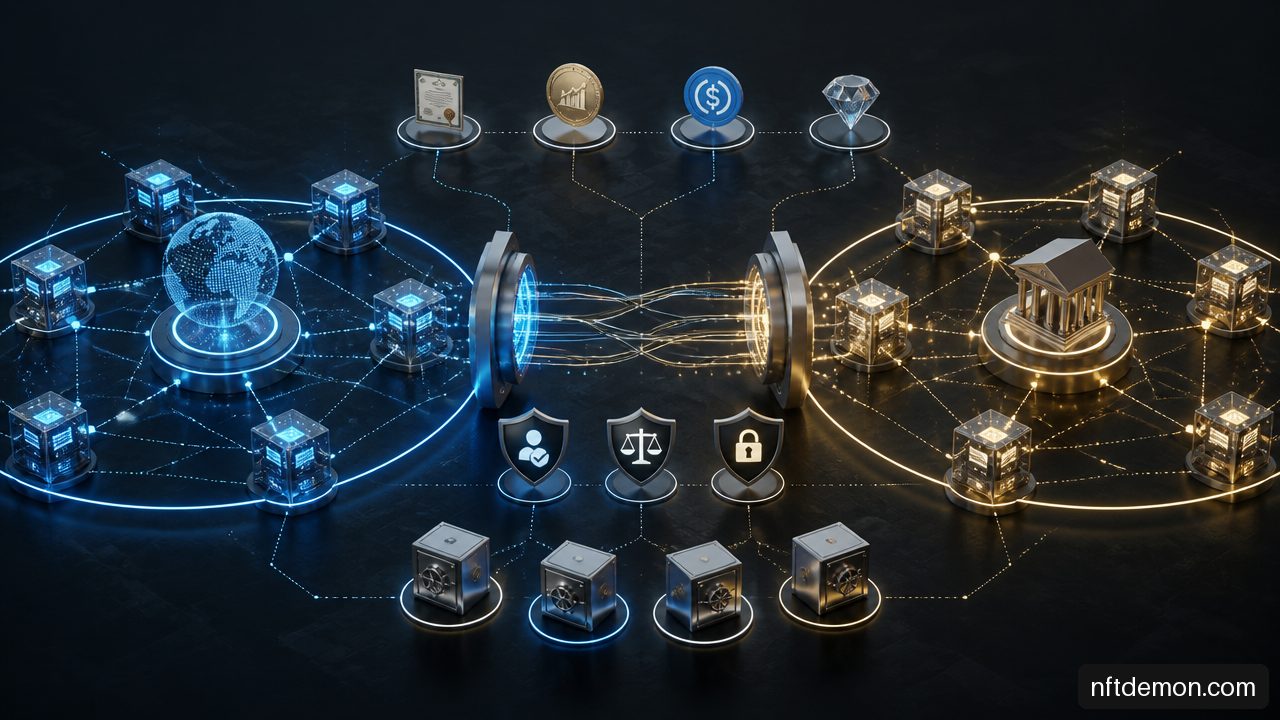
For decision makers, interoperability should be treated as infrastructure design rather than a bridge selection exercise. A fast transfer that creates a duplicate claim, loses investor eligibility data, or cannot be reconciled during a chain outage is not institutional interoperability. It is an operational liability.
- What Must Interoperate
- Protocol Design Controls And Selection
- Key Takeaways
- Frequently Asked Questions
- Sources And References
What Must Interoperate
A Token Transfer Is Only One Layer
The direct answer is that tokenized-asset interoperability is the ability of separate blockchain networks, custody systems, and business platforms to exchange asset-related value and instructions without creating conflicting records. The word asset-related matters. A token contract may transfer successfully while the broader asset workflow fails.
We can separate interoperability into four practical layers:
| Layer | What Must Remain Consistent | Failure If It Does Not |
|---|---|---|
| Asset layer | Token identifier, supply, denomination, ownership state | Duplicate or unredeemable claims |
| Instruction layer | Transfer, collateralization, redemption, corporate-action instructions | Asset arrives without intended business action |
| Identity and compliance layer | Eligibility, sanctions controls, investor limits, permissions | Transfer breaches issuer policy or regulation |
| Settlement and operations layer | Finality, custody record, accounting state, audit trail | Parties disagree on whether settlement occurred |
A common token interface helps only at the first layer. ERC-20 defines common behavior for fungible tokens, while ERC-721 provides a common interface for unique tokens. Those interfaces reduce integration work, but they do not automatically carry identity proofs, contractual restrictions, tax treatment, or a legal record of title.
Northern Trust makes this distinction clearly: token standards and standardized data formats are foundational to interoperable tokenized-asset platforms. Foundational does not mean sufficient. Standards make a shared language possible; they do not settle every business rule spoken in that language.
Consider a tokenized private-credit instrument issued on a permissioned network. It might be technically possible to represent it on a public chain. Yet the public representation is not operationally equivalent unless the destination environment can enforce transfer eligibility, preserve the authoritative investor record, handle payment events, and support a controlled redemption path. The bridge moved units. It may not have moved the instrument.
This is why Choosing between public and permissioned blockchains should be resolved before selecting a cross-chain protocol. The network model determines who may validate, view, recover, or restrict an asset transfer.
Cross-Chain Messaging Versus Asset Bridging
Cross-chain messaging and bridging are related, but they solve different problems.
A cross-chain message carries an instruction or data payload from one environment to another. The destination application decides what to do with it. A message might request that a custodian release collateral, update a portfolio record, trigger a subscription workflow, or mint an asset representation.
A bridge is the mechanism that changes the token’s usable state across networks. It may lock tokens, burn tokens, mint representations, or coordinate release on another ledger. Some systems combine messaging and token transfer in one workflow. Others deliberately keep them separate.
That distinction changes the risk analysis. A message can be delivered correctly while the asset action fails because a destination contract is paused. Conversely, a destination token can be minted while a related accounting instruction fails. An institutional design should therefore treat the asset transfer and its business instruction as separate states that must be reconciled.
Chainlink describes CCIP as a system that can carry tokens, arbitrary data, and instructions between blockchains. In practical terms, Swift messaging standards combined with Chainlink CCIP were used in experiments involving tokenized value across public and private blockchains. The implication is significant: established financial messaging can coordinate with blockchain transport, but neither layer removes the need for common settlement rules.
Public, Private, And Enterprise System Connectivity
A tokenized-asset platform rarely begins and ends on-chain. It usually touches investor onboarding, custody, treasury, ERP, CRM, identity systems, transfer-agent workflows, and reporting. An interoperability plan that ignores those systems can produce a technically elegant but commercially incomplete deployment.
The International Monetary Fund’s ASAP model notes that digital-asset-platform interoperability can operate through API-based access-layer and service-layer interactions. Access-layer interoperability concerns how wallets, users, and applications connect. Service-layer interoperability concerns what platforms can actually do together, such as exchange data, coordinate workflows, or settle obligations.
That is a useful planning boundary. A wallet API might display an asset on two networks, while the underlying systems still cannot perform synchronized delivery-versus-payment or share a compliance decision. Visibility is not settlement.
For enterprise architecture, Integrating blockchain with existing enterprise systems should be part of the same design discussion as token mobility. The blockchain protocol, identity service, custody platform, and general ledger need explicit ownership of every state transition.
Protocol Design Controls And Selection
Transfer Models: Lock, Mint, Burn, Or Release
Most interoperability protocols for tokenized assets use one of three broad transfer models. Each solves the supply problem differently.
| Transfer Model | Mechanism | Best Fit | Primary Trade-Off |
|---|---|---|---|
| Lock and mint | Original tokens are locked; a representation is minted elsewhere | Assets needing a visible origin-chain reserve | Introduces custody, redemption, and wrapper risk |
| Lock and unlock | Tokens are locked on one chain and released from liquidity on another | Networks with pre-positioned liquidity | Requires careful liquidity and state coordination |
| Burn and mint | Tokens are destroyed on the source chain and newly issued on the destination | Issuer-controlled assets with native multi-chain design | Depends on trusted authorization for burning and issuance |
With lock and mint, the original asset remains immobilized while a wrapped version circulates elsewhere. This can be appropriate when the original chain remains the authoritative venue. The obvious concern is redemption: holders must trust that the locked asset remains controlled, available, and redeemable.
With burn and mint, the source token is destroyed before an equivalent amount is created on the destination. CCTP is a widely cited token-specific model for USDC transfers using this approach. Omnichain standards such as LayerZero OFT, Axelar Interchain Token Service, and Chainlink’s Cross-Chain Token standard similarly illustrate the broader design direction: make the asset’s supply portable rather than create a stack of independently liquid wrapped claims.
For regulated products, burn and mint can simplify supply accounting because one canonical supply is distributed across networks rather than locked behind multiple wrappers. It is not automatically safer. The issuer or authorized protocol component has substantial power to approve, pause, or reject movement. That authority can be desirable for a regulated fund share and unacceptable for an asset meant to minimize issuer discretion.
Fair warning: no model removes operational risk. A source-chain burn may finalize while the destination chain is unavailable. The system must then represent the transfer as pending rather than invite an operator to mint a second time manually.
Trust Models Determine Who Can Stop A Transfer
The more useful protocol comparison is not a feature checklist. It is a question of authority: who can halt, censor, replay, or falsely authorize a transfer?
We should assess common trust patterns this way:
| Trust Pattern | Typical Decision Authority | Main Advantage | Decision-Maker Concern |
|---|---|---|---|
| Native issuer authorization | Issuer or designated token controller | Strong control over supply and compliance | Centralized pause and censorship power |
| Validator or attester committee | A defined set of independent or appointed validators | Flexible cross-network verification | Committee compromise or availability failure |
| Oracle or relay network | External message-verification network | Can support heterogeneous chains | Security depends on verification design and configuration |
| Gateway operator | Institution-operated or consortium-operated gateway | Suitable for private and heterogeneous systems | Gateway becomes a critical operational dependency |
| Native chain consensus | Source and destination chains directly validate shared state | Fewer external trust layers where feasible | Often unavailable across unrelated networks |
There is no universal winner. A retail stablecoin may prioritize broad network reach. A tokenized government bond may prioritize permissioning, controlled recovery, auditable approvals, and known operational accountability.
SATP offers a useful conceptual direction for the latter category. The protocol research proposes standardized gateway-to-gateway asset transfer between heterogeneous asset networks. Gateways can provide a disciplined boundary between distinct networks, particularly where direct smart-contract interoperability is impractical. But they must be designed as high-value infrastructure: monitored, audited, recoverable, and governed under documented operating rules.
Compliance Does Not Travel Automatically
For tokenized securities, funds, deposits, and restricted real-world assets, the most difficult question is often not “Can the token arrive?” It is “Can the destination honor the conditions under which it may be held and transferred?”
ERC-1400 and ERC-3643 are relevant because they address security-token and permissioned-transfer patterns. Still, a token standard cannot independently prove that an investor remains eligible in a given jurisdiction, that an off-chain agreement is enforceable, or that a privacy requirement has been satisfied.
A recent compliance-focused study observes that token standards alone do not cover every traceability, privacy, enforceability, finality, and tokenizability requirement. That is the central governance lesson. Compliance is a composed system of token controls, identity attestations, records, policies, human accountability, and legal agreements.
Before a transfer, the source environment should validate authority to initiate it. During transfer, the protocol should bind the message to a unique identifier and expected destination. Before destination issuance or release, the destination should validate recipient eligibility and the current policy version. After completion, both sides should write an auditable record that can be matched to custody and accounting systems.
This is where Blockchain integration architecture for ERP and CRM systems becomes practical. Compliance status and asset ownership should not diverge simply because one system receives an update before another.
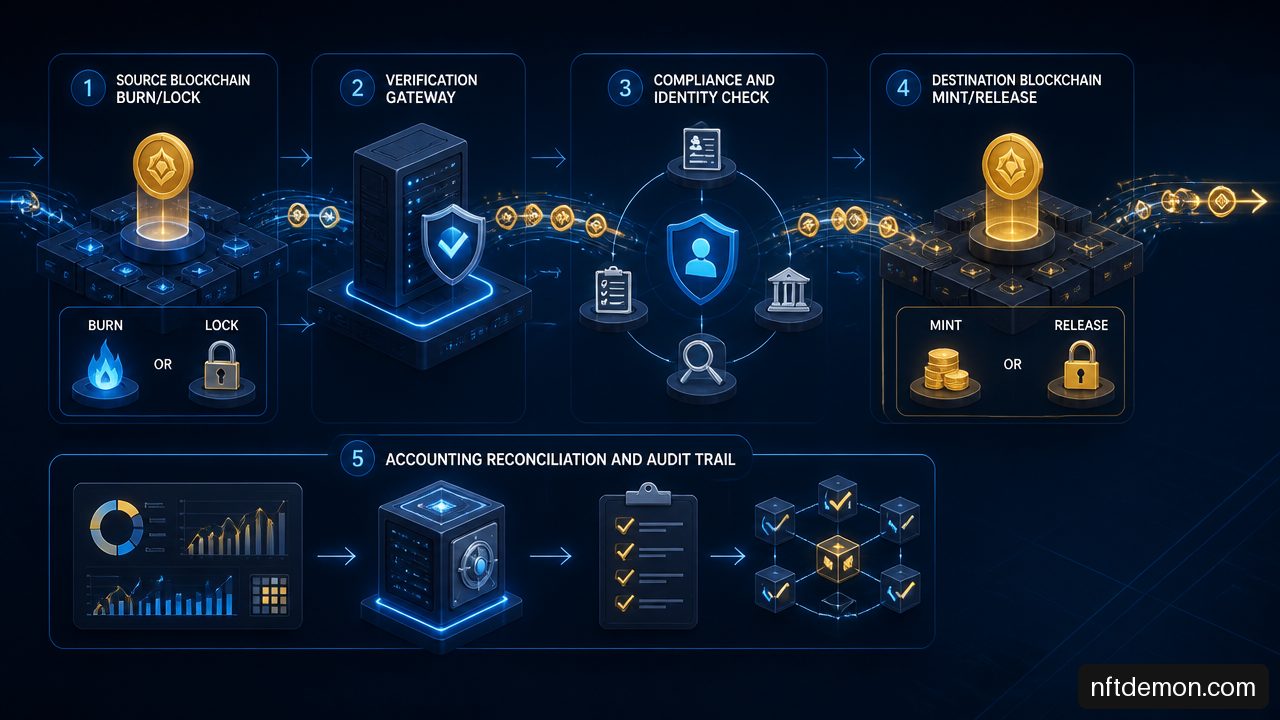
Supply Reconciliation And Failure Recovery
Supply preservation is an operational control, not a background technical property. Every multi-network asset program needs a reconciliation process that answers three questions each day, and more frequently for critical assets:
- What is the authorized total supply across all networks?
- Which transfers are final, pending, failed, or awaiting manual resolution?
- Does every destination issuance map to exactly one authorized source lock, burn, or release event?
The controls should cover at least the following cases:
• Duplicate delivery: A destination must reject a message identifier it has already processed, even if a relay retries it.
• Destination downtime: A completed source-side action should enter a durable pending state until the destination is available, not trigger an ad hoc duplicate operation.
• Message ordering: Instructions may arrive out of sequence. A redemption should not execute before the related asset position exists.
• Chain reorganization or uncertain finality: The protocol should wait for its defined finality threshold and retain evidence of the source event.
• Paused compliance state: If eligibility cannot be confirmed, the asset should be held in a controlled pending or recovery workflow rather than delivered to an unverified address.
• Manual intervention: Operators need bounded authority, dual approvals where appropriate, and immutable logs explaining why a transfer was repaired, canceled, or re-routed.
A reliable proof of concept should intentionally break the happy path. Send a duplicate message. Pause the destination chain. Change a recipient’s eligibility between initiation and settlement. Force a timeout after a source burn. Then verify that supply, accounting, customer communications, and recovery permissions remain coherent.
Selecting A Protocol For A Regulated Asset
Protocol selection should begin with business constraints, then move to technical capabilities. It is tempting to start with the most recognized protocol brand. That reverses the decision.
Use this sequence:
Define the authoritative asset record. Identify which ledger, registry, or legal record controls issuance, redemption, and dispute resolution.
Choose the transfer model. Decide whether the asset should be wrapped, liquidity-backed, or natively burned and minted across networks.
Document the trust boundary. Identify every party or system that can authorize, block, alter, or recover a transfer.
Set finality and recovery rules. Specify when a source action is irreversible, when a destination claim becomes usable, and who may intervene after timeout.
Test metadata and policy preservation. Verify that identifiers, decimals, partitions, restrictions, identity references, and corporate-action states remain accurate.
Run operational conformance tests. Reconcile supply, test retries, simulate outages, assess audit logs, and validate staff escalation paths.
Choose a generalized cross-chain messaging protocol when the asset must travel with programmable instructions across several ecosystems. Choose a token-specific burn-and-mint design when issuer-controlled supply portability is the central requirement. Choose a gateway-oriented model when private networks, legal boundaries, and controlled institutional operations matter more than open composability.
Avoid production deployment when the team cannot explain the recovery path in plain language. If no one can state who resolves a transfer stranded between networks, the design is unfinished.
Key Takeaways
• Interoperability is broader than token movement. Asset supply, instructions, identity, compliance, and settlement status must remain aligned.
• Token standards help but do not guarantee operational or legal compatibility. ERC interfaces do not independently solve eligibility, finality, custody, or enforceability.
• Transfer models create different liabilities. Lock and mint concentrates wrapper and redemption risk; burn and mint concentrates authorization and issuer-control risk.
• Trust assumptions should drive protocol selection. Evaluate who can halt, censor, replay, authorize, or recover a transfer before comparing features.
• Reconciliation belongs in the operating model. Supply invariants, pending-transfer queues, duplicate-message controls, and recovery approvals need continuous oversight.
• A proof of concept should test failure, not just successful transfers. Downtime, retries, policy changes, and partial completion reveal whether a design is deployable.
Frequently Asked Questions
What Does Interoperability Mean For Tokenized Assets?
It means separate blockchain networks and connected business systems can exchange tokenized assets or asset-related instructions while preserving the rules that make those assets valid. A transfer is interoperable only when supply, ownership, restrictions, records, and settlement status remain consistent enough for the intended use.
What Is The Difference Between Cross-Chain Messaging And Token Bridging?
Cross-chain messaging delivers data or instructions from one network to another. Bridging changes an asset’s usable state across networks through locking, releasing, burning, minting, or issuing a representation. One workflow can use both, but they should be monitored as distinct states.
How Do Burn-And-Mint And Lock-And-Mint Transfers Differ?
Burn and mint destroys tokens on the source chain and creates equivalent tokens on the destination chain. Lock and mint immobilizes source tokens and creates a wrapped representation elsewhere. Burn and mint can simplify native supply management, while lock and mint relies more directly on the locked reserve and redemption mechanism.
Are ERC-20 And ERC-721 Tokens Automatically Interoperable Across Blockchains?
No. They define familiar token interfaces, not a universal cross-chain transfer process. Compatible contracts can reduce integration complexity, but they do not provide common message verification, identity controls, legal treatment, metadata rules, or settlement finality.
How Do Interoperability Protocols Prevent Double Spending?
They attempt to bind one destination action to one verified source action. Common controls include source locks or burns, unique transfer identifiers, destination replay protection, finality thresholds, supply monitoring, and reconciliation. The precise effectiveness depends on the protocol’s verification model and its operational controls.
Can Tokenized Securities Move Between Permissioned And Public Blockchains?
They can in a technical sense, but the legal and operational design is demanding. The destination must preserve or reapply investor eligibility, transfer restrictions, privacy controls, authoritative ownership records, and redemption rights. For many issuers, a controlled gateway or permissioned representation may be more appropriate than unrestricted public-chain circulation.
What Should An Interoperability Proof Of Concept Test Before Production?
Test successful transfers, duplicate messages, delayed delivery, destination outages, recipient ineligibility, policy updates during transfer, source-chain finality delays, accounting reconciliation, and manual recovery approvals. A demonstration that only proves a token can arrive does not prove that the operating model can withstand failure.
Sources And References
Northern Trust + Interoperability of Tokenized Assets – Towards a Secured and Scalable Future
https://www.northerntrust.com/content/dam/northerntrust/asset-servicing/global/en/documents/insights-research/2024/interoperability-of-tokenized-assets.pdfSwift + Connecting blockchains: Overcoming fragmentation in tokenised assets
https://www.swift.com/swift-resource/252093/download?force_download=1arXiv + SATP: Secure Asset Transfer Protocol research paper
https://arxiv.org/pdf/2501.17732International Monetary Fund + ASAP: A Conceptual Model for Digital Asset Platforms
https://www.imf.org/-/media/files/publications/wp/2024/english/wpiea2024019-print-pdf.pdfarXiv + A Regulatory Compliance Protocol for Asset Interoperability Between Traditional and Decentralized Finance in Tokenized Capital Markets
https://arxiv.org/abs/2603.29278v2
NFT Demon Holdings helps enterprises scope, evaluate, and build blockchain programs — start with a free evaluation call.
Talk through your use case
Free evaluation call — objective, constraints, and fit, before any proposal.