Interoperability layer design between CBDC networks and public Web3 protocols
By Jeremy Ryan, Founder & CEO · October 2026
Interoperability layer design between CBDC networks and public Web3 protocols is not primarily a bridge-building exercise. It is a boundary-design exercise. The central question is not whether a CBDC can send a message to Ethereum, another public blockchain, or a decentralized application. It is which functions can safely cross that boundary, who authorizes them, and what happens when the two systems disagree.

A sound design keeps the CBDC core ledger authoritative while allowing carefully controlled external representation, redemption, settlement, and data exchange. That distinction matters because public Web3 protocols are built for open participation and composability, while CBDC systems must meet monetary, legal, operational, privacy, and supervisory requirements.
• Build The Interoperability Layer
• Design For Settlement And Failure
• Govern The Public Web3 Connection
• FAQ
Define The Trust Boundary
The safest default is usually not to expose the CBDC core ledger directly to arbitrary public smart contracts. Instead, I would treat the CBDC network as the system of record and place a controlled interoperability layer between it and public Web3 protocols.
That layer can expose approved capabilities without making central-bank money itself permissionless. For example, it may support a regulated institution minting a limited public-chain representation after funds are immobilized or redeemed on the authoritative CBDC ledger. It may allow a tokenized securities platform to request payment settlement through an accredited gateway. It should not allow any contract with a wallet address to initiate unrestricted CBDC transfers.
The Bank for International Settlements notes that CBDC interoperability includes technical, operational, legal, supervisory, security, and settlement dimensions, and that some interoperability functions can sit outside the CBDC core through shared processing or settlement arrangements. This is the architectural basis for a layered approach to CBDC interoperability rather than a direct connection to an open execution environment.
Separate Authority From Representation
A CBDC balance and a public-chain token should never be casually treated as the same thing. They may be connected economically, but their legal and technical status can differ.
A public-chain token might represent:
• A redeemable claim against a regulated intermediary
• A fully reserved token whose backing is immobilized in a CBDC-side account
• A delivery instruction that settles only after a CBDC payment is confirmed
• A restricted settlement asset usable by accredited institutions and approved smart contracts
This is more than legal wording. It determines where loss occurs if a bridge fails, who can freeze an asset, whether holders have direct claims on the central bank, and how redemptions work during an outage.
Consider a tokenized bond marketplace. A buyer may hold a public-chain settlement token that is backed one-for-one by CBDC funds held in a controlled account. The marketplace can use that token in a smart contract for delivery-versus-payment. Yet the CBDC ledger remains the source of truth for issuance and redemption. The marketplace token is useful because it is programmable; it is constrained because it must not become an ungoverned duplicate monetary claim.
Identify What Must Remain Inside The CBDC Domain
Several functions should generally remain under CBDC-side authority, even when a public Web3 integration exists:
| Function | Recommended Location | Reason |
|---|---|---|
| Monetary issuance and retirement | CBDC core ledger | Prevents duplicate claims and preserves monetary authority |
| Participant eligibility | Identity and policy layer | Applies regulated access rules before value reaches public protocols |
| Sanctions screening and AML/CFT decisions | Policy engine and supervised gateway | Enables accountable enforcement and evidence retention |
| Final settlement record | CBDC ledger or designated settlement system | Establishes the authoritative payment outcome |
| Emergency controls | Governed operator layer | Supports legally defined freezes, pauses, and recovery actions |
This boundary is especially relevant when choosing between public and permissioned blockchains. The decision is not simply about throughput or openness. It is about which system can enforce the obligations attached to each transfer.
Do Not Mistake ISO 20022 For A Bridge
ISO 20022 can structure payment instructions, references, party data, and status messages. It is valuable for translating between financial infrastructure and CBDC components. It does not make a public smart contract compliant, establish wallet identity, or solve cross-chain finality.
A practical mapping may look like this:
A public-chain smart contract emits an approved settlement request.
A gateway converts the request into an internal instruction with defined identifiers, limits, and policy metadata.
The CBDC-side service performs identity, authorization, AML/CFT, and liquidity checks.
The resulting settlement status is returned to the public-chain workflow through an authenticated relayer or oracle mechanism.
The message format is only one layer. Policy, authority, and settlement remain separate concerns.
Build The Interoperability Layer
A robust interoperability layer is best designed as a set of services with explicit responsibilities. Calling the whole arrangement “the bridge” is too vague. It hides where risk actually lives.
The International Telecommunication Union’s CBDC reference architecture identifies standardized APIs, message structures, data formats, and multiple architectural layers as core interoperability requirements. Its access-layer model also supports transaction processing, identity verification, and data exchange, which is why a CBDC access-layer API architecture should be policy-aware rather than a simple payment endpoint.
The Five Functional Layers
| Layer | Core Responsibility | Design Question |
|---|---|---|
| Identity layer | Links approved participants, wallets, and credentials | Who is permitted to request, receive, redeem, or administer value? |
| Policy layer | Enforces limits, sanctions controls, risk rules, and contract permissions | Which activity is allowed under which conditions? |
| Message layer | Translates events, requests, and settlement statuses | How are messages authenticated, versioned, and reconciled? |
| Asset layer | Defines lock, burn, mint, escrow, redemption, and reserve logic | What exactly exists on each side of the boundary? |
| Settlement layer | Determines when payment is final and legally effective | Which record controls if systems diverge? |
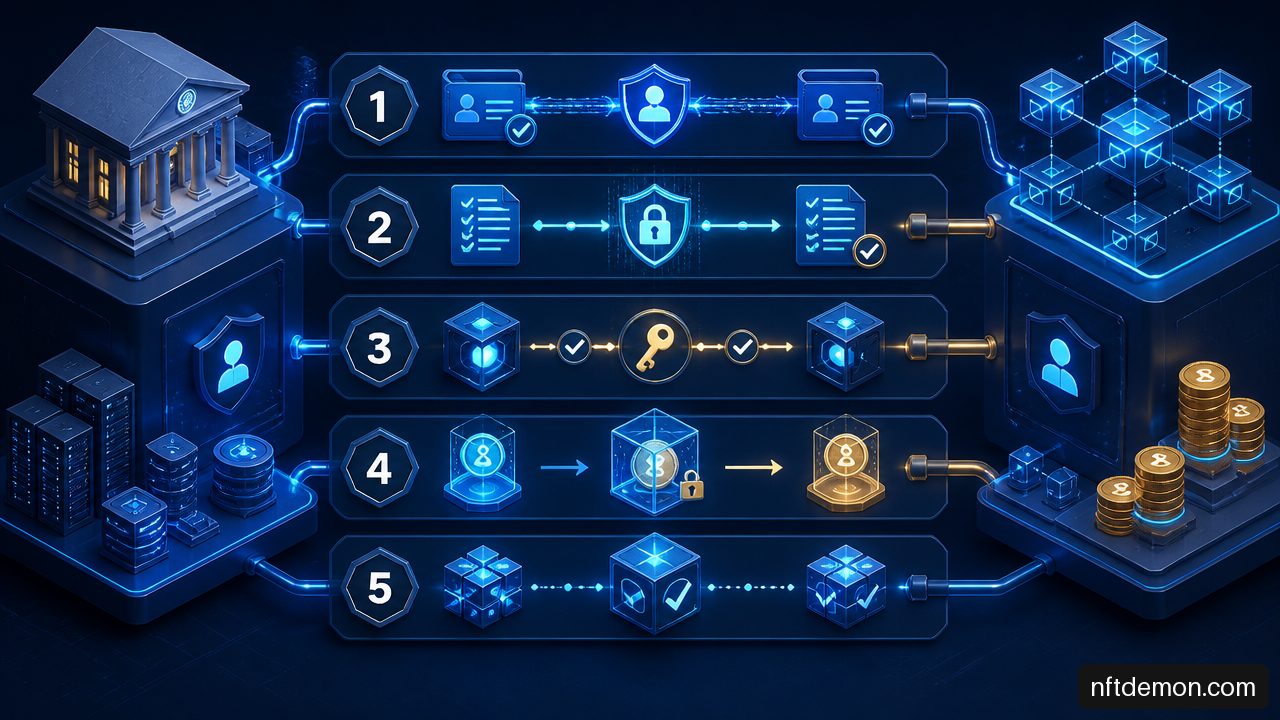
The value of separation is operational clarity. A policy change should not require rewriting asset contracts. A new public protocol should not require changing the CBDC core. A failed relayer should not create uncertainty about ledger balances.
Use A Capability Model For Smart Contracts
Public Web3 composability is powerful precisely because contracts can call other contracts. For CBDC-connected systems, that freedom needs a narrow interface.
A capability model specifies what a verified actor or contract may
do. Instead of exposing a generic transferCBDC() function,
the gateway might expose distinct, limited functions such as:
• Request delivery-versus-payment settlement up to a defined value threshold
• Submit a redemption request from an approved token contract
• Query a privacy-preserving settlement status using a transaction reference
• Initiate a time-limited escrow release after both legs are validated
Each capability should include conditions: approved contract code, transaction limits, valid credentials, jurisdictional rules, and an auditable purpose. The core principle is simple: an endpoint is not a permission model.
This approach fits broader blockchain integration architecture practice. Enterprise systems rarely expose unrestricted access to their ledgers or identity records. CBDC interoperability should be at least as disciplined.
Choose The Right Connection Pattern
The World Economic Forum argues that CBDCs should be technology-agnostic and able to interoperate across DLT, non-DLT, private, permissioned, and public systems. That broad requirement supports controlled connections, but it does not prescribe one universal mechanism. A technology-agnostic CBDC interoperability model still needs a use-case-specific architecture.
| Pattern | Best Fit | Avoid When |
|---|---|---|
| Regulated API gateway | Payment initiation, reporting, controlled redemption | The use case requires public-chain atomic execution |
| Lock and mint representation | Limited on-chain utility with defined reserves | Reserve governance and redemption rights are unclear |
| Burn and mint model | Two controlled ledgers with aligned operators | Public-chain issuance cannot be reliably constrained |
| Escrowed atomic exchange | Tokenized securities and bilateral exchange | Legal settlement cannot be tied to technical completion |
| Direct interlinking | Closely governed institutional networks | The external network is unrestricted and independently governed |
For many retail-facing or public DeFi scenarios, a regulated gateway plus a restricted tokenized representation is more realistic than direct CBDC access. It provides programmable utility without assuming the central bank controls the public protocol’s validators, upgrade path, congestion, or censorship environment.
Design For Settlement And Failure
A cross-network transaction has more than one kind of finality. Treating “confirmed on-chain” as equivalent to “settled” is a costly mistake.
Model Four Finality Domains
| Finality Domain | Question It Answers | Typical Failure Risk |
|---|---|---|
| Public-protocol finality | Is the public-chain transaction unlikely to be reversed? | Reorganizations, congestion, protocol incidents |
| Bridge finality | Has the relayer network accepted and authenticated the event? | Key compromise, quorum failure, message duplication |
| CBDC ledger finality | Has the authoritative payment record been updated? | Policy rejection, liquidity failure, system outage |
| Legal finality | Is the transfer enforceable and irrevocable under applicable rules? | Rulebook ambiguity, jurisdictional conflict, insolvency questions |
These domains can occur in different orders. That is not a theoretical concern.
Imagine a public-chain tokenized security contract marks a bond as delivered after receiving a bridge message. The CBDC-side transfer is then rejected because the buyer exceeded a risk limit or the recipient failed a policy screen. If the security is already freely transferable, the system has created an exposure that must be reconciled through escrow, reversal, collateral, or a legally defined claims process.
The design response is to avoid premature completion. Public contracts should move through explicit states such as requested, policy-approved, funds-reserved, CBDC-settled, and released. A user interface may show progress, but it must not overstate finality.
Build Reconciliation Before Launch
Every CBDC-to-Web3 connection needs a durable reconciliation model. At minimum, it should maintain an immutable event record containing:
• A unique transaction identifier spanning both systems
• The initiating wallet or institutional identity reference
• Requested amount, asset type, and applicable policy version
• Public-chain transaction hash and confirmation threshold
• CBDC-side acceptance, rejection, or settlement status
• Relayer signatures, timestamps, and exception evidence
• The recovery path if either leg fails
Project Mariana offers a useful architectural reference. The Banque de France and BIS Innovation Hub documented bridges using domestic and transnational smart contracts alongside off-chain relayers to synchronize cross-platform instructions. The important lesson is not that every CBDC should copy the project. It is that a paired smart-contract and relayer bridge pattern has identifiable operators, message paths, and accountability points.
Plan Recovery Paths Explicitly
A credible implementation should define recovery before any token is minted or any public contract is accredited.
Public chain succeeds, CBDC settlement fails: Hold the public asset in escrow or mark it non-transferable until resolution.
CBDC settlement succeeds, public chain fails: Record the CBDC-side outcome and either retry through an idempotent request or initiate a governed compensation process.
Relayer outage: Pause new settlement requests, preserve existing state, and use quorum-backed recovery procedures rather than manual guesswork.
Bridge key compromise: Activate emergency controls, isolate affected capabilities, rotate credentials, reconcile events, and communicate the legal status of in-flight transfers.
Sanctions or policy change after initiation: Define whether funds are held, returned, or frozen, and ensure the answer is consistent with the governing rulebook.
Fair warning: no universal standard resolves every asymmetric failure. The right answer depends on custody, applicable law, transaction type, and whether the public-chain asset can be frozen. That uncertainty should be made visible to decision-makers, not buried under smart-contract terminology.
Govern The Public Web3 Connection
A public-chain connection creates an institutional boundary problem. The CBDC operator may govern issuance, but it does not govern the public protocol’s validators, upgrades, transaction ordering, fee market, or ecosystem applications.
That means governance is not an operational afterthought. It is part of the security model.
Treat Relayers As Regulated Infrastructure
Relayers observe one environment and submit messages to another. Their trust model must be explicit.
A strong design specifies:
• Who may operate relayers and under what accreditation criteria
• Whether settlement messages require a single signer, threshold signatures, or an independent quorum
• How keys are stored, rotated, revoked, and audited
• How software upgrades are approved and tested
• What evidence is retained for disputes and supervisory review
• Which party can pause the bridge, and what legal authority supports that action
The World Economic Forum’s interoperability work identifies messaging, privacy, AML/CFT, identity, authentication, DLT protocols, and settlement as connected control domains. A cross-domain interoperability control framework is necessary because no amount of cryptographic proof substitutes for incomplete governance.
Privacy Must Include Public Metadata
Keeping identity data off-chain is necessary but insufficient. Public-chain activity can reveal information through wallet reuse, transaction timing, balance movements, fee patterns, and redemption behavior.
For example, a merchant using the same public wallet for daily CBDC-backed token redemptions may expose business volume patterns even if no customer names appear on-chain. A user who repeatedly receives funds from a known exchange address can become easier to cluster. Privacy design must therefore minimize not only personal data fields but also observable behavioral traces.
Possible controls include rotating addresses, batching, delayed reporting, privacy-preserving credentials, transaction limits, and keeping sensitive policy decisions off-chain. Each control has trade-offs. Batching can reduce linkability but may delay settlement. Stronger credential systems can improve privacy but increase implementation complexity and governance responsibilities.
Establish A Multi-Party Operating Model
For regulated environments, the operating model should identify the central bank or issuing authority, regulated intermediaries, bridge operators, public-chain service providers, auditors, and dispute-resolution authority.
This is central to enterprise blockchain architecture in regulated industries, where technical control and legal responsibility must align. A smart contract can automate a rule, but it cannot independently decide who bears liability when an external system changes unexpectedly.
Key Takeaways
The objective is not maximum openness. It is controlled, auditable utility across systems with fundamentally different trust assumptions.
• Keep CBDC issuance, retirement, authoritative balances, and legal settlement within the controlled CBDC domain.
• Decompose the interoperability layer into identity, policy, messaging, asset representation, and settlement functions.
• Prefer controlled representations, redemption models, or regulated gateways when public-chain composability is needed.
• Define public-protocol, bridge, CBDC-ledger, and legal finality separately. They are not interchangeable.
• Design reconciliation, exception handling, pauses, and recovery procedures before connecting value to a public protocol.
• Make bridge governance visible: relayer operation, key control, upgrades, audits, and emergency authority are first-class design decisions.
• Measure privacy risk through public metadata, not only through the presence or absence of names on-chain.
FAQ
What Does Interoperability Between A CBDC Network And A Public Blockchain Actually Mean?
It means enabling controlled communication, data exchange, asset representation, or settlement coordination between separate systems. It does not necessarily mean that public wallets can directly hold or transfer native CBDC balances. In a mature design, the connection is usually limited to approved use cases, authenticated participants, and defined settlement pathways.
Should A CBDC Connect Directly To A Public Blockchain Or Use A Regulated Gateway?
A regulated gateway is generally the safer default when the use case involves public smart contracts. It can enforce identity, transaction limits, sanctions controls, and contract permissions before instructions reach the CBDC environment. Direct interlinking is more suitable for tightly governed institutional networks with aligned operating rules, not arbitrary public applications.
How Can A CBDC Be Represented On A Public Web3 Network Without Creating Duplicate Claims?
The representation needs a clear backing and redemption rule. Common approaches include immobilizing CBDC funds before minting a corresponding token, burning the token before releasing funds, or using an escrowed claim that cannot exceed a verified reserve. Independent reconciliation is essential because a token supply cap alone does not prove that backing remains intact.
What Happens If A Public-Chain Transaction Succeeds But CBDC Settlement Fails?
The public-chain workflow should not release final value before CBDC settlement is confirmed. Use state-based contracts, escrow, transfer restrictions, or collateralized exception handling. If a public asset becomes transferable before the CBDC leg completes, the system may require a reversal or claims process, which is exactly the outcome good architecture tries to avoid.
How Should Identity And AML/CFT Checks Work With Permissionless Smart Contracts?
Checks should execute at the controlled access boundary, not be assumed to exist because a wallet signed a transaction. The gateway can verify institutional credentials, wallet attestations, approved contract status, limits, and relevant risk rules. Public contracts should receive only the minimum confirmation needed to continue their workflow.
Can ISO 20022 Connect A CBDC Directly To Ethereum Or Another Public Protocol?
No. ISO 20022 helps structure financial messages and metadata, but it does not create consensus between ledgers, verify public wallet identity, manage bridge keys, or establish legal finality. It is useful inside a broader interoperability design, especially where payment infrastructure and regulated institutions exchange instructions.
Who Should Operate CBDC Bridge Relayers?
That depends on the legal and operational model, but the operators should be explicitly authorized, auditable, and subject to defined resilience requirements. A threshold or quorum model may reduce dependence on one operator, yet it also introduces more coordination and governance complexity. The design should state who can approve upgrades, rotate keys, pause activity, and resolve disputes.
Sources/References
• International Telecommunication Union + CBDC Reference Architecture Report: https://www.itu.int/en/ITU-T/extcoop/dcgi/Documents/DCGI%20CBDC%20Reference%20Architecture%20Report-20-01-2025.pdf
• Bank for International Settlements + CBDC — System Design and Interoperability: https://www.bis.org/publications/othp42-system-design.pdf
• World Economic Forum + Central Bank Digital Currency: Global Interoperability Principles: https://www3.weforum.org/docs/WEF_Central_Bank_Digital_Currency_Global_Interoperability_Principles_2023.pdf
• World Economic Forum + Defining Interoperability: https://www3.weforum.org/docs/WEF_Defining_Interoperability_2021.pdf
• Banque de France + Project Mariana Final Report: https://www.banque-france.fr/system/files/2023-09/20230928-mariana-final-report.pdf
NFT Demon Holdings helps enterprises scope, evaluate, and build blockchain programs — start with a free evaluation call.
Talk through your use case
Free evaluation call — objective, constraints, and fit, before any proposal.