Integrating Web3 digital passport technology into legacy CRM systems
By Jeremy Ryan, Founder & CEO · October 2026
Integrating Web3 digital passport technology into legacy enterprise CRM systems should not mean replacing Salesforce, SAP, HubSpot, or a custom customer database with a blockchain application. The stronger approach is to treat the digital passport as a trusted product, ownership, and lifecycle record while the CRM remains the operational system for customer relationships, service, consent, and commercial activity.
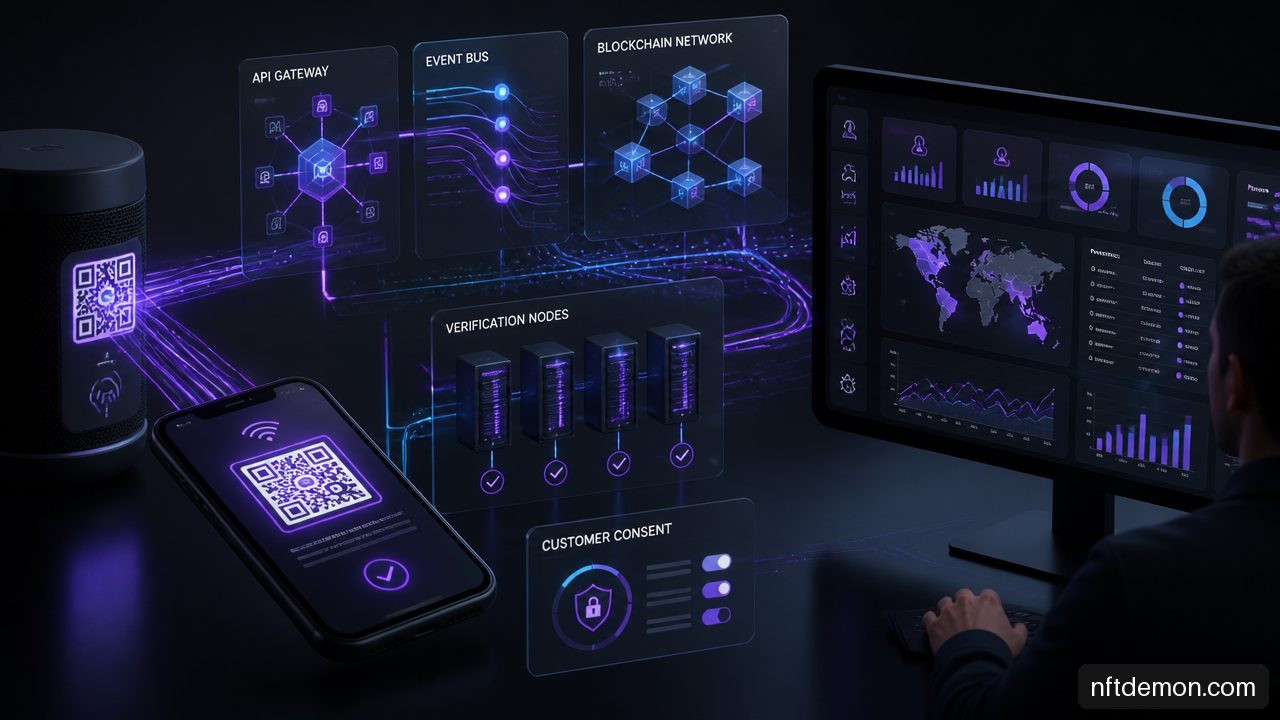
The central decision is simple: what should the CRM know, what should it reference, and what should remain outside the CRM entirely? Get that boundary right and a passport program can support authenticity, warranty, repair, resale, loyalty, and sustainability workflows without turning the CRM into an unreliable copy of blockchain data.
- Architecture That Preserves Legacy CRM Stability
- Data Boundaries, Identity Resolution, And Consent
- Implementation Workflow, Failures, And Pilot Criteria
- Key Takeaways
- Frequently Asked Questions
- Sources And References
Architecture That Preserves Legacy CRM Stability
Define The Digital Passport As A Product And Event Record
A Web3 digital passport is a digital record connected to a physical or digital asset. Depending on the program, it can hold or reference product identity, provenance, material data, warranty eligibility, service history, ownership signals, recycling instructions, or authenticated resale status.
It is not automatically a customer identity record.
That distinction matters because product facts and customer facts change under different rules. A product serial number, manufacturing batch, or authenticity credential may need a durable audit trail. A customer email address, marketing preference, address, and support history require correction, deletion, retention, and access controls that belong in conventional enterprise systems.
For decision makers, the practical model is this:
| System Or Layer | Primary Responsibility | Data It Should Usually Hold |
|---|---|---|
| Passport network | Product provenance, credential references, ownership events, lifecycle attestations | Token or passport identifier, product identifier, signed events, limited public metadata |
| Integration layer | Translation, validation, replay protection, event routing | Event IDs, mappings, retry status, operational logs |
| CRM | Customer relationships, consent, service, campaigns, cases, commercial actions | CRM contact ID, account ID, consent status, passport reference, normalized event summaries |
| Product or ERP system | Authoritative product, inventory, fulfillment, and manufacturing data | SKU, serial number, order reference, warranty rules, supply-chain attributes |
I recommend treating the CRM as a system of customer references and consent, not as the owner of raw blockchain identity data. The CRM might store a passport ID, hashed wallet reference, wallet verification status, last confirmed ownership event, and service eligibility. It usually should not store every token transfer payload or a full on-chain event history.
This separation also makes it easier to replace a wallet provider, passport protocol, or blockchain network later. The CRM sees stable enterprise fields rather than protocol-specific structures.
Use An Anti Corruption Layer Between Systems
The most reliable architecture uses an integration boundary between the Web3 passport service and the legacy CRM. In enterprise architecture, this is often called an anti corruption layer: a translation component that prevents an external data model from contaminating internal systems.
A token transfer, for example, may include transaction hashes, block timestamps, chain IDs, token IDs, addresses, and confirmations. A CRM workflow does not need all of that. It needs a business event such as: passport ownership was verified, warranty registration became eligible, or authenticated resale transfer occurred.
The integration layer should handle:
• Authentication and authorization for APIs, webhooks, and service accounts
• Field transformation between passport events and CRM objects
• Idempotency checks so duplicate events do not create duplicate records
• Retry queues and dead letter handling for failed CRM writes
• Rate limiting, observability, alerting, and audit logs
• Consent checks before triggering campaigns or profile enrichment
Enterprise Web3 systems commonly connect CRM and legacy databases through APIs, webhooks, and enterprise service buses, as described in AgileSoft Labs’ enterprise Web3 integration guidance. The implication is not that any webhook is enough. It means the passport layer must be engineered as part of the enterprise integration estate, with the same reliability expectations applied to payment, order, and support systems.
For a deeper technical model, review this guide to blockchain integration architecture for ERP, CRM, and identity systems. The key design principle is decoupling: passport events should enter a controlled event pipeline before they influence CRM records or customer communications.
Choose Direct Integration Only For Narrow Use Cases
Direct API integration can work when the program is small and the workflow is simple. For example, an e-commerce order can issue one passport, attach it to an authenticated customer account, and create a CRM activity showing that the passport was claimed.
SAP’s Arianee partner material describes a pattern where passport information can be drawn from an SAP product database through an API call while supporting CRM-oriented Web3 functionality. See SAP’s Arianee digital product passport integration example for that product-system-to-passport model.
Direct integration becomes risky when several systems publish or consume events. If product information management, ERP, e-commerce, loyalty, customer service, resale verification, and CRM all interact with the passport, middleware is usually the safer choice. It creates one place to validate events, map identifiers, and define which platform is authoritative for each field.
Data Boundaries, Identity Resolution, And Consent
Separate Immutable Product Facts From Mutable Customer Data
A digital passport can create a false sense that every fact should be permanent. That is not appropriate for customer data.
A product’s manufacturing date may be a durable fact. A customer’s email, consent preference, delivery address, or account association is not. These values can change, be contested, or become subject to privacy requests. The right architecture stores personal data off-chain in the CRM or identity platform and keeps only minimal references in passport-related systems.
A useful data classification rule is:
| Data Category | Recommended Primary Location | Reason |
|---|---|---|
| Product serial number and model | ERP or product master data | Enterprise product authority and correction controls |
| Passport identifier and cryptographic proof | Passport platform or blockchain layer | Integrity and verification |
| Customer profile and contact data | CRM | Privacy, service, segmentation, and retention workflows |
| Marketing consent | Consent platform or CRM | Revocation and compliance controls |
| Wallet verification status | CRM plus integration layer | Operational customer relationship context |
| Full transaction payload | Event store or passport platform | Avoids bloating CRM objects and exposing unnecessary data |
A verifiable credential can help here. Instead of copying a detailed identity claim into the CRM, a system can record that a credential was verified at a certain time for a defined purpose. A decentralized identifier, or DID, may provide a portable identity reference, but it does not remove the need for identity resolution and lifecycle rules.
Fair warning: a wallet address is not a verified person. A customer may control multiple wallets, share a wallet with a household or organization, rotate addresses, or lose access entirely. Treat wallet ownership as a claim that requires a verification process, not as a permanent customer key.
Build Wallet Matching Around Evidence, Not Assumptions
I would use a tiered identity resolution model rather than automatically merging a wallet event into a customer profile.
Unlinked passport event: The system knows the passport and wallet address but has no verified CRM association.
Customer initiated link: The customer signs in to an enterprise account and proves wallet control through a signature or approved wallet connection.
Verified association: The integration layer links the wallet reference to a CRM contact or account, records the verification time, and applies consent rules.
Reverification or expiration: The association is reviewed after a defined period, a wallet rotation, suspicious activity, or ownership transfer.
Consider a premium appliance manufacturer. A QR code on a product opens a passport page. The customer can view care information without connecting a wallet. If the customer wants warranty extension or loyalty benefits, the portal asks them to sign in and complete an explicit account-to-passport association. That sequence preserves a low-friction customer experience while avoiding premature identity claims.
The same approach applies to NFC. An NFC tap can open a digital passport experience and trigger a product interaction event. It should not silently overwrite a CRM owner field merely because a phone touched a tag.
Design Consent And Privacy Controls Before Launch
Customer control over personal data is one of the strongest arguments for a Web3-aware design, but it only holds if consent is explicit and operationally enforceable.
The integration layer should evaluate whether the customer has agreed to:
• Link a wallet or identity reference to their CRM profile
• Receive marketing based on passport ownership or product usage
• Share passport events with service, loyalty, resale, or recycling partners
• Allow the enterprise to retain a verification record after account changes
If a customer revokes consent, the enterprise should stop CRM activation and partner sharing. The immutable passport record may still exist, but the CRM association can be removed or pseudonymized according to the organization’s policy and applicable law. That is why direct storage of personal information on-chain is generally a poor fit for enterprise CRM use.
Implementation Workflow, Failures, And Pilot Criteria
Start With One Business Workflow, Not A Technology Showcase
The first production workflow should answer a narrow commercial or operational question. Good candidates include warranty registration, authenticated resale, repair history, product recall communication, or premium post-purchase engagement.
RIMOWA’s digital passport approach, described by Inside LVMH’s RIMOWA digital passport feature, illustrates that a passport can operate as a post-purchase customer-experience channel rather than only a supply-chain record. That distinction is useful for CRM leaders: the passport should trigger a meaningful next action, not become a static token customers never revisit.
A focused pilot can follow this sequence:
Select one product line and one customer journey.
Define authoritative sources for product, order, customer, consent, and ownership fields.
Create a canonical passport event schema independent of the blockchain provider.
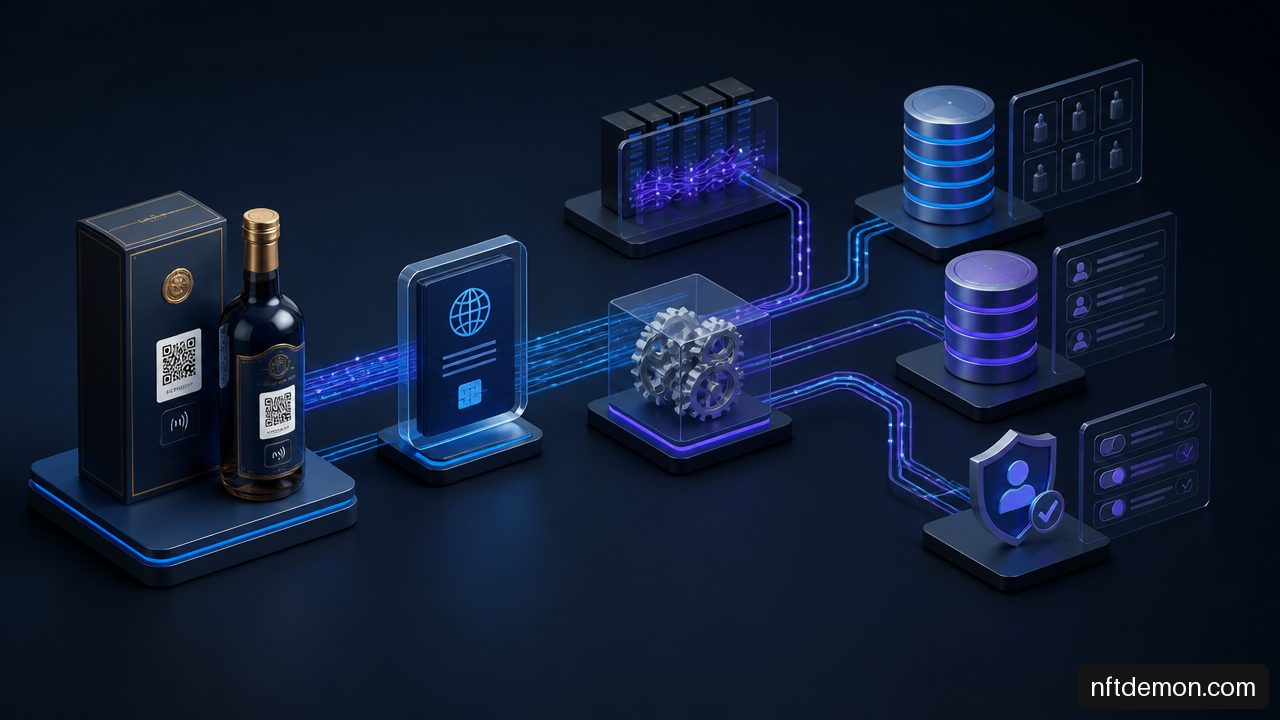
Build the anti corruption layer, API gateway, and event queue.
Add CRM workflows only after event validation and identity matching are working.
Test wallet loss, transfer, duplicate delivery, out-of-order events, and consent revocation.
Release to a limited cohort, measure operational results, then expand.
Platforms can reduce direct blockchain work. For example, PicoNext’s passport and loyalty API documentation describes token creation and event APIs that connect supply-chain, product-information, and e-commerce systems to digital-product-passport workflows. That can be useful when the enterprise wants product teams to publish approved passport events without embedding blockchain transactions in every back-office system.
The DigitalProductPassport project also provides an SDK for Web3 passport integration and management. An SDK may accelerate prototyping, but it does not eliminate decisions around enterprise identity, consent, system ownership, or service operations.
Make Event Ingestion Idempotent
This is where many integrations become unreliable. Blockchain and webhook systems may resend events. A message can arrive late. A CRM write can succeed but the integration layer may time out before receiving confirmation. Without idempotency, one passport transfer can generate multiple CRM activities, duplicate cases, or repeated loyalty rewards.
Each incoming event should have a stable idempotency key. This may combine the passport identifier, event type, transaction or source event ID, and version. Before writing to the CRM, the integration layer checks whether that key has already produced a successful business outcome.
A basic event flow looks like this:
The passport platform emits an ownership or lifecycle event.
The integration layer validates the signature, schema, and source.
The event is stored in an append-only operational log.
The system checks the idempotency key and entity mapping.
A normalized CRM action is created only if the event is new and authorized.
Failed writes move to a retry queue; unresolved failures move to a dead letter queue for review.
Do not assume event order. A repair event may arrive before a prior ownership confirmation due to asynchronous delivery. CRM automation should therefore support provisional statuses rather than making irreversible decisions based on a single event.
For technical teams planning that pattern, this explanation of how APIs and event streams connect blockchain applications to legacy software provides a useful companion view of event-driven synchronization.
Measure Value In CRM And Operations Terms
Token counts are not a business outcome. A serious program needs a measurement model that covers identity quality, operational reliability, customer value, and support burden.
| Measurement Area | Useful Metric | Why It Matters |
|---|---|---|
| Identity resolution | Verified passport-to-customer match rate | Shows whether CRM activation is based on trustworthy associations |
| Data reliability | Duplicate-event rate and failed-write rate | Reveals whether automation is creating cleanup work |
| Customer experience | Passport claim completion and repeat engagement | Indicates whether customers can actually use the experience |
| Service operations | Warranty, repair, or authenticity case resolution time | Tests whether the passport improves frontline workflows |
| Privacy operations | Consent capture, revocation, and deletion-request completion | Demonstrates control over personal data use |
| Commercial performance | Attributable repeat purchase, service conversion, or loyalty participation | Connects the program to measurable business outcomes |
Independent evidence for common implementation costs, match rates, synchronization latency, and support volumes remains limited. That means a decision maker should not accept generic benchmarks as a business case. A pilot should establish an internal baseline instead. For example, compare the number of manual authenticity checks before and after passport-enabled verification, or compare warranty-registration completion between QR-only access and wallet-linked access.
For broader planning, this guide on how to integrate blockchain with existing enterprise systems can help frame the sequencing of governance, security, and integration work.
Key Takeaways
• Keep the CRM authoritative for customer relationships, consent, service, and commercial workflows. Keep passport proofs and product lifecycle events in the passport ecosystem or a controlled event store.
• Use an anti corruption layer. It translates blockchain and wallet events into business-safe CRM actions while managing authentication, retries, observability, and idempotency.
• Do not treat a wallet address as a customer identity. Require customer initiated verification, record the strength of that association, and support rotation or loss.
• Separate immutable product facts from mutable personal data. This is essential for privacy operations, corrections, retention, and customer trust.
• Start with one measurable workflow. Warranty, repair, resale, authenticity, or post-purchase engagement can prove value without disrupting the entire CRM estate.
• Judge success by CRM and operational metrics. Match quality, error rates, service outcomes, consent performance, and attributable commercial results matter more than token issuance volume.
Frequently Asked Questions
What Is A Web3 Digital Passport In A CRM Context?
It is a product or asset record that can provide cryptographically verifiable provenance, ownership, authenticity, or lifecycle information. The CRM uses selected passport references and events to support customer service, loyalty, warranty, engagement, or resale workflows.
Should Passport Data Be Stored Directly In Salesforce, SAP, Or A Legacy CRM?
Only selected, normalized data should be stored in the CRM. Keep CRM-friendly fields such as passport ID, verification status, consent state, and event summaries. Store raw transaction payloads, cryptographic proofs, and high-volume event histories in the passport platform or integration layer unless a specific operational need requires otherwise.
How Can A Wallet Address Be Matched To A Customer Record?
Use a customer initiated process. The customer signs in to the enterprise account, proves control of the wallet through an approved connection or signature, and explicitly agrees to the association. Do not infer identity from a wallet address alone.
Can QR Codes Or NFC Tags Update The CRM Without A Wallet?
Yes. A QR code or NFC tag can open a passport experience and create an interaction event. The CRM can record that interaction if the customer is authenticated and has provided appropriate consent. Wallet use can remain optional for customers who only need product information, service support, or warranty registration.
What Happens If A Customer Loses Access To A Wallet?
The answer depends on custody. A custodial wallet may support recovery through the provider’s account process. A non-custodial wallet may not. The enterprise should define whether product benefits can be recovered through purchase evidence, identity verification, support review, or a replacement credential. This policy should be designed before launch, not improvised during a support escalation.
How Do We Prevent Duplicate CRM Records From Passport Events?
Use idempotency keys, a durable event log, retries, and dead letter queues. Each event should produce one effective CRM action even if the source resends it, delivery is delayed, or the CRM temporarily rejects the update.
Can One Passport Support Loyalty, Warranty, Repair, Resale, And Recycling?
Potentially, yes, if each workflow has clear ownership rules. Product provenance may come from ERP or manufacturing systems, service history from a repair platform, consent from the CRM, and transfer status from the passport layer. The passport can connect those experiences, but it should not become an uncontrolled duplicate of every enterprise system.
Sources And References
SAP — Arianee SAS | Digital Product Passports for E-commerce: https://www.sap.com/products/crm/partners/arianee-sas-digital-product-passports-for-ecommerce.html
PicoNext — Digital Product Passport and Web3 Loyalty APIs: https://piconext.com/article/digital-product-passport-loyalty-apis/
DigitalProductPassport — GitHub organization: https://github.com/DigitalProductPassport
Inside LVMH — RIMOWA’s approach to Digital Product Passport: https://www.insidelvmh.com/article/rimowas-approach-to-digital-product-passport
AgileSoft Labs — Web3 Development for Enterprises: Building Decentralized Applications: https://www.agilesoftlabs.com/blog/2026/01/web3-development-for-enterprises
NFT Demon Holdings helps enterprises scope, evaluate, and build blockchain programs — start with a free evaluation call.
Talk through your use case
Free evaluation call — objective, constraints, and fit, before any proposal.