Implementing chainlink ccip and layerzero for multi chain transfers
By Jeremy Ryan, Founder & CEO · October 2026
When executing tokenized asset settlement or institutional treasury operations across disparate ledgers, architecture teams must establish robust cross-chain interoperability. Successfully implementing Chainlink CCIP and LayerZero for enterprise multi-chain asset transfers requires a deep understanding of trust boundaries, verification mechanics, operational controls, and settlement finality. Rather than viewing cross-chain bridges as simple relayers, institutional engineering teams must treat cross-chain infrastructure as an extension of their core control plane.
In this comprehensive guide, we analyze the architectural mechanisms, control-plane integrations, governance frameworks, and operational runbooks necessary to deploy Chainlink Cross-Chain Interoperability Protocol (CCIP) and LayerZero in high-value enterprise environments.
• Key Takeaways
• Architectural
Mechanisms: Chainlink CCIP vs. LayerZero
• Control-Plane
Architecture and Compliance Frameworks
• Route-Specific
Decision Matrix and Governance Models
• Operational
Failure Modes, Finality, and Reconciliation
• Benchmarking
Testing Methodologies and Cost Structures
• Frequently Asked
Questions
• Sources and References
Key Takeaways
• Architectural Divergence: Chainlink CCIP relies on
a unified defense-in-depth model with centralized decentralized oracle
networks and secondary monitoring, whereas LayerZero uses modular,
application-configured Decentralized Verifier Networks (DVNs).
• Control-Plane Segregation: Enterprise asset security
requires decoupling compliance, policy controls, and key management from
the underlying messaging layer.
• Programmable Transfers: CCIP enables atomic execution
of logic alongside asset movement through Programmable Token Transfers,
while LayerZero provides custom payload messaging across standard token
contracts.
• Risk Management: Mitigating cross-chain exploits
requires rate limiting, strict finality thresholds on source networks,
and dual-verifier signature verification.
• Operational Preparedness: Production deployment
demands automated reconciliation systems, idempotency keys, and explicit
failure-state runbooks for stuck or delayed transactions.
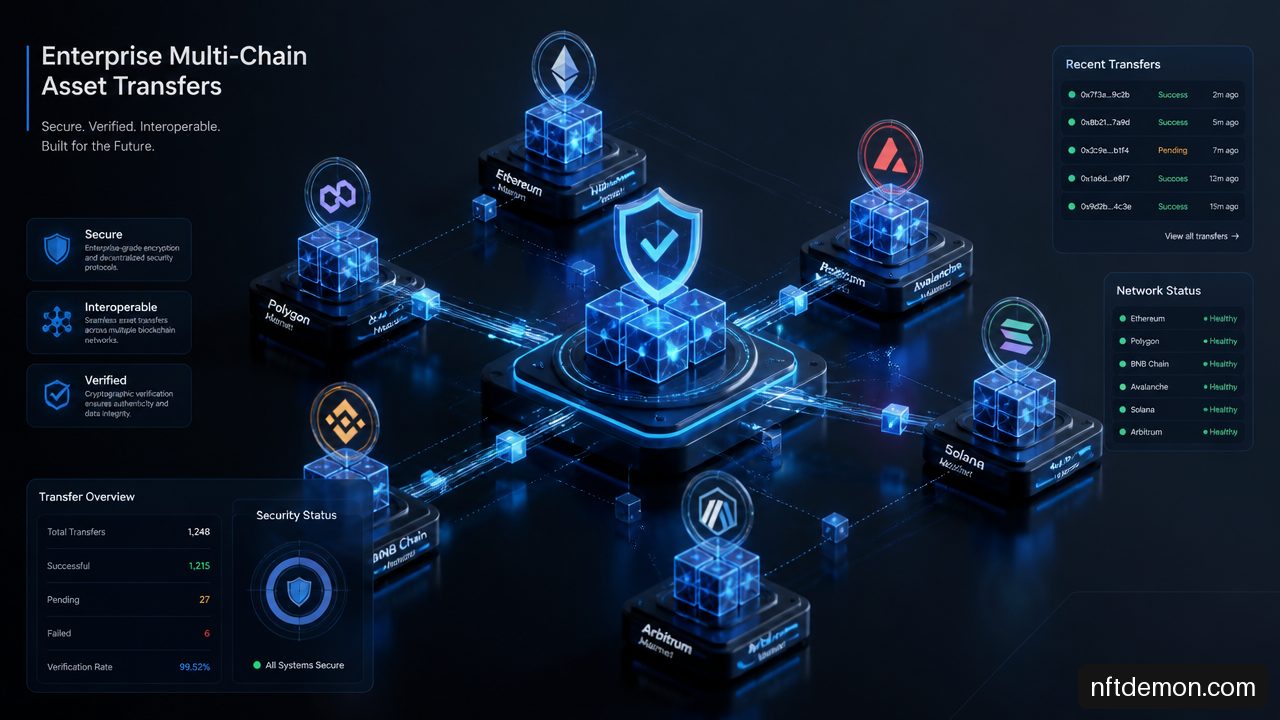
Architectural Mechanisms: Chainlink CCIP vs. LayerZero
To evaluate interoperability protocols for enterprise adoption, we must examine how messages move across networks and how cryptographic consensus is verified. Neither system functions as a traditional lock-and-mint bridge; instead, both serve as generalized message-passing standards that support arbitrary contract calls and token transfers.
Trust Models and Verification Architecture
The fundamental difference between Chainlink CCIP and LayerZero lies in their security architecture and trust assumptions. Chainlink CCIP uses an established Decentralized Oracle Network (DON) architecture combined with an independent security framework. In CCIP, cross-chain state changes are validated by a Committing DON, verified by an Execution DON, and continuously supervised by an independent Risk Management Network (RMN).
LayerZero decouples message delivery from verification. In LayerZero v2, verification is offloaded to customizable Decentralized Verifier Networks (DVNs), while execution is handled by Executors. Applications can define an arbitrary threshold of DVNs (such as requiring consensus among Google Cloud, Polygon, and an internal enterprise node) to validate a payload before the destination contract executes it.
Message Lifecycle and Execution Mechanics
When initiating a cross-chain transfer, both protocols enforce multi-stage transaction pipelines to maintain consistency:
- Source Chain Phase: The client application invokes the source router contract, locking or burning assets and emitting an event log containing the standardized payload.
- Verification Phase: For CCIP, the Committing DON writes a message root to the destination chain. The Risk Management Network independently validates the root. For LayerZero, designated DVNs read the header/payload, sign off on valid transactions, and post quorum signatures to the destination Endpoint.
- Destination Chain Phase: The payload is validated against the verified root or signature set. In CCIP, the Execution DON submits the merkle proof to execute the destination transaction. In LayerZero, an Executor submits the payload to the Endpoint contract to execute the call.
| Architectural Attribute | Chainlink CCIP | LayerZero v2 |
|---|---|---|
| Core Security Model | Integrated DONs + Independent Risk Management Network | Configurable Decentralized Verifier Networks (DVNs) |
| Flexibility / Customization | Protocol-enforced security parameters and consensus | Application-defined verifier thresholds and worker selection |
| Token Standard | Cross-Chain Token (CCT) / Programmable Token Transfers | Omnichain Fungible Token (OFT) / Omnichain Non-Fungible Token (ONFT) |
| Out-of-Band Safety | Secondary Risk Management Network can halt transactions | Custom DVN selection, including self-hosted enterprise verifiers |
| Data Payload Mechanics | Token + Arbitrary Bytes (Programmable Token Transfers) | Generalized Arbitrary Data Bytes with custom execution gas limits |
Control-Plane Architecture and Compliance Frameworks
Enterprise asset transfers cannot operate solely on public smart contract logic. Institutional deployment demands an off-chain control plane that bridges core enterprise databases, identity solutions, regulatory compliance checks, and blockchain networks.
Separating Custody, Verification, and Settlement
An enterprise architecture should maintain strict separation between key management, verification, and settlement. We recommend isolating key signers inside Hardware Security Modules (HSMs) or Multi-Party Computation (MPC) vaults, keeping them separate from transaction orchestration services. Knowing how to integrate blockchain with existing enterprise systems requires building robust middleware that acts as an adapter between internal core banking or ERP platforms and public or private cross-chain routers. (how to integrate blockchain with existing enterprise systems)
In this framework, the enterprise middleware processes transaction requests, applies business logic, performs compliance checks, and passes sanitized payloads to the vault for signing. The signed transaction is then broadcast to either CCIP or LayerZero router contracts. CCIP supports cross-chain asset and message transfers with issuer-defined controls, programmable instructions, and configurable settlement requirements.
| Core Banking/ERP |–>| Compliance Engine |–>| HSM / MPC | | Asset System | | (KYC/AML/Sanctions) | | Key Signer | +——————–+ +———————+ +——-+——–+ |
+—————————————————————-|——–+
| Sign Transaction
v
+————————————————————————-+
| BLOCKCHAIN INTEROPERABILITY LAYER |
| |
| +————————+ +—————————+ |
| | Chainlink CCIP Router | | LayerZero Endpoint v2 | |
| | (Committing / Exec DON)| | (Configured DVNs) | |
| +———–+————+ +————-+————-+ |
+—————-|————————————-|——————+
| Cross-Chain Relaying | Cross-Chain Relaying
v v
+————————————————————————-+
| DESTINATION BLOCKCHAIN |
| |
| +————————+ +—————————+ |
| | Destination Contract | | Destination Contract | |
| | Execution | | Execution | |
| +————————+ +—————————+ |
+————————————————————————-+
Automated Compliance and Policy Enforcement
Regulated entities moving tokenized securities or fiat-backed stablecoins across chains must enforce Know Your Customer (KYC), Anti-Money Laundering (AML), and sanctions screening on every operation. Smart contract architecture must validate compliance status at both ends of a cross-chain transfer.
Key Architectural Rule: Never assume that a user who is compliant on Chain A remains compliant when receiving assets on Chain B. Compliance checks must be evaluated on both source and destination chains prior to settlement.
To enforce policy controls effectively, enterprises should implement:
- Pre-Transfer Checks: Source-chain contracts query an on-chain identity registry or Automated Compliance Engine to confirm the sender’s account status, transfer limits, and geographic permissions.
- Programmable Instructions: Using CCIP Programmable Token Transfers, the source payload packs execution parameters—such as target account identity hashes and compliance proofs—directly into the transaction payload.
- Post-Transfer Verification: Destination contracts verify payload attributes against local compliance registries before releasing tokens to the recipient wallet. If verification fails, the assets are diverted to an escrow contract rather than being delivered to an unauthorized entity.
Route-Specific Decision Matrix and Governance Models
Choosing between Chainlink CCIP and LayerZero is not a binary decision. Many institutional deployment patterns leverage both protocols based on route availability, network permissioning, security models, and compliance requirements.
Selection Framework for Multi-Chain Transfers
Evaluating enterprise blockchain architecture in regulated industries requires analyzing specific transfer characteristics before selecting an interoperability protocol. Decision makers should evaluate routes using a clear framework: (enterprise blockchain architecture in regulated industries)
• Use CCIP when: High-value asset transfers require
strict, protocol-enforced security oversight; when institutional asset
issuers require built-in rate limiters; or when native cross-chain token
minting requires independent Risk Management Network monitoring.
• Use LayerZero when: High-speed, micro-payload
messaging demands ultra-low latency; when connecting bespoke or private
EVM/non-EVM routes unsupported by turnkey providers; or when full
internal control over verifier selection (such as running bespoke
enterprise DVNs) is required.
• Use a Dual-Protocol Approach when: Failover
redundancy is required for critical institutional settlement routes, or
when asset transfers are routed through CCIP while administrative state
synchronizations run via LayerZero.
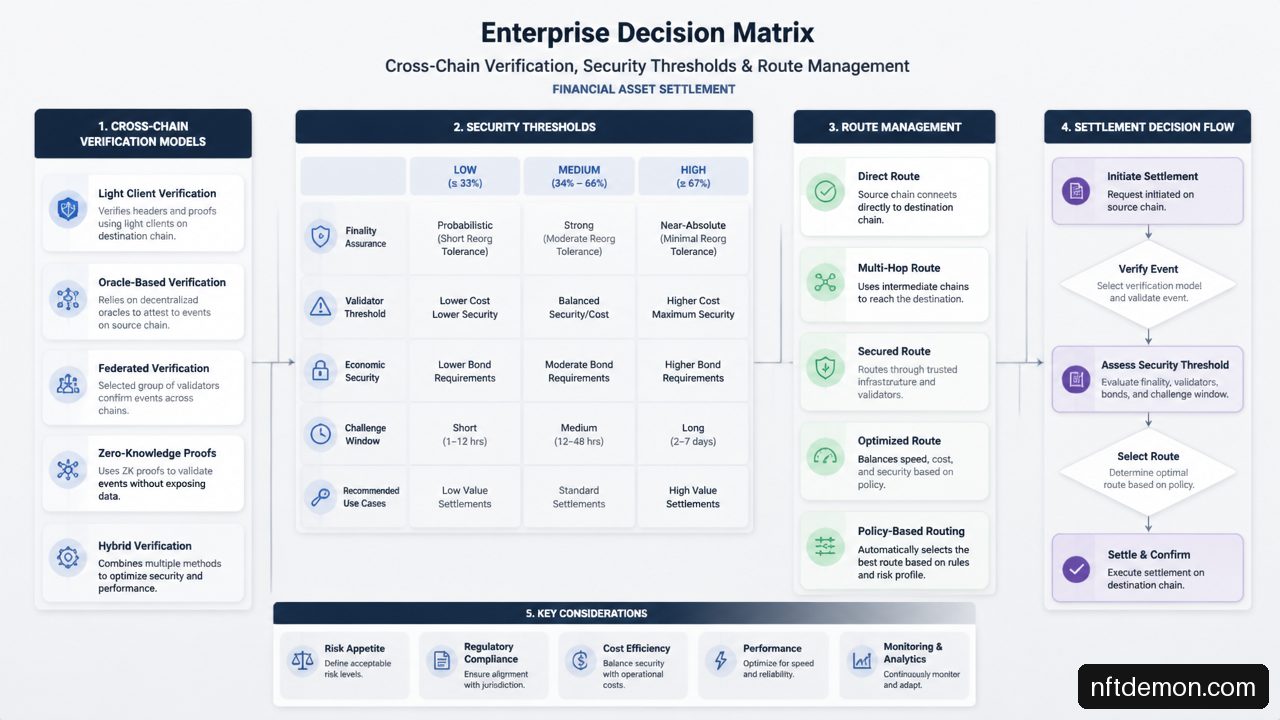
Verifier Governance and Emergency Authority
Managing cross-chain contracts requires clear policy governance. When designing governance for a multi-party enterprise blockchain network, organizations must define who holds emergency pause rights, who controls rate-limiting updates, and how verifier updates are applied. (designing governance for a multi-party enterprise blockchain network)
Under CCIP 2.0 architectures, CCIP 2.0 describes Cross-Chain Verifiers and additional cryptographic verification for institutional transfers. This allows an enterprise to combine public network security with private cryptographic signatures.
Similarly, when configuring LayerZero, LayerZero describes value-transfer infrastructure for wallets, treasuries, stablecoins, and enterprise workflows. Enterprise security teams can configure custom DVNs so that no message processes without sign-off from both external security providers and internal corporate verification nodes.
Operational Failure Modes, Finality, and Reconciliation
Cross-chain operations face dynamic network environments, including source-chain reorganizations, gas price surges, destination-chain congestion, and relayer timeouts. Enterprise architectures must treat failure handling as a core component of system design.
Handling Stuck Messages and Destination Outages
A transaction can stall for several operational reasons:
• Insufficient Destination Gas: Gas volatility can
cause the gas limit defined on the source chain to fall short on the
destination chain.
• Destination Chain Outage: The target network may
temporarily stop producing blocks or experience severe RPC
instability.
• Compliance Halt: Destination contracts may reject
execution if a recipient wallet becomes sanctioned between transfer
initiation and execution.
To handle stuck transactions, both protocols offer manual and automated execution recovery mechanisms. In CCIP, if an execution fails due to temporary gas spikes, the transaction can be re-executed manually or automatically once gas conditions normalize. In LayerZero v2, execution is decoupled from verification: once DVNs verify a message, the payload stays stored in the destination Endpoint contract until an Executor or client node submits the required gas to complete execution.
Finality Thresholds and Idempotency Runbooks
Re-org protection is critical for cross-chain transfers. Releasing unbacked destination assets after a deep source-chain reorganization can cause severe capital loss. Consequently, source-chain confirmation requirements must reflect the underlying consensus security of the network.
| Step 1: Detect Delayed Message (> T+15 Mins) | | - Monitor CCIP / LayerZero Indexer for Unexecuted Hashes | +——————————–+——————————–+ | v +—————————————————————–+ | Step 2: Validate Source Chain Finality | | - Verify Block Confirmations >= Policy Threshold | | - Check for Re-org Events on Source Chain | +——————————–+——————————–+ | v +—————————————————————–+ | Step 3: Identify Root Cause | | - Out of Gas? –> Top up Gas / Bump Gas Limit | | - Verifier Delayed? –> Check DVN / Committing DON Status | | - Recipient Blocked? –> Route to Escrow Vault | +——————————–+——————————–+ | v +—————————————————————–+ | Step 4: Execute Recovery & Update Ledger | | - Re-submit Execution Payload with Updated Parameters | | - Idempotency Check: Match Message Key to Prevent Replay | | - Write Audit Event to Enterprise ERP Database | +—————————————————————–+ |
Real-world institutional deployments highlight the effectiveness of these structured workflows. For instance, the ANZ tokenized-asset settlement scenario using CCIP-related programmable token-transfer infrastructure demonstrates how strict finality protocols and programmable delivery mechanisms enable secure cross-currency tokenized asset settlement across disparate ledgers.
Benchmarking Testing Methodologies and Cost Structures
Engineering teams must benchmark performance and cost dynamics before deploying production cross-chain architecture. Latency and fee models vary significantly depending on the protocol and the underlying networks involved.
Latency and Throughput Evaluation
Cross-chain latency is primarily driven by source-chain finality requirements, verification overhead, and destination block times:
- Source Finality Latency: Waiting for required block confirmations on the source chain (e.g., ~12-15 minutes on Ethereum Mainnet vs. a few seconds on fast L2s).
- Verification Latency: The time required for DON nodes or DVNs to read logs, sign state updates, and submit roots to the target network.
- Execution Latency: The duration required for the execution transaction to be included in a block on the destination chain.
When evaluating systems, enterprise benchmarks should measure total end-to-end latency—from initial client invocation on the source chain to receipt confirmation on the destination chain—across varying network load levels.
Fee Structures and Dynamic Congestion Management
Cross-chain fees cover three primary cost layers:
• Source Gas: The gas burned to execute lock, burn,
or message emission logic on the origin ledger.
• Protocol / Infrastructure Fees: Flat or
percentage-based fees charged by the cross-chain protocol to compensate
relayers, verifiers, and security networks.
• Destination Execution Gas: Gas paid to execute mint,
unlock, or contract delivery operations on the receiving network.
To prevent operational disruptions during gas spikes, enterprise control planes should use dynamic gas estimation algorithms, buffer gas limits, and maintain managed relayer wallets across all connected chains.
Frequently Asked Questions
What is the difference between Chainlink CCIP and LayerZero for enterprise asset transfers?
Chainlink CCIP provides an integrated defense-in-depth model utilizing Chainlink’s decentralized oracle networks alongside an independent Risk Management Network. LayerZero offers a modular framework that allows applications to select custom combinations of Decentralized Verifier Networks (DVNs) and Executors to validate cross-chain payloads.
Which protocol is safer for transferring tokenized securities or stablecoins?
Both protocols can be secured to meet institutional standards. CCIP offers protocol-enforced rate limits and independent secondary risk monitoring out of the box. LayerZero allows enterprises to achieve high security by requiring signatures from an internal enterprise-hosted DVN alongside reputable institutional verifier nodes.
Can an enterprise use CCIP and LayerZero together?
Yes. Many institutional architectures use both protocols to provide failover redundancy, expand chain coverage, or separate cross-chain value transfers (routed via CCIP) from high-frequency messaging operations (routed via LayerZero).
How does CCIP’s Risk Management Network differ from LayerZero’s DVN model?
CCIP’s Risk Management Network is a secondary, independent network that continuously monitors the primary Committing and Execution DONs for malicious or anomalous activity, automatically pausing operations if inconsistencies are detected. LayerZero’s DVN model allows applications to configure a customizable set of independent verification entities that must reach a defined quorum before a payload can execute.
How are KYC, AML, and sanctions screening enforced in cross-chain asset movements?
Compliance checks are enforced using smart contracts and off-chain middleware on both the source and destination chains. Tools like CCIP Programmable Token Transfers allow compliance data and instruction parameters to travel alongside the asset payload, enabling destination contracts to verify identity and policy requirements before releasing funds.
How should an enterprise handle stuck or failed cross-chain messages?
System architectures should include automated indexers to detect pending or unexecuted message hashes. Recovery runbooks use manual or automated re-execution tooling to update gas limits, resolve execution errors, or divert rejected funds to an escrow contract while maintaining idempotency to prevent duplicate operations.
What finality threshold should be required before releasing an enterprise asset?
Finality thresholds depend on the source chain’s consensus mechanism. For high-value enterprise transfers originating on networks like Ethereum, applications should require full block finality before releasing destination assets to eliminate risk from block reorganizations.
Sources and References
• Chainlink — Cross-Chain Interoperability Protocol (CCIP):
https://chain.link/cross-chain
• Chainlink — Introducing CCIP 2.0: The Interoperability Standard for
Institutions: https://chain.link/blog/introducing-ccip-2-0
• LayerZero — Interoperability: https://layerzero.network/interop
• Chainlink — ANZ Cross-Chain Tokenized Asset Settlement Case Study:
https://pages.chain.link/hubfs/e/anz-ccip-cross-chain-tokenized-asset-settlement-case-study.pdf
NFT Demon Holdings helps enterprises scope, evaluate, and build blockchain programs — start with a free evaluation call.
Talk through your use case
Free evaluation call — objective, constraints, and fit, before any proposal.