How to evaluate an AI vendor for enterprise deployment
By Jeremy Ryan, Founder & CEO · November 2026
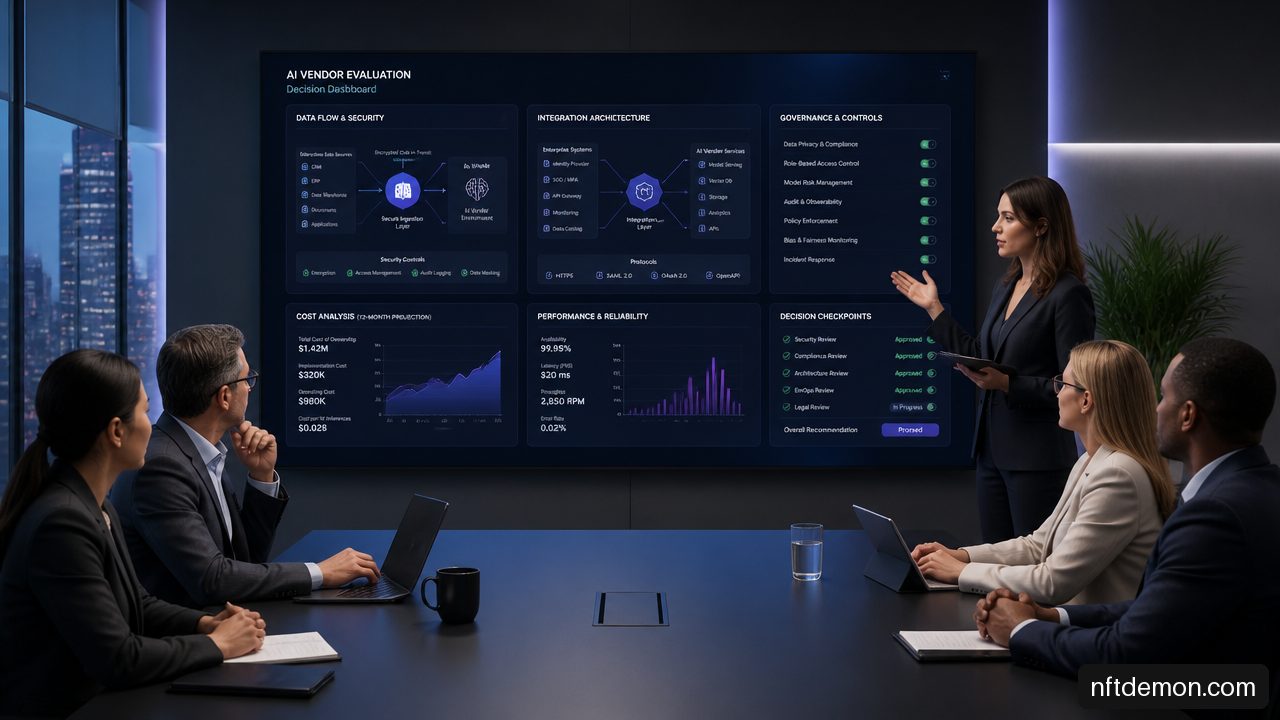
Selecting an AI platform is not simply a software procurement exercise. It is an operating model decision involving enterprise data, business workflows, employee behavior, security controls, and long term commercial commitments. When I evaluate an AI vendor for an enterprise deployment, I start by separating vendors that can deliver a convincing demonstration from vendors that can operate reliably inside a governed production environment.
• Key Takeaways
• Set Non
Negotiable Requirements Before Comparing Vendors
• Demand Evidence, Not
Capability Claims
• Evaluate
Commercial Fit, Operations, And Exit Readiness
• Frequently Asked
Questions
Key Takeaways
An enterprise should evaluate an AI vendor through a gated process rather than a simple feature comparison. A vendor that fails a critical privacy, identity, residency, or control requirement should not remain in contention because it offers a more polished interface or a lower initial price.
The practical decision framework is straightforward:
- Define the business workflow, users, inputs, approvals, expected outcomes, and failure tolerance.
- Establish non negotiable requirements before reviewing model capability or commercial pricing.
- Require evidence for material claims, including architecture diagrams, test results, contract language, audit artifacts, and comparable references.
- Run a proof of value using identical business scenarios, realistic data, production like load, and pre agreed acceptance criteria.
- Compare total cost of ownership and cost per successful business outcome, not token pricing or seat pricing alone.
- Test portability, change management, support obligations, and incident recovery before signing a long term agreement.
A useful vendor scorecard still has value. StackAI’s enterprise vendor evaluation framework separates security and privacy, governance, architecture fit, model quality, operations, scalability, cost, and ROI. I would treat that scorecard as the second stage of selection, after the organization has eliminated vendors that cannot satisfy essential controls.
The central procurement question is not “Which model is best?” It is “Which vendor can repeatedly produce an acceptable business outcome within our security, operational, and financial constraints?”
Set Non Negotiable Requirements Before Comparing Vendors
Define The Deployment Decision, Not Just The Use Case
The phrase AI use case is often too broad to drive a buying decision. “Use AI for customer support” could mean drafting internal answers, summarizing tickets, routing requests, autonomously issuing refunds, or providing regulated advice. Those are different systems with different risk profiles.
I recommend documenting the workflow in operational terms before inviting vendors into a formal evaluation:
| Decision Element | Questions To Resolve | Why It Changes Vendor Fit |
|---|---|---|
| Business trigger | What event starts the workflow? | Defines integration and latency requirements. |
| Input data | Which documents, records, messages, or databases are accessed? | Determines privacy, residency, and access control needs. |
| Output | Is the output a draft, recommendation, classification, or action? | Establishes the required human review level. |
| User group | Who can initiate, review, or approve output? | Shapes identity and role based access requirements. |
| Failure consequence | What happens if the system is wrong, unavailable, or delayed? | Determines controls, fallback processes, and SLA needs. |
| Success measure | What business outcome improves? | Creates a defensible ROI baseline. |
For example, an AI assistant that summarizes internal meeting notes may tolerate occasional omissions. An AI workflow that prepares payment instructions cannot. The second case needs stronger identity controls, approval gates, complete audit trails, and a clearly tested fallback process. A vendor’s general claim of “enterprise grade AI” does not answer those design questions.
Use Gates For Requirements That Cannot Be Traded Away
Weighted scorecards can create a dangerous illusion: a vendor may appear to win overall despite failing a requirement that should be disqualifying. A high model quality score cannot compensate for a vendor that cannot meet contractual data residency obligations. Low cost does not offset the absence of identity integration where sensitive data is involved.
Create three decision categories:
- Mandatory gates: Requirements that must be met before a vendor can proceed. Examples include approved data residency, SSO support, role based access control, an acceptable data processing agreement, and a documented incident notification process.
- Measured differentiators: Criteria used to rank qualified vendors. Examples include task accuracy, deployment speed, observability, workflow configuration, support quality, and unit economics.
- Negotiable preferences: Features that matter but should not dominate the decision. Examples include dashboard design, bundled templates, or a vendor’s preferred model provider.
This distinction prevents a common procurement failure. A business unit may strongly prefer a tool because its demo is fast and intuitive, while legal or security teams later discover that the vendor reserves broad rights to retain inputs or use data in ways the organization cannot approve. Put the gate at the entrance, not at the end of the process.
Assess Architecture And Integration At The Trust Boundary
Integration is more than asking whether the vendor has an API. The real question is how the AI system will authenticate, retrieve data, invoke tools, record actions, and enforce policy across existing enterprise infrastructure.
A reference architecture should show:
• Identities for end users, service accounts, administrators, and AI
agents.
• Data flows between source systems, retrieval components, models,
logging systems, and human reviewers.
• Trust boundaries where sensitive data enters or leaves a controlled
environment.
• Enforcement points for permissions, content filtering, prompt
injection defenses, and approval workflows.
• Monitoring paths for audit logs, security events, performance
telemetry, and incident investigation.
Ask the vendor to map its proposed architecture to your identity provider, data warehouse, CRM, content repositories, SIEM, ticketing platform, and network controls. If the answer is “we integrate with everything,” request the exact connector behavior. Does it honor source system permissions at query time? Does it cache documents? Can it restrict retrieval by user role? Can logs be exported to your systems?
The same discipline appears in other complex technology procurement. This enterprise blockchain consulting selection guide is useful because it emphasizes capability fit, implementation evidence, and ongoing operational responsibility rather than presentation quality alone.
Make Data Use And Security Verifiable
Data privacy requirements should be translated into specific questions that a vendor can answer in writing. It is not enough to accept a broad claim that customer data is protected or not used for training.
Require clear answers on:
• Where data is stored, processed, backed up, and logged.
• Whether customer inputs, outputs, metadata, embeddings, and feedback
data are retained.
• Which subprocessors may access or process data.
• Whether enterprise data can be used for training, service improvement,
abuse detection, or model evaluation.
• How deletion requests are executed and confirmed.
• How encryption, tenant isolation, privileged access, and audit logging
work in practice.
Sphere’s guidance on enterprise AI vendor review specifically recommends asking where data resides, how long it is retained, which subprocessors can access it, and how deletion is confirmed. Those questions matter because data control is often distributed across application layers, model providers, analytics platforms, support tools, and backup systems.
Demand Evidence, Not Capability Claims
Build An Evidence Register During Due Diligence
Vendor due diligence often produces a large collection of PDFs, slide decks, security questionnaires, and sales notes. That is documentation, but it is not necessarily evidence. I recommend using an evidence register that ties each material claim to a verifiable artifact and an accountable owner.
| Vendor Claim | Evidence To Request | Acceptance Test |
|---|---|---|
| Customer data is not used for training | Contract clause and data use policy | Legal confirms permitted use language. |
| Access is role based | Identity architecture and configuration demonstration | Test distinct permissions for three representative roles. |
| The platform supports enterprise scale | Load test output and capacity assumptions | Validate peak concurrency and recovery behavior. |
| The platform is portable | Export documentation and completed export exercise | Import artifacts into an agreed neutral format or replacement environment. |
| Support is production ready | SLA, escalation path, and incident runbook | Review response ownership and notification timing. |
This method changes the vendor conversation. Instead of debating whether a platform is “secure” or “scalable,” the evaluation team asks what proves the claim, who validates it, and whether the evidence applies to the proposed deployment model.
Customer references should be treated the same way. Request references with a similar industry risk level, integration complexity, user population, deployment architecture, and support model. Ask about implementation duration, unexpected costs, product changes, escalation quality, and what happened when something failed. A glowing reference from a small internal pilot may not predict success for a regulated deployment across several business units.
Run A Proof Of Value That Can Fail
A proof of concept proves that something can work. A proof of value determines whether it should be deployed. The distinction matters.
A credible proof of value uses the same scenarios for every shortlisted vendor. It should include representative inputs, normal workflows, difficult edge cases, real user roles, and acceptance thresholds agreed before testing begins. Vendors should not select only their strongest examples.

Test at least four behavior categories:
- Normal task performance: Can the system complete the intended task accurately and within the required time?
- Ambiguity and incomplete data: Does it ask for clarification, identify uncertainty, or confidently invent an answer?
- Adversarial and unsafe inputs: Can untrusted text override instructions, expose restricted data, or cause unauthorized tool use?
- Degraded operations: What happens during model unavailability, source system failure, rate limiting, slow responses, or partial retrieval failure?
Consider an AI contract review assistant. A shallow evaluation may measure whether it identifies common clauses in clean sample agreements. A production evaluation should also test scanned documents, missing appendices, contradictory language, access restricted documents, unusual jurisdictions, and a retrieval outage. The system may still be useful, but only if the workflow routes uncertainty to a qualified reviewer rather than silently producing a confident answer.
Test Workload Shape, Not Average Performance
Average response time is rarely the operational reality that matters. An AI vendor may perform well at ten simultaneous requests and fail when a service center opens, a batch process begins, or a regulatory deadline creates a spike in usage.
Specify workload shape in the proof of value:
• Expected peak concurrent users.
• Maximum acceptable latency for interactive tasks.
• Batch document volume and completion window.
• API rate limits and throttling behavior.
• Retry behavior and duplicate action prevention.
• Recovery time when a dependency fails.
• Monitoring alerts and escalation paths.
There is no universal acceptance threshold for accuracy, latency, or availability because the right threshold depends on the workflow. A marketing drafting assistant may tolerate several seconds of delay. A fraud operations queue may not. Where consensus is lacking, set a threshold based on the cost of a miss, delay, or human rework, then test it under realistic conditions.
Measure Cost Per Successful Outcome
Token and API pricing are useful inputs, but they are not business metrics. A lower cost model may generate more human review, rework, escalations, and exceptions. It can become more expensive than a higher priced service that completes the workflow reliably.
Use this practical calculation:
Cost per successful outcome = total deployment and operating cost ÷ accepted business outcomes completed without unacceptable rework
Total cost should include licensing, usage, implementation, connectors, security review, customization, model evaluation, human review, monitoring, support, training, and exit preparation. If an AI workflow drafts 10,000 responses but 35% require extensive revision, the relevant number is not cost per response. It is cost per response accepted at the required quality level.
Evaluate Commercial Fit, Operations, And Exit Readiness
Clarify Who Operates The System
Many enterprise AI projects fail in the gap between vendor responsibility and customer responsibility. The vendor may operate the platform, but who approves access? Who curates source data? Who evaluates model updates? Who monitors unsafe output? Who owns incident communications?
Create a responsibility matrix before contract signature.
| Operating Area | Vendor Responsibility | Enterprise Responsibility |
|---|---|---|
| Platform availability | Maintain service and report outages | Define business fallback procedures. |
| Identity and access | Support approved authentication methods | Approve users, roles, and periodic access reviews. |
| Data quality | Provide documented ingestion behavior | Maintain source data accuracy and permissions. |
| Model updates | Provide notice, release details, and rollback options where available | Run regression tests and approve material changes. |
| Incident response | Investigate platform events and notify per contract | Coordinate legal, security, business, and customer communications. |
| Output review | Provide workflow controls | Assign reviewers for high impact decisions. |
The vendor’s support model should align with your operating hours, geography, incident severity, and internal escalation process. A service level agreement is meaningful only if it defines measurable commitments, remedies, support response expectations, and obligations during a material security or service incident.
Treat Vendor Changes As A Production Risk
AI systems can change when a vendor updates a model, modifies safety policies, replaces an underlying provider, changes retrieval logic, or introduces a new platform release. The visible interface may stay the same while output quality, latency, cost, or behavior shifts.
Request contractual and operational clarity on:
• Advance notice for material model, policy, pricing, and
subprocessor changes.
• Version identification or version pinning where the product supports
it.
• Regression testing access before major changes.
• Rollback options when outputs materially degrade.
• Documentation of changed behavior and known limitations.
This is especially important when AI output triggers downstream actions. If a model update changes how an agent interprets a refund policy, an otherwise stable workflow can begin escalating incorrect cases or approving exceptions it previously rejected. Change control is not bureaucracy here. It is a production safety mechanism.
Make Portability An Executable Test
An exit clause is useful, but contract language alone does not prove that you can migrate. Before signing, conduct a portability test that exports assets required to operate or recreate the workflow.
The export should cover, where relevant:
• Prompts, policies, workflow definitions, and configuration
settings.
• Evaluation sets, test results, and feedback labels.
• Audit logs and operational metrics in usable formats.
• Knowledge base indexes, embeddings, and source mappings where
contractually permitted.
• Fine tuned artifacts, custom tools, and integration
specifications.
A vendor may reasonably be unable to export proprietary model weights or internal platform components. That does not automatically make the product unsuitable. It does mean the enterprise should understand what it would have to rebuild, what formats are available, what data can be extracted, and how long migration would take.
For broader procurement discipline, these questions to ask a blockchain firm offer a useful parallel: implementation support, maintenance, ownership, and operational accountability deserve scrutiny before a contract is signed. A structured blockchain consulting vendor due diligence checklist can also help executives organize evidence and ownership across technical and commercial review.
Frequently Asked Questions
What Should An Enterprise Evaluate Before Selecting An AI Vendor?
Evaluate the workflow fit, mandatory security and privacy controls, deployment architecture, integration requirements, governance features, reliability, support model, total cost of ownership, and exit readiness. Start with requirements that cannot be compromised, such as data use restrictions or identity controls, before comparing AI capabilities.
How Can We Verify That A Vendor Will Not Train On Enterprise Data?
Request explicit contract language defining permitted data use, including inputs, outputs, metadata, feedback, logs, and derived artifacts. Then verify that the vendor’s technical architecture and operational policies match the agreement. A general privacy statement is not enough when the deployment will process sensitive enterprise information.
Should Model Quality Or Integration Fit Receive More Weight?
Neither should automatically win. A highly capable model that cannot enforce source permissions or connect safely to core systems may never reach production. A well integrated platform with weak task performance creates expensive human rework. Use mandatory gates for integration and controls, then compare qualified vendors on outcome quality within the intended workflow.
What Should A Proof Of Value Measure?
Measure accepted task completion, error types, human review time, latency, reliability, security control behavior, and cost per successful outcome. Include difficult inputs, missing data, unsafe instructions, and failure scenarios. A proof of value should show what happens when the system is uncertain or degraded, not merely when it receives clean examples.
How Do We Calculate Total Cost Of Ownership For Enterprise AI?
Include subscription fees, usage charges, implementation, integration, customization, security and legal review, monitoring, model evaluations, user training, support, human review, incident handling, and migration costs. A three year estimate is often more useful than first year pricing because early discounts can hide increasing usage and operating expenses.
What Contract Terms Reduce AI Vendor Lock In?
Prioritize data ownership, permitted use restrictions, export rights, deletion verification, subprocessor notice, service level commitments, incident notification, pricing change notice, portability support, and termination assistance. Test the export process before signing when the deployment depends on proprietary workflow configuration or accumulated evaluation data.
When Should Security, Privacy, Legal, And Procurement Teams Join The Process?
Bring them in before the proof of value begins. Their early involvement allows the team to screen vendors against non negotiable requirements and prevents a business unit from investing in a pilot that cannot be approved for production. Their role is not to slow selection; it is to prevent late stage rework and unmanageable risk.
Sources And References
• sphereinc.com:
https://www.sphereinc.com/blogs/enterprise-ai-companies
• stackai.com:
https://www.stackai.com/insights/enterprise-ai-vendor-selection-12-essential-questions-every-cio-must-ask
NFT Demon Holdings helps enterprises scope, evaluate, and build blockchain programs — start with a free evaluation call.
Talk through your use case
Free evaluation call — objective, constraints, and fit, before any proposal.