How to evaluate an AI system before production deployment
By Jeremy Ryan, Founder & CEO · November 2026

Knowing how to evaluate an AI system before production deployment is less about finding one impressive benchmark score and more about proving that the complete application can operate safely, reliably, and economically under real conditions. A model may produce excellent answers in a controlled demo while the deployed system fails because retrieval returns stale records, a tool times out, a parser breaks, or an unsafe edge case reaches a customer.
For decision makers, production readiness should be treated as a release decision with evidence behind it. The question is not simply, “Is the model good?” It is, “Can this system meet its business objective within defined quality, risk, operational, and cost limits?”
- Key Takeaways
- Define Production Readiness As A Release Gate
- Build An Evaluation Corpus That Reflects Real Risk
- Test The Entire AI Application, Not Just The Model
- Make The Go Or No Go Decision
- Frequently Asked Questions
Key Takeaways
• I recommend treating AI production readiness as a multi dimensional release gate, not a single accuracy score.
• Evaluate the complete AI system: model, instructions, retrieval, data transformations, user interface, tools, APIs, retry logic, and human escalation paths.
• Segment results by task type, user group, data sensitivity, risk tier, and input type. A strong average can conceal a serious failure in a small but high impact segment.
• Separate ordinary quality regressions from launch blocking failures, such as unauthorized disclosure, dangerous tool execution, material policy violations, or severe financial errors.
• Measure operational budgets directly: p50 and p95 latency, cost per successful task, retries, timeout rate, tool errors, agent steps, and dependency reliability.
• Every meaningful change to a model, prompt, retrieval source, tool, policy, dataset, or orchestration path should trigger a proportionate re evaluation.
An AI system is ready for production only when it meets defined requirements across quality, safety, reliability, scalability, interpretability, and cost for the work it is actually expected to perform.
Define Production Readiness As A Release Gate
A production evaluation starts before testing. First define what success means, who can be harmed by failure, and which outcomes are unacceptable regardless of average performance. This prevents teams from optimizing for a convenient metric while missing the actual business decision.
Microsoft notes that application specific pre production evaluation should measure quality and safety dimensions using relevant data. That framing matters: generic benchmarks can inform model selection, but they cannot prove readiness for a specific workflow involving your documents, policies, customers, or connected systems.
Translate Business Objectives Into Testable Requirements
Start with the job the system must perform. A support assistant may need to resolve billing questions accurately while routing regulated complaints to a human. A document analysis tool may need to extract specific fields, show source evidence, and refuse to infer missing values. An AI agent that can initiate account actions requires even tighter controls because a plausible sentence is not the same thing as a correct transaction.
Write requirements in a form that can be tested:
| Requirement Area | Example Requirement | Evidence Needed Before Release |
|---|---|---|
| Task success | Correctly classify eligible service requests | Labeled task set and error analysis |
| Groundedness | Cite only approved knowledge sources | Source attribution and unsupported claim rate |
| Safety | Never expose restricted account data | Adversarial tests and access control review |
| Reliability | Complete approved requests despite transient tool errors | Failure simulation and recovery tests |
| Performance | Meet p95 response target at planned concurrency | Load and concurrency test results |
| Cost | Stay within budget per successful resolution | Token, tool, retry, and infrastructure cost analysis |
I would avoid vague goals such as “helpful,” “accurate,” or “enterprise ready” unless they are translated into observable behavior. For example, “helpful” might mean the answer addresses the stated issue, follows the approved policy, provides a next action, and does not invent unsupported facts.
Establish Blocking Criteria Before Seeing The Results
Teams often set thresholds after they have seen evaluation results. That invites rationalization. Define the release gate first.
A useful gate has three levels:
- Release blockers: failures that prevent deployment regardless of average score.
- Minimum thresholds: requirements that each important segment must meet.
- Optimization targets: desirable improvements that do not necessarily delay launch.
A release blocker may include disclosure of protected information, unsafe instructions, unauthorized tool use, bypassed approval controls, or a failure to preserve required audit records. These are not “slightly lower quality.” They are different categories of risk.
StackAI’s guidance on agent testing supports explicit release criteria covering quality, safety, reliability, latency, cost, and blocker rules. The practical implication is straightforward: a system with a 95% task success rate may still be unfit for release if the remaining 5% includes a prohibited action.
Use Failure Severity, Not Only Averages
An aggregate score can hide the wrong failure. Consider a lending workflow that performs well for ordinary applications but mishandles the rare cases involving identity discrepancies. Or consider a customer service agent that resolves most account questions but sometimes sends a cancellation request to the wrong tool endpoint.
Segment evaluations at least by:
• User role and permission level
• Request intent and task complexity
• Data sensitivity and compliance category
• Language, format, and input quality
• Tool dependency and action level
• Expected consequence of an incorrect result
There is no universal formula for weighting failures. In many cases, the right approach is a simple policy: a severe failure blocks release; a moderate failure requires mitigation; a minor quality regression is logged and prioritized. The classification should be approved by product, security, legal or compliance where relevant, and the operational owner of the workflow.
For broader deployment governance, the same discipline appears in a production deployment checklist for enterprise blockchain systems: critical controls should be verified explicitly rather than assumed from an overall system score.
Build An Evaluation Corpus That Reflects Real Risk
An evaluation dataset is not a collection of easy example prompts. It is a controlled representation of the decisions, ambiguity, data quality problems, and adversarial conditions the system will face. The corpus should make failures visible before users find them.
Start With Real Workflows And Protected Data Handling
The most valuable test cases come from actual business tasks: historical support requests, sanitized documents, approved knowledge base questions, observed workflow exceptions, and policy scenarios. Sensitive data should be de identified, minimized, access controlled, or replaced with synthetic equivalents where necessary.
A static benchmark is useful for comparing candidates, but it should not be your only evidence. Microsoft’s well architected guidance explains that complete AI applications should be tested under realistic load and external dependency failure conditions, including the use of mocked integrations and synthetic data where appropriate.
Synthetic records are especially useful when testing rare incidents. For instance, a retrieval assistant can be tested against contradictory policies, expired policy documents, corrupted PDF text, missing metadata, and intentionally misleading instructions without exposing live customer information.
Design Cases Around Decisions, Not Prompts
Each evaluation case should include enough structure to support repeatable scoring. A practical record often contains:
• A user input or event payload
• Relevant context, documents, or tool state
• Expected answer properties or expected action
• A risk tier
• A scoring method
• A known failure mode, if the case was created from an incident
For a knowledge assistant, the expected output may not be one exact sentence. Instead, score whether it answers the question, relies on supplied evidence, acknowledges uncertainty, cites or points to the right source, and avoids prohibited claims.
For an agent, expected behavior may be a state transition rather than prose. The system should call the correct tool, pass valid arguments, stop when required data is absent, and ask for approval before any high consequence action.
Use Multiple Evaluators, Then Calibrate Them
No single evaluator is enough for every dimension.
| Evaluation Method | Best Use | Main Limitation |
|---|---|---|
| Deterministic assertion | Schema validity, policy rules, tool arguments, known facts | Cannot judge nuanced helpfulness well |
| Human review | Ambiguous correctness, safety context, tone, domain judgment | Expensive and slower at scale |
| LLM based judge | Scalable rubric scoring for open ended outputs | Can inherit bias or miss subtle errors |
| Automated telemetry | Latency, retries, errors, cost, tool success | Does not establish semantic quality alone |
LLM based judges can be useful, but I would not treat them as an unquestionable authority. Calibrate them against a reviewed sample. If human reviewers and the judge repeatedly disagree on groundedness or policy compliance, refine the rubric, adjust the judge instructions, or reserve that category for human review.
The goal is not to remove human judgment. It is to apply it where it changes the release decision.
Keep The Corpus Alive After Every Failure
A production incident, customer complaint, near miss, or red team discovery should become a regression case once it is understood and safely represented. This turns organizational learning into a durable control.
For example, if a system follows malicious text embedded in a retrieved document, preserve a sanitized version of that attack in the corpus. Future changes must pass that case before release. Otherwise, the same failure can return after a harmless looking model or prompt update.
A recent research approach described in work on production traffic based performance prediction argues for using a recent, representative traffic window to estimate post deployment behavior rather than relying exclusively on static test scores. This is useful when user requests, document inventories, or product usage patterns shift faster than the evaluation suite.
Test The Entire AI Application, Not Just The Model
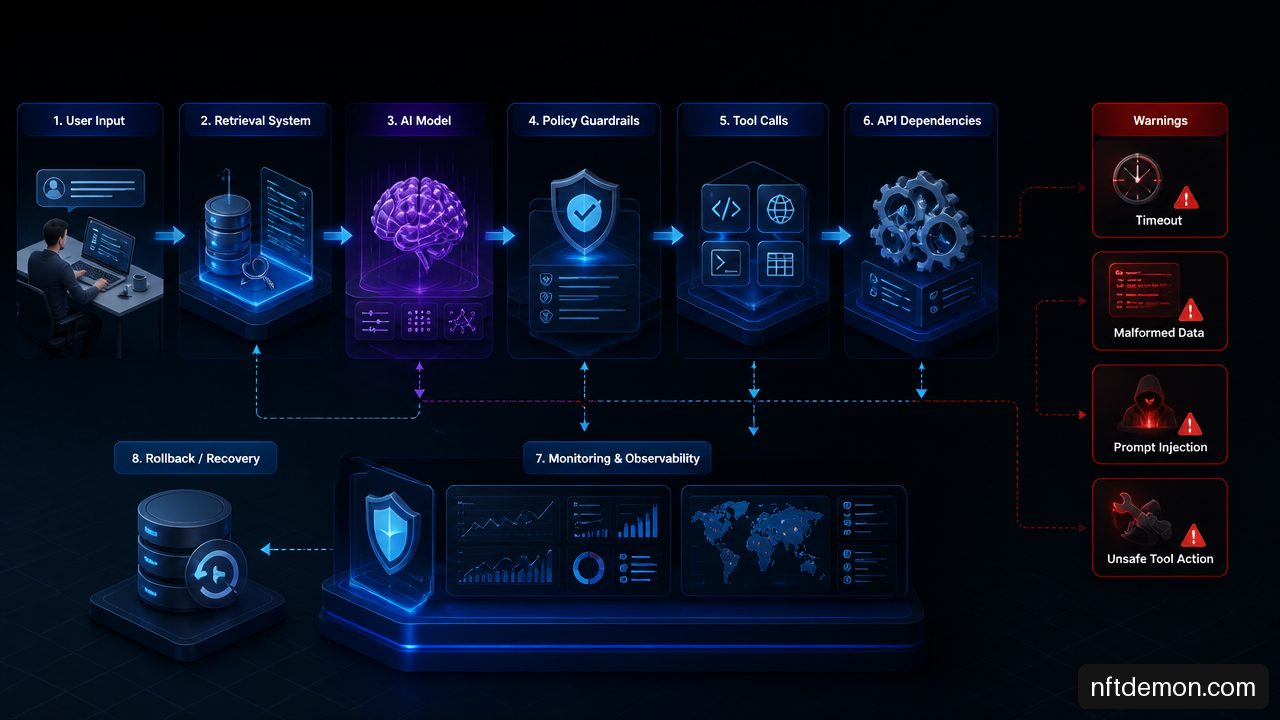
The deployed system is a chain. Model behavior is only one link. A high quality model can still fail because the retrieval layer selects irrelevant records, the prompt builder omits permissions, the parser accepts malformed output, or an external API returns incomplete data.
Test Deterministic Boundaries Like Conventional Software
AI outputs may be probabilistic, but many surrounding components are not. Test them with ordinary software engineering discipline.
Examples include:
• Prompt templates and variable substitution
• Retrieval filters and document permission checks
• Output schemas and parsers
• Validators and policy enforcement rules
• Tool wrappers and API contracts
• Retry limits, timeout handling, and fallback logic
• Audit logging and approval workflows
A tool call contract test should verify that the system sends valid arguments, rejects unapproved actions, and handles both success and failure responses correctly. If an agent receives malformed JSON from a third party service, it should not hallucinate that the requested action succeeded.
This is where many systems become brittle. The model may reason correctly, yet the orchestration layer converts its output into an invalid database update or repeats an expensive action after an ambiguous timeout.
Simulate Broken Dependencies And Partial Failure
Testing only happy paths is not production evaluation. Simulate API latency, stale retrieval indexes, expired credentials, malformed responses, rate limits, unavailable tools, partial outages, and contradictory source records.
Ask practical questions:
• Does the system tell the user when it cannot verify an answer?
• Does it retry safely, or does it create duplicate transactions?
• Does it degrade to a read only response when an action tool fails?
• Does it preserve context and audit data during recovery?
• Does it stop after a defined number of steps?
For systems connected to vendors or external infrastructure, deployment due diligence should include the same operational questions found in questions to ask a blockchain firm about deployment and maintenance. Ownership, monitoring, maintenance windows, incident response, and rollback responsibility must be clear before launch.
Measure Operational Budgets At The System Level
Average latency is not enough. A service can appear responsive on average while one in twenty requests is slow enough to cause abandonment or a downstream timeout. Measure p50 and p95 latency, throughput, concurrency behavior, error rates, and long running execution paths.
Cost also needs a better denominator than cost per request. Measure cost per successful task. An agent that resolves a request after five retries, twelve tool calls, and a long context window may look affordable until usage scales.
Track at least:
• p50 and p95 end to end latency
• Successful task rate
• Tool error and timeout rate
• Retry count and maximum execution steps
• Tool calls per completed task
• Token, model, API, and infrastructure cost per successful outcome
The operational mindset is comparable to how enterprises evaluate blockchain latency, throughput, and finality: performance measures must reflect the user’s real completion experience, not just an isolated component benchmark.
Make The Go Or No Go Decision
The final decision should be documented, reviewable, and reversible. A release meeting should not become a debate over whether a demo “felt good.” It should review the evidence against pre approved criteria.
Use A Decision Record, Not A Slide Deck
A concise release record should identify:
• Intended use, excluded use, and user population
• System version, model version, prompt version, data sources, and tools
• Evaluation corpus version and test coverage by risk tier
• Segment level quality, safety, reliability, latency, and cost results
• Open issues, mitigations, and accountable owners
• Release blockers, waiver decisions, and approval authority
• Rollback plan, monitoring plan, and escalation contacts
This document matters because AI systems change in more places than traditional applications. A prompt update can alter safety behavior. A retrieval refresh can change answer quality. A provider model update can affect formatting, latency, and tool selection.
Match The Rollout Method To Uncertainty
When residual uncertainty remains, use a limited release rather than an all at once launch. A canary release can expose the system to a controlled traffic share while enforcing tighter logging, rate limits, human review, and immediate rollback conditions.
Use a limited rollout when:
• The workflow is new or behavior is difficult to predict
• The model, prompt, or retrieval source changed materially
• Evaluation results are strong but a small high risk segment has limited test coverage
• External tools have uncertain performance characteristics
Avoid broad deployment when launch blockers remain unresolved. A canary is a risk reduction method, not permission to release a known unsafe system.
Define Re Evaluation Triggers And Rollback Signals
Re evaluation should be event driven. At minimum, trigger it when you change the model, system instructions, prompt template, retrieval source, embedding model, tool schema, agent workflow, policy, access control, or evaluation dataset.
Also define rollback conditions before release. Examples include a spike in unsupported answers, a rise in failed tool calls, breached p95 latency, unexpected cost growth, policy violating output, or a confirmed security incident.
The strongest operational loop is simple: monitor, investigate, convert the failure into a test, fix the system, and rerun the relevant gate. Production monitoring is not separate from evaluation. It is how the evaluation corpus stays connected to reality.
Frequently Asked Questions
What Does It Mean For An AI System To Be Ready For Production?
It means the complete application has met defined requirements for its intended use across task quality, safety, robustness, reliability, scalability, latency, and cost. It also has operational controls: monitoring, human escalation, incident response, version tracking, and rollback procedures. A model score alone does not establish readiness.
Which Metrics Should Be Measured Before Deployment?
Measure task success, groundedness, relevance, policy compliance, unsafe output rate, tool success, timeout rate, retry rate, p50 and p95 latency, throughput, concurrency behavior, and cost per successful task. The exact mix depends on the use case. A writing assistant may prioritize quality and safety, while an action taking agent must prioritize tool reliability and authorization controls.
How Large Should A Pre Production Evaluation Dataset Be?
There is no credible universal number. The corpus must be large enough to cover important workflow segments and serious failure modes with meaningful repetition. A low volume, high consequence workflow may need fewer cases but much deeper review. For example, a system approving financial actions may require exhaustive scenario coverage around authorization even if it handles only a limited number of request types.
How Should Hallucinations And Unsupported Answers Be Evaluated?
Define groundedness rules before testing. For retrieval augmented systems, verify whether claims are supported by approved source material, whether citations point to the right evidence, and whether the system admits uncertainty when evidence is absent. Penalize confident unsupported claims more severely than a clear abstention when the task requires verifiable information.
When Should Human Review Be Used Instead Of Automated Graders?
Use human reviewers when correctness depends on nuanced business context, legal interpretation, safety implications, brand judgment, or ambiguous evidence. Automated and LLM based graders are better suited to scalable screening, structured rubrics, and regression detection. Human review should also calibrate automated evaluators before their scores influence release decisions.
How Do You Test Prompt Injection And Tool Misuse?
Use adversarial cases that attempt to override instructions, extract restricted data, manipulate retrieval content, trigger unauthorized tool calls, or cause the agent to ignore approval requirements. Test both direct attacks in user input and indirect attacks embedded in documents, web content, tool responses, and retrieved records. A safe system should preserve instruction hierarchy, enforce permissions outside the model, and fail closed for high consequence actions.
What Changes Should Trigger A Full Re Evaluation?
A full or targeted re evaluation should follow changes to models, prompts, retrieval sources, embeddings, tools, agent logic, policy controls, permissions, output schemas, or critical datasets. The scope should match the change. A copy edit may need focused regression tests; a new model provider or action tool usually warrants a broader release gate.
Sources And References
• Microsoft Azure — Observability in Generative AI: https://learn.microsoft.com/en-us/azure/foundry/concepts/observability
• Microsoft Azure Well-Architected Framework — Test and Evaluate AI Workloads on Azure: https://learn.microsoft.com/en-us/azure/well-architected/ai/test
• arXiv — Towards Automating the AI Operations Lifecycle: https://arxiv.org/html/2003.12808
• StackAI — How to Evaluate and Test AI Agents Before Deploying to Production: https://www.stackai.com/insights/how-to-evaluate-and-test-ai-agents-before-deploying-to-production
NFT Demon Holdings helps enterprises scope, evaluate, and build blockchain programs — start with a free evaluation call.
Talk through your use case
Free evaluation call — objective, constraints, and fit, before any proposal.