How to estimate the return on investment of a custom AI system
By Jeremy Ryan, Founder & CEO · November 2026

Knowing how to estimate the return on investment of a custom AI system starts with a simple principle: measure the business change, not the novelty of the technology. A model that processes thousands of requests has little financial value if it creates review work, is rarely adopted, or cannot be integrated into the workflow that produces revenue.
For decision makers, the goal is not to produce an optimistic ROI percentage for a board presentation. It is to build a financial model that can survive real invoices, changing volumes, imperfect model outputs, and the operational friction of deployment. I recommend treating the estimate as a decision tool: it should show whether to proceed, pilot, redesign, buy an existing product, or walk away.
• Calculate Lifecycle Costs And Benefits
• Model Quality, Adoption, And Break Even
• Validate The Forecast With A Controlled Pilot
• FAQ
Define The Economic Case
Start With One Decision And One Measurable Outcome
A custom AI system is software built or materially adapted around an organization’s data, workflows, permissions, controls, and integrations. That distinction matters. Unlike a simple software subscription, a custom system often carries meaningful data engineering, security, change management, and maintenance obligations.
The first question is not, “Where can we use AI?” It is, “Which business decision or workflow has enough volume, cost, risk, or revenue potential to justify a custom system?” A credible business case identifies one primary economic outcome, then treats secondary benefits separately.
For example, a document processing system might aim to reduce the cost per completed case. A customer service assistant might aim to increase resolution capacity without increasing staffing. A sales intelligence system might aim to improve qualified conversion rates. These are different economic mechanisms and should not be blended into one vague productivity claim.
A useful starting structure is:
| Component | Question To Answer | Example Metric |
|---|---|---|
| Business objective | What must improve? | Reduce claims processing cost |
| Eligible workload | How much work could use the system? | 120,000 claims per year |
| Baseline | What happens without AI? | 14 minutes and 6% escalation rate |
| AI intervention | What work changes? | Classification, extraction, and routing |
| Financial mechanism | How does improvement become value? | Avoided contractor spend and faster settlement |
| Decision threshold | What makes the investment viable? | Payback within 24 months |
This framework also makes AI projects easier to compare with other capital allocations. The logic is similar to how executives measure blockchain ROI: define the current cost or revenue constraint, specify the intervention, and quantify the incremental outcome.
Build A Baseline Before Forecasting Benefits
Without a baseline, an ROI model is usually a collection of assumptions. Measure the current process over a representative period, ideally long enough to capture ordinary demand variation, exceptions, and seasonal behavior. Three months may be sufficient for stable workflows; businesses with seasonal volume may need a longer period.
Novemind’s AI ROI measurement framework identifies useful baseline fields that include task time, error rate, escalation rate, throughput, customer outcomes, compliance exceptions, and audit findings. Those fields are valuable because AI frequently shifts cost rather than simply removing it.
Consider an intake team that handles 10,000 submissions a month. If the average case takes eight minutes, it is tempting to multiply all minutes by an hourly wage and call that the savings opportunity. That misses reality. Some cases may require senior review, some may be rejected, and some may lead to expensive downstream corrections. Measure the complete process, including exception handling.
Separate Cash Savings From Capacity Release
This is where many AI business cases fail. Time saved is not automatically money saved.
Cash savings occur when spending actually falls or a planned expense is avoided. Examples include reducing temporary staffing, eliminating outsourced processing fees, avoiding a planned hire, or retiring a redundant software service.
Capacity value occurs when employees use freed time to process more profitable work, reduce backlog, improve service levels, or complete higher value tasks. Capacity can be economically meaningful, but it needs a concrete conversion plan.
A system that saves 3,000 hours but does not reduce spending, increase output, or improve a measurable business result has created operational flexibility, not necessarily realized financial ROI.
For example, a compliance team may save 1,500 annual hours through AI assisted evidence collection. If no roles, contractors, backlog penalties, or additional compliance work change, assigning the full loaded labor rate as savings would overstate the result. A more defensible model might value only the portion used to avoid a planned contractor engagement or reduce costly late filings.
This distinction should appear in the business case from day one. The same discipline applies when building a broader investment proposal, including how to build an enterprise blockchain business case, where technical capability must be tied to a financial mechanism.
Calculate Lifecycle Costs And Benefits
Use Total Cost Of Ownership, Not Build Cost Alone
The basic formula is straightforward:
ROI = (Total financial benefits minus total investment) divided by total investment × 100
The difficult work is defining both sides honestly. For a custom AI system, total investment should be the full total cost of ownership, not just the development contract or model usage bill.
| Cost Category | What To Include | Common Omission |
|---|---|---|
| Discovery and design | Process mapping, requirements, architecture, evaluation design | Underestimating stakeholder time |
| Data preparation | Cleaning, labeling, rights review, storage, pipelines | Assuming existing data is usable |
| Development | Application engineering, model configuration, testing | Treating prototype code as production ready |
| Integration and security | Identity, permissions, APIs, audit logs, error handling | Ignoring enterprise controls |
| Deployment | Infrastructure, model inference, observability, release work | Counting only API fees |
| Change management | Training, workflow redesign, documentation, support | Assuming staff will adopt automatically |
| Operations | Human review, monitoring, incident response, retraining | Omitting recurring labor |
| Retirement | Migration, archival, vendor exit, decommissioning | Assuming the system runs forever |
A custom system may have lower unit costs at scale than a general purpose product, but only if there is enough sustained workload to absorb its fixed costs. I recommend modeling at least a first year and a three year view. The first year tests liquidity and execution risk. The three year view shows whether recurring maintenance, infrastructure, and review costs erode the apparent return.
For investment decisions spanning multiple years, Microsoft Learn’s ROI criteria for AI powered business solutions notes that decision makers can use payback period, net present value, cost benefit ratio, and annualized ROI. No single metric is enough.
Quantify Benefits Through Unit Economics
The strongest benefit estimates are built from operational units, not broad claims such as “improved efficiency.” Start with the unit that creates or consumes value: a claim, support ticket, report, invoice, lead, transaction, or document.
For each unit, calculate the baseline cost and the expected post deployment cost:
Measure baseline labor, vendor fees, rework, and error costs per completed unit.
Estimate AI processing cost, including model use, infrastructure, and human review.
Calculate the expected reduction in time, errors, or external spend.
Multiply the quality adjusted gain by the number of eligible units actually routed through the system.
Add revenue only when the causal connection is reasonably measurable.
A revenue model needs particular restraint. If an AI recommendation engine is expected to improve conversion, use a conservative estimate based on incremental conversion, average contribution margin, eligible volume, and actual adoption. Do not count gross revenue as benefit when fulfillment, discounts, returns, and sales commissions consume much of it. Contribution margin is usually the more useful measure.
A Worked ROI Example
Assume a company considers a custom AI intake system for 96,000 annual cases. The current workflow costs $9.00 per case, including labor and rework. The AI assisted workflow costs $4.50 per case after model use and human review. The system is expected to handle 70% of eligible volume in year one because rollout and user adoption will be gradual.
| Year One Item | Calculation | Amount |
|---|---|---|
| Eligible cases routed to AI | 96,000 × 70% | 67,200 cases |
| Baseline cost avoided | 67,200 × $9.00 | $604,800 |
| New operating cost | 67,200 × $4.50 | $302,400 |
| Gross operating benefit | $604,800 minus $302,400 | $302,400 |
| One time build and integration | Fixed | $220,000 |
| Year one monitoring and training | Fixed | $45,000 |
| Net year one benefit | $302,400 minus $265,000 | $37,400 |
| Year one ROI | $37,400 divided by $265,000 | 14.1% |
This result is useful precisely because it is not spectacular. It shows that the project may work, but its success depends on sustaining adoption, controlling review effort, and preserving quality. If the system reaches 90% adoption in year two with limited incremental fixed cost, the economics could improve significantly. If adoption stalls at 40%, the project may not recover its investment.
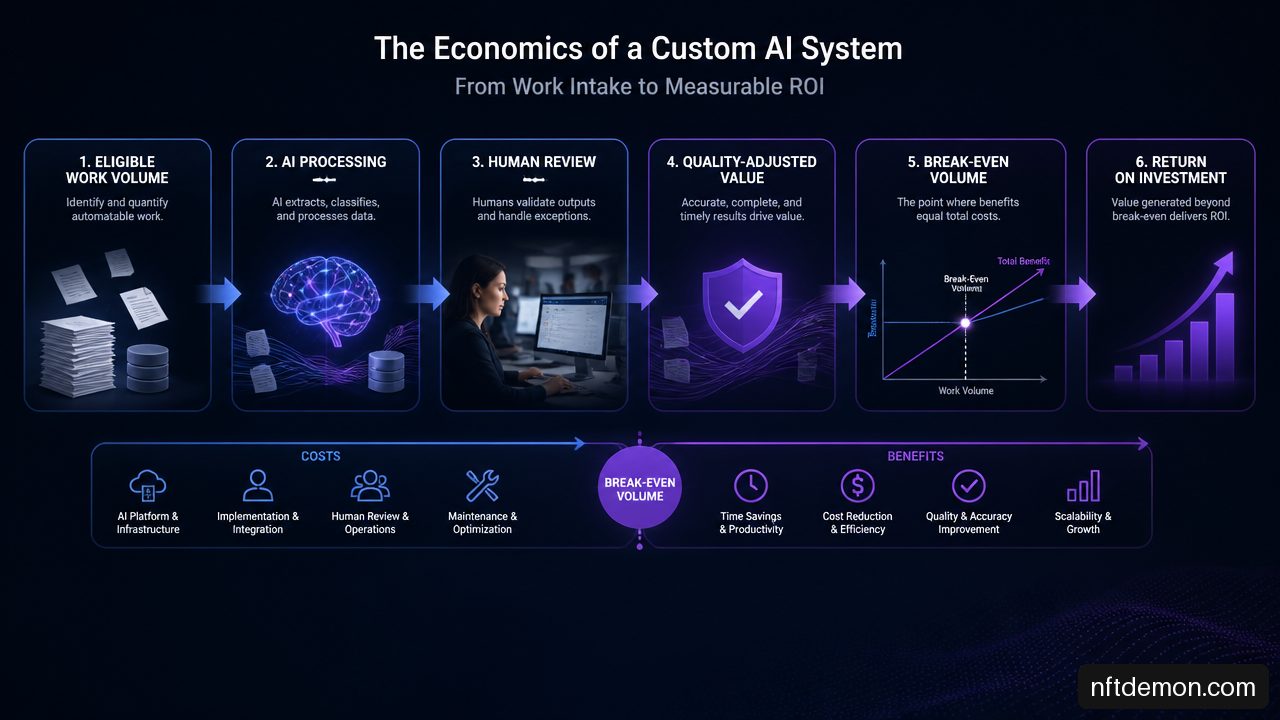
Model Quality, Adoption, And Break Even
Calculate Quality Adjusted Benefit
Gross automation volume is not the same as economic value. A model may complete 80% of cases automatically but still create enough false positives, missed exceptions, or rework to make the system uneconomical.
A practical quality adjusted benefit model includes four deductions:
• Human review time for uncertain or high risk outputs
• Rework time for incorrect outputs
• Cost of false positives, where an incorrect approval or action creates harm
• Cost of false negatives, where the system misses a valid opportunity, risk, or case
Suppose an AI system reduces processing time by six minutes per case but sends 25% of cases to review. If review takes nine minutes, the net time gain is much smaller than a model that counts only fully automated cases. In regulated, financial, healthcare, or security sensitive workflows, a single material error can outweigh many small labor savings. Use scenario based downside costs when precise probabilities are not yet known.
Treat Adoption As A Financial Variable
A technically capable system can still have negative ROI if employees route only a small share of eligible work through it. Adoption is affected by workflow fit, trust, training, incentives, integration speed, and whether users must duplicate work across systems.
Model adoption as a rate, not as a binary assumption:
Realized benefit = eligible volume × adoption rate × quality adjusted benefit per unit
Launchpad Lab’s guidance on AI ROI scenarios recommends varying uncertain assumptions such as time saved per item and the number of people who actually use the system. That is sound practice because adoption uncertainty can matter more than a small difference in model cost.
Build at least three cases:
| Scenario | Adoption | Quality And Review Assumption | Decision Use |
|---|---|---|---|
| Conservative | Slow uptake | Higher review and rework | Downside protection |
| Expected | Planned rollout | Validated pilot performance | Operating plan |
| Upside | Broad uptake | Improved workflow maturity | Strategic potential |
Avoid using the upside scenario to justify the initial spend. Approve the project only if the expected case meets the organization’s threshold and the conservative case is survivable.
Find Break Even Volume And Accuracy
Break even analysis answers a blunt but valuable question: is there enough work for a custom build to make economic sense?
A simplified annual break even volume is:
Break even volume = annual fixed cost divided by net value per AI processed case
If annual fixed costs are $180,000 and each quality adjusted AI processed case produces $3.00 of net value, the system needs 60,000 processed cases per year to break even. If expected routed volume is 35,000 cases, a custom build may be premature. An off the shelf tool, process redesign, outsourcing alternative, or no investment may be financially stronger.
You can apply the same logic to quality. If every additional percentage point of error adds $30,000 in annual review and remediation expense, the acceptable error rate is not a technical preference. It is a financial boundary. Define it before development, then use it as a go or no go condition.
Validate The Forecast With A Controlled Pilot
Design The Pilot Around A Counterfactual
A pilot should prove that the AI system changed an outcome that would otherwise have remained different. That alternative outcome is the counterfactual.
Where practical, use one of these designs:
A matched comparison, where similar work is handled with and without AI during the same period.
A staggered rollout, where comparable teams adopt the system at different times.
A before and after analysis adjusted for volume, mix, staffing, and seasonal changes.
The first option is generally strongest when workflow and risk allow it. A simple before and after comparison can mislead if a policy change, staffing shift, or demand spike occurs at the same time as the AI deployment.
Track the pilot using both economic and operational indicators. Revenue, cost per completed case, and backlog show financial consequences. Review rate, override rate, latency, escalation rate, and error severity explain why the economics moved.
Set Stop Conditions Before Spending More
A pilot is not successful because the model demo works. It is successful when it crosses the thresholds defined in the business case. Set those conditions before rollout to reduce the temptation to reinterpret weak results.
Possible decision rules include:
• Adoption reaches at least 60% of eligible cases by the agreed pilot milestone.
• Quality meets the minimum accuracy or review threshold for the workflow’s risk level.
• Cost per completed case falls below the baseline after including human review.
• No unacceptable privacy, security, compliance, or customer harm is observed.
• Forecast payback remains inside the approved investment window.
If performance misses one threshold, diagnose the mechanism before deciding to scale. Low adoption may require user interface changes, training, or deeper integration. High review rates may require narrower task scope, better retrieval, improved data quality, or a rule based safety layer. High inference cost may require batching, routing simpler cases to smaller models, or revisiting the architecture.
Update The Business Case With Actual Data
The forecast should become a living operating model after launch. Compare actual invoices, labor hours, model usage, review time, output quality, and routed volume against the original assumptions each month. This prevents a project from retaining its original ROI story after operating conditions have changed.
The cost structure can also be adapted from a blockchain business case template for cost savings: document baseline spend, intervention costs, realized savings, variance, owner, and next action. The technology differs, but disciplined financial governance does not.
Key Takeaways
• Estimate ROI from a specific business outcome, not from a general claim of AI productivity.
• Build the denominator from full lifecycle total cost of ownership, including data, integration, security, human review, monitoring, retraining, and retirement.
• Count employee time saved as cash savings only when it reduces expenditure or produces measurable additional value.
• Use quality adjusted benefits so review, rework, false positives, and false negatives do not disappear from the model.
• Treat adoption rate, eligible volume, and model quality as explicit variables in conservative, expected, and upside scenarios.
• Calculate break even volume before approving a custom build. Low volume can make a capable system economically irrational.
• Validate claims through a pilot with a credible counterfactual, predefined success thresholds, and monthly forecast updates.
FAQ
What Is The Correct ROI Formula For A Custom AI System?
Use ROI = (financial benefits minus total investment) divided by total investment × 100. Total investment should include lifecycle costs, not only software development. For multi year decisions, pair ROI with payback period and net present value because timing matters.
Which Costs Belong In Total Cost Of Ownership?
Include discovery, design, data preparation, development, integration, security, infrastructure, model usage, testing, training, change management, human review, monitoring, retraining, support, and eventual decommissioning. If a cost is necessary for safe, sustained operation, it belongs in the model.
How Do I Estimate The Value Of Employee Time Saved?
First determine whether released time becomes avoided payroll, avoided hiring, lower contractor spend, increased throughput, backlog reduction, or higher value work. Count full labor savings only when the organization can actually capture them. Otherwise, report capacity release separately.
How Do Model Accuracy And Human Review Affect ROI?
They change the net value per case. Lower accuracy can increase review, rework, escalation, remediation, and customer harm costs. Include the time and cost of reviewed cases, not merely the cases completed without intervention.
What Adoption Rate Should I Use In An AI ROI Forecast?
Use a range rather than one assumed rate. Base the expected case on pilot behavior and rollout constraints. A conservative scenario should reflect slower training, incomplete integration, user resistance, or workflows that remain ineligible for automation.
How Can A Pilot Prove That AI Caused The Improvement?
Use a comparison group, staggered rollout, or carefully adjusted before and after analysis. Measure similar work under comparable conditions. The objective is to distinguish the AI system’s effect from unrelated changes in staffing, policy, demand, or process design.
How Do I Compare A Custom Build With An Off The Shelf AI Product?
Compare both options against the same baseline and economic outcome. Include implementation time, integration depth, data controls, recurring fees, customization limits, switching cost, quality, and volume capacity. A custom build should win because its incremental value exceeds the next best alternative, not because custom development is inherently superior.
Sources/References
• launchpadlab.com: https://launchpadlab.com/blog/ai-roi/
• learn.microsoft.com: http://www.learn.microsoft.com/en-us/training/modules/evaluate-costs-benefits-ai-powered-business-solution/2-roi-criteria-ai-powered-business-solution-including-total-cost-ownership
• novemind.com: https://novemind.com/ai/ai-project-roi-measurement-framework
NFT Demon Holdings helps enterprises scope, evaluate, and build blockchain programs — start with a free evaluation call.
Talk through your use case
Free evaluation call — objective, constraints, and fit, before any proposal.