Enterprise readiness for CBDCs, a practical decision framework
By Jeremy Ryan, Founder & CEO · October 2026
Enterprise readiness for CBDCs is not primarily a question of whether an organization can connect to a new payment rail. It is a question of whether finance, compliance, operations, technology, and governance can process central bank digital currency transactions reliably at production scale. For most enterprises, the hard part is not the digital currency itself. It is managing the controls, records, liquidity, exceptions, and external dependencies around it.

- Define CBDC Readiness Before Funding Integration
- Map The Systems And Interoperability Requirements
- Build Controls, Governance, And A Measurable Pilot
- Key Takeaways
- Frequently Asked Questions
- Sources And References
Define CBDC Readiness Before Funding Integration
CBDCs are digital forms of money issued or authorized by a central bank. For enterprises, their relevance depends on the CBDC model. A retail CBDC may affect merchant acceptance, customer payments, wallets, refunds, and point of sale workflows. A wholesale CBDC is more likely to affect banks, payment service providers, financial market infrastructures, treasury teams, and institutional settlement processes.
The practical question is not, “Will CBDCs replace every current payment method?” There is no reliable basis for assuming that outcome. The more useful question is: which specific payment, settlement, or treasury problem could a CBDC solve better than existing rails in a particular jurisdiction?
Treat Readiness As A Business Capability
I recommend treating enterprise readiness for CBDCs as a six part capability assessment rather than a technology procurement exercise. A company may have capable APIs and still be unready because its reconciliation process cannot distinguish a settled CBDC payment from an authorization, reversal, or failed transfer.
| Readiness Area | Evidence To Review | Common Decision Risk |
|---|---|---|
| Commercial case | Payment volumes, settlement pain points, customer demand, partner availability | Funding an experiment with no defined business value |
| Technology | API capacity, wallet approach, identity integration, ERP interfaces, resilience testing | Assuming an existing payment gateway handles CBDC status events |
| Operations | Reconciliation, refund workflows, exception queues, service support | Leaving manual teams to resolve unfamiliar transaction states |
| Compliance | KYC, AML, sanctions screening, retention, privacy controls | Treating a CBDC transfer as exempt from established financial-crime duties |
| Treasury and accounting | Liquidity position, cash forecasting, accounting entries, audit trail | Misstating cash positions or creating unresolved ledger differences |
| Governance | Ownership, escalation rights, vendor oversight, legal signoff | Allowing a pilot to become a production dependency without accountable owners |
A readiness scorecard should require evidence, not self reported confidence. For example, a “ready” reconciliation rating should mean the organization can ingest payment messages, assign a unique transaction identifier, match the transaction to an invoice or obligation, capture finality status, and route exceptions to a named team within an agreed service level.
Separate Retail, Wholesale, And Cross Border Decisions
Retail, wholesale, and cross border CBDC opportunities have different readiness thresholds. Combining them into one program usually creates vague requirements and unhelpful architecture debates.
| CBDC Context | Likely Enterprise Use | Primary Readiness Test | When To Avoid Early Adoption |
|---|---|---|---|
| Retail domestic CBDC | Merchant payments, disbursements, customer refunds | Can current POS, checkout, wallet, and customer service processes support it? | When customer access or domestic payment acceptance remains uncertain |
| Wholesale CBDC | Interbank settlement, securities delivery, institutional treasury | Can the organization manage finality, liquidity, collateral, and operational windows? | When the institution lacks direct or sponsored access to the relevant ecosystem |
| Cross border CBDC | Trade settlement, foreign exchange, multinational treasury | Can identity, sanctions, FX, and legal processes work across jurisdictions? | When there is no credible interoperability arrangement or operating agreement |
The Bank for International Settlements notes that CBDC deployment depends on bank and payment service provider participation while scalability, performance, coexistence with conventional infrastructure, cybersecurity, resilience, and legal arrangements remain unresolved implementation areas in many contexts. Those constraints are detailed in its Lessons Learnt on CBDCs. For decision makers, that means external ecosystem readiness is as material as internal readiness.
Establish A Funding Gate
A CBDC initiative should not receive integration funding merely because a central bank, commercial bank, or vendor has announced a pilot. Before approving architecture work, ask for four artifacts:
- A defined use case with a measurable baseline, such as settlement time, exception volume, cost of reconciliation, or failed payment rate.
- A counterpart map showing which banks, PSPs, processors, wallet providers, merchants, regulators, or custodians must participate.
- A control map identifying identity, sanctions, transaction monitoring, access management, audit, and incident response responsibilities.
- A production decision rule specifying what pilot evidence would justify expansion and what result would stop the program.
This avoids a common failure mode: a technically successful proof of concept that cannot be reconciled, governed, or commercially sponsored after the demonstration ends.
Map The Systems And Interoperability Requirements
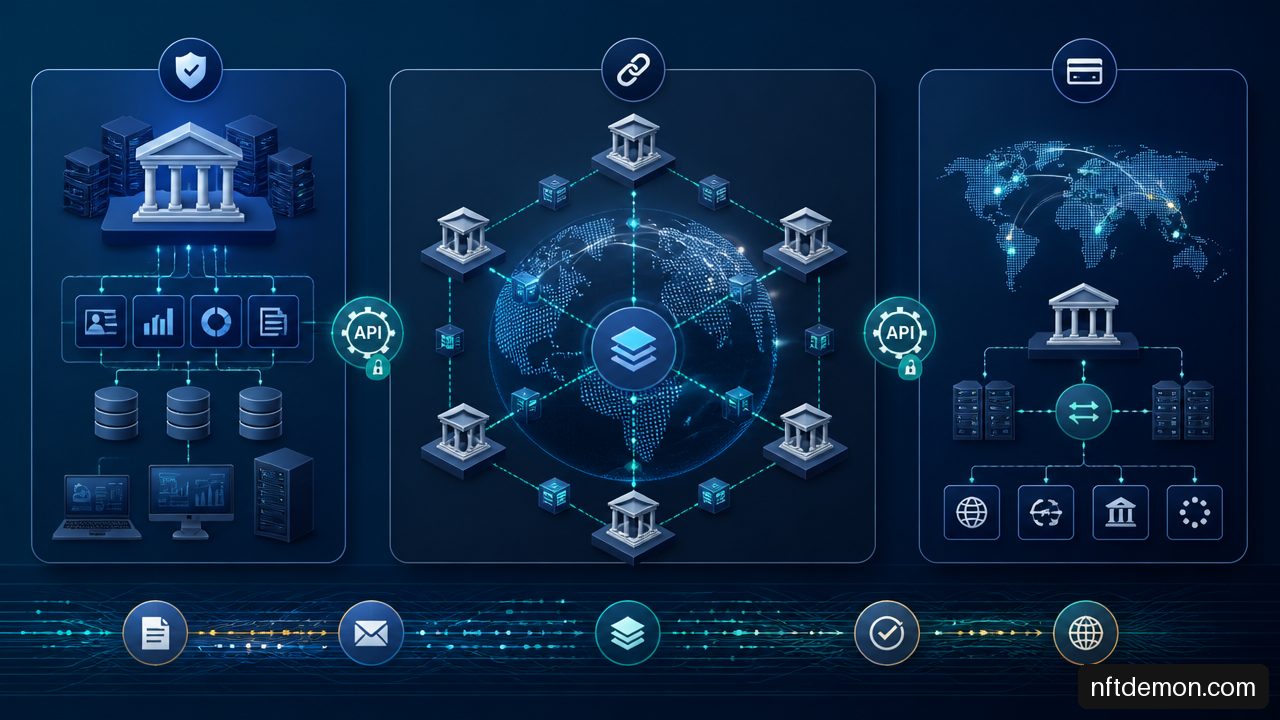
CBDC integration is usually an orchestration problem. The enterprise does not simply “hold CBDC.” It needs systems to request, receive, validate, record, reconcile, report, and sometimes reverse or investigate transactions. These steps may cross conventional payment rails, middleware, wallet services, ERP platforms, core banking systems, and third party identity services.
Build A System By System Integration Inventory
Start with the transaction lifecycle, not the ledger choice. A retail merchant flow may begin at checkout, move through a PSP or wallet, receive a transaction confirmation, update an order, generate a receipt, post to the general ledger, and later process a refund. A wholesale flow may involve participant eligibility, liquidity reservation, payment instruction, settlement finality, reporting, and intraday treasury updates.
The following inventory exposes where integration work typically appears:
| Enterprise System | CBDC Capability To Assess | Evidence Of Readiness |
|---|---|---|
| ERP and general ledger | New payment codes, settlement timestamps, journal rules, audit extracts | Test postings reconcile to bank or wallet records without manual rekeying |
| Treasury management | Cash visibility, intraday liquidity, funding triggers, counterparty limits | CBDC balances appear in cash forecasts and liquidity reports |
| Core banking or payment hub | Message routing, payment status, limits, exception handling | End to end messages survive retries, duplicates, and delayed confirmations |
| Wallet or custody service | Key management, entitlement controls, recovery procedures, transfer approvals | Access roles and recovery actions are documented and tested |
| POS and ecommerce stack | Payment selection, QR or wallet interaction, refunds, receipts | Existing merchant workflows can accept the new method without replacing every terminal |
| KYC and AML systems | Identity verification, sanctions screening, monitoring, reporting | Alerts and investigations include CBDC transactions and counterparties |
| Data platform | Reporting, retention, privacy controls, analytics | Transaction data has a defined owner, retention schedule, and access policy |
This is closely related to the discipline required when integrating blockchain with existing enterprise systems. The important distinction is that CBDCs introduce central bank, regulated intermediary, and public policy constraints that may not apply to a private enterprise blockchain deployment.
Test Coexistence Rather Than Assuming Replacement
A CBDC platform may use distributed ledger technology, conventional databases, or a hybrid design. Enterprises should not assume that their existing systems must become blockchain native. The more practical requirement is coexistence: can the enterprise handle different message formats, transaction states, settlement models, and support procedures without breaking established payment operations?
Consider a manufacturer paying suppliers through a CBDC enabled channel while retaining bank transfers for other markets. If its treasury dashboard treats both as “cash paid” before final settlement is confirmed, the company may overstate available liquidity. The remedy is not necessarily a new treasury platform. It may be a status normalization layer that distinguishes initiated, accepted, pending, settled, rejected, and reversed events.
Fair warning: performance tests should include degraded conditions. A successful transfer in a controlled environment is weak evidence if the system has not been tested against duplicate messages, connectivity loss, wallet unavailability, delayed compliance responses, and an unavailable external participant.
Make Interoperability A Strategic Choice
Interoperability is often described as one requirement. In practice, it has distinct models with different commercial and technical implications. The International Telecommunication Union identifies compatibility, interlinking, and a single shared system as core approaches in its CBDC Reference Architecture Report. The same report describes Project Helvetia as an example of wholesale CBDC integration with existing core banking systems and processes.
| Interoperability Model | What It Means | Enterprise Implication |
|---|---|---|
| Compatibility | Separate systems use common standards and comparable rules | Often lowers integration friction, but does not guarantee shared settlement or legal treatment |
| Interlinking | Separate systems connect through technical, legal, and operational arrangements | Useful for cross border flows, but dependency management becomes more complex |
| Single shared system | Participants operate on a common platform | Can simplify shared processes, but may increase concentration, governance, and migration concerns |
For cross border use, compatibility may be enough when the need is standardized reporting or messaging. Interlinking is more relevant when value, foreign exchange, identity, and compliance decisions must travel between distinct systems. A single shared platform may be attractive for tightly coordinated institutional networks but is rarely a neutral assumption for a multinational enterprise.
Build Controls, Governance, And A Measurable Pilot
Technology choices should follow operating design. Without a target operating model, an enterprise may create a pilot that works only because a small group manually watches every transaction. That is not production readiness. It is supervised experimentation.
Define The Target Operating Model
A target operating model specifies future roles, systems, decisions, controls, service levels, and escalation paths. It should answer who can approve transfers, who monitors exceptions, who manages wallet credentials, who owns customer disputes, and who can pause activity during an incident.
The design should also address programmable money carefully. Conditional payments can automate releases after delivery confirmation, time based disbursements, or restricted purpose funds. Yet programmability introduces control questions that are easy to miss:
• What happens if the condition is technically satisfied but commercially disputed?
• Can a transaction be paused, corrected, or reversed, and under whose authority?
• Does the rule conflict with contract terms, local consumer protections, or accounting policy?
• Can operations staff explain the payment outcome to an auditor, supplier, or customer?
A programmable payment should therefore be treated like a controlled business rule, not a novelty feature. It needs version control, legal review, testing, approval authority, monitoring, and an exception path. The broader governance work aligns with creating an enterprise blockchain operating model, particularly where multiple internal teams and external participants share operational responsibility.
Design A Pilot That Can Fail Usefully
The International Monetary Fund recommends iterative pilots that test feasibility, benefits, risks, stakeholder readiness, existing payment infrastructure, and POS integration. Its analysis of CBDC adoption also notes that PSP training and technical support can reduce barriers to processing CBDC transactions.
A pilot should be narrow enough to diagnose failure, but realistic enough to expose operating friction. For example, a retailer might test CBDC acceptance at a limited set of stores, using existing POS infrastructure where possible, while measuring payment completion, refund handling, cashier training needs, reconciliation accuracy, and customer support volume.
| Pilot Dimension | Example Success Criterion | Production Gate |
|---|---|---|
| Performance | Transaction confirmation stays within an agreed service threshold | Meets target during normal and peak test conditions |
| Settlement | Finality status is visible and retained | Treasury and finance accept the settlement evidence |
| Reconciliation | Payments match orders and ledger entries | Exceptions remain below a defined manual handling threshold |
| Compliance | Screening and monitoring events are captured | Compliance approves auditability and escalation procedures |
| Resilience | The process recovers from outage or delayed messages | Recovery steps are documented and independently rehearsed |
| Adoption | Staff and counterparties complete workflows correctly | Training and support demand are sustainable at larger volumes |
There is no universal cost, duration, or performance benchmark for enterprise CBDC integration. Scope depends on jurisdiction, access model, payment volume, legacy architecture, and external partner maturity. A practical approach is to sequence work from a short diagnostic to an architecture assessment and then, only if justified, a production program. Some providers estimate a preliminary analysis at roughly two to three weeks, an initial assessment at one to two months, and larger financial institution integrations at twelve to eighteen months. Those figures are planning references, not universal delivery commitments.
Align Compliance, Privacy, And Recovery
CBDC transactions do not remove established regulatory obligations. Enterprises may need to maintain KYC, AML, sanctions, fraud, retention, privacy, and reporting controls through the intermediaries and systems involved. The exact division of responsibility depends on the CBDC design and local rules, so legal and compliance teams should validate roles before a pilot begins.
The IMF’s CBDC Virtual Handbook frames preparation around objectives, success criteria, feasibility, capacity, risks, and early stakeholder communication. That structure is useful because CBDC readiness spans policy and people as much as software.
For regulated organizations, architecture choices should reflect data residency, identity boundaries, third party access, cryptographic controls, and incident response obligations. Guidance on enterprise blockchain architecture in regulated industries can help frame those design decisions without assuming that every CBDC will use the same underlying technology.
Key Takeaways
What Decision Makers Should Fund First
- Fund a readiness diagnostic before committing to platform integration or wallet infrastructure.
- Require a use case with a measurable baseline, a partner dependency map, and explicit production gates.
- Map the full transaction lifecycle across POS, payment rails, ERP, treasury, compliance, and support systems.
- Test coexistence with conventional payment infrastructure rather than planning a wholesale replacement.
What Should Stop Or Slow A Program
• No credible central bank, bank, PSP, or payment partner path exists for the intended use case.
• Settlement finality, accounting treatment, compliance ownership, or customer dispute handling remains undefined.
• The pilot relies on manual intervention that cannot scale or be audited.
• Programmable rules lack legal review, version control, exception handling, or accountable ownership.
CBDC readiness is strongest when it is treated as a controlled operating change with measurable evidence, not as a speculative technology bet.
Frequently Asked Questions
Readiness And Use Cases
What Does Enterprise Readiness For CBDCs Actually Mean?
It means the organization can safely use, accept, process, reconcile, report, and govern CBDC transactions for a defined purpose. Readiness includes technical connectivity, but also covers treasury, accounting, compliance, privacy, customer operations, resilience, and external ecosystem participation.
Which Businesses Are Most Likely To Benefit From CBDCs First?
Banks, PSPs, large merchants, financial market infrastructures, multinational treasury functions, and organizations with complex settlement requirements may have the clearest early use cases. The strongest candidates have a specific payment or settlement problem, an available ecosystem path, and enough transaction volume to justify process changes.
Systems And Operations
Can Existing ERP, Treasury, POS, And Banking Systems Process CBDC Transactions?
Potentially, yes. The key issue is whether those systems can interpret CBDC transaction states, retain reliable settlement evidence, reconcile identifiers, support refunds or exceptions, and report balances accurately. Existing infrastructure may be extended with adapters, middleware, or PSP services rather than replaced outright.
How Would CBDCs Affect Reconciliation And Liquidity Management?
They may introduce new timing, finality, message, and balance visibility requirements. Treasury teams need clarity on when value is actually available, while finance teams need a durable audit trail that connects payment events to invoices, orders, and ledger entries. A status normalization layer can reduce confusion where multiple payment rails use different terminology.
Compliance And Deployment
What Cybersecurity And Privacy Controls Are Required?
The required controls depend on the CBDC design and applicable regulation, but enterprises should assess identity access management, wallet or credential recovery, transaction authorization, encryption, monitoring, logging, data retention, incident response, vendor access, and business continuity. Testing should include failed connections, duplicate messages, delayed confirmations, and compromised user credentials.
How Can A Business Join A CBDC Pilot Without Committing To Production?
Set a bounded use case, limited participants, controlled transaction value or volume, and pre agreed success criteria. The pilot should include exit conditions, data handling rules, incident ownership, legal review, and a decision meeting that determines whether to stop, iterate, or scale. A pilot is valuable when it produces evidence, including evidence that the business case is not yet strong enough.
Sources And References
CBDC Deployment And Adoption
• Bank for International Settlements — Lessons Learnt on CBDCs: https://www.bis.org/publications/lessons-learnt-cbdcs.pdf
• International Monetary Fund — Central Bank Digital Currency Adoption: https://www.imf.org/-/media/files/publications/ftn063/2024/english/ftnea2024005.pdf
Architecture And Preparation
• International Telecommunication Union — CBDC Reference Architecture Report: https://www.itu.int/en/ITU-T/extcoop/dcgi/Documents/DCGI%20CBDC%20Reference%20Architecture%20Report-20-01-2025.pdf
• International Monetary Fund — CBDC Virtual Handbook: https://www.imf.org/en/topics/digital-payments-and-finance/central-bank-digital-currency/virtual-handbook
NFT Demon Holdings helps enterprises scope, evaluate, and build blockchain programs — start with a free evaluation call.
Talk through your use case
Free evaluation call — objective, constraints, and fit, before any proposal.