Custom L2 blockchain costs and requirements for global brands
By Jeremy Ryan, Founder & CEO · September 2026
The cost and technical requirements to build custom application-specific L2 blockchains for global brands depend less on smart contract development alone than on operational responsibility. A branded L2 is not simply an application with lower gas fees. It is a production network with transaction ordering, settlement, data availability, bridge security, compliance controls, uptime obligations, and a long maintenance horizon.

For a global brand, the practical question is not whether a custom chain is technically possible. It is whether the organization needs enough control over economics, governance, user experience, compliance, and integrations to justify owning another operational layer.
When A Brand Should Build A Custom L2
A custom application-specific L2 is a rollup or related scaling network designed around a defined product ecosystem rather than an open-ended public application market. It may be public, permissioned, or hybrid. The brand can control transaction sequencing, fee policy, validator or sequencer governance, approved applications, identity requirements, and the customer experience around wallets and payments.
The strongest reason to build one is not branding. It is persistent platform-level requirements that cannot be handled cleanly on an existing L2.
The Decision Threshold: Control Must Create Measurable Value
I would treat a custom L2 as justified only when at least several of these requirements are durable rather than speculative:
• The product needs predictable fee policy, including sponsored transactions, stable fee exposure, or business-funded gas.
• The organization needs transaction ordering rules, such as priority processing for ticketing, loyalty redemption, digital collectibles, supply-chain events, or settlement windows.
• Identity, KYC, sanctions screening, geographic restrictions, or role-based permissions must be enforced close to the transaction layer.
• The application has high enough recurring volume that shared-network congestion, fee volatility, or third-party governance creates material commercial risk.
• The business needs a controlled ecosystem for partners, franchisees, distributors, creators, or customers.
• The product roadmap requires chain-level features that cannot be reliably added through smart contracts alone.
Ethereum’s institutional materials note that private and public rollups can be tailored to enterprise needs while settling on Ethereum, reducing the need to create a standalone validator network from scratch. That is the central economic advantage of a rollup approach: the brand can own application policy without also inventing an entirely new base-layer security model. See Ethereum.org’s enterprise Layer 2 overview for that specific model.
When An Existing L2 Is The Better Choice
Building a chain too early creates a costly distraction. If a brand mainly needs token issuance, NFT programs, loyalty rules, payments, or gated access, deploying smart contracts on an established L2 is often the more rational first move.
| Decision Factor | Existing L2 Deployment | Custom Application-Specific L2 |
|---|---|---|
| Governance | Network rules are externally governed | Brand can define upgrade, sequencer, and policy controls |
| Launch speed | Often measured in weeks or a few months | Commonly requires several phased releases |
| Upfront cost | Lower because core infrastructure already exists | Higher because protocol, bridge, and operations must be funded |
| Fee policy | Subject to host-chain mechanics | Can support tailored sponsorship and economic rules |
| Compliance controls | Primarily implemented at the application layer | Can be integrated into network and access architecture |
| Operational burden | Lower | Requires continuous infrastructure and security ownership |
A useful test is simple: if the project can succeed while the company does not control the sequencer, bridge policy, or network economics, it probably does not yet need its own L2.
This distinction also matters when building an enterprise blockchain business case. The case should quantify avoided costs, revenue enablement, operational efficiency, and risk reduction. “Owning the chain” is not itself a business benefit.
Selecting The Basic Rollup Model
Most enterprise teams will evaluate an optimistic rollup, a zero-knowledge rollup, or a configurable rollup framework such as OP Stack or Arbitrum Orbit.
| Architecture Path | Best Fit | Main Tradeoff |
|---|---|---|
| Optimistic rollup | EVM-compatible applications seeking familiar tooling and faster development | Withdrawal and dispute design can introduce timing and operational complexity |
| ZK rollup | High-volume use cases where proof-based validity and finality characteristics matter | Prover infrastructure and specialized engineering can increase cost and complexity |
| OP Stack-based chain | Teams seeking modularity and broad Ethereum ecosystem alignment | Governance, sequencing, data availability, and upgrade design still require deliberate choices |
| Arbitrum Orbit chain | Applications seeking configurable chain deployment within the Arbitrum ecosystem | Interoperability and hosting choices must be assessed against long-term ecosystem dependency |
There is no universal winner. A global loyalty platform with frequent low-value actions may prioritize low friction, account abstraction, sponsored transactions, and EVM compatibility. A regulated settlement workflow may place more value on access controls, audit trails, finality expectations, and controlled bridge exposure.
Cost Breakdown And Budget Drivers
A credible budget separates initial build cost from launch cost and annual operating cost. Combining them into one headline number hides the components that routinely create overruns: bridge scope, security reviews, high availability infrastructure, enterprise integrations, and compliance engineering.
Published estimates vary widely. Blockchain App Factory’s Layer 2 cost guide separates enterprise development ranges from recurring infrastructure and audit expenses, citing infrastructure estimates of roughly $5,000 to $20,000 per month and audit estimates of roughly $50,000 to $200,000 annually. These are directional market estimates, not fixed quotes. A global deployment with multiple integrations, high availability, and regulated workflows can exceed them materially.
One-Time Build Budget
For planning purposes, a scoped proof of concept might begin in the low six figures, while a production-grade enterprise L2 can move into the $500,000 to $3 million-plus range. The upper end is not necessarily caused by writing more smart contracts. It is caused by the controls surrounding those contracts.
| Cost Area | Typical Scope | Indicative Planning Range |
|---|---|---|
| Discovery and architecture | Requirements, threat model, transaction modeling, vendor selection | $40,000 to $150,000 |
| Protocol and chain engineering | Rollup configuration, sequencing, settlement, nodes, developer tooling | $150,000 to $700,000 |
| Smart contracts and application layer | Asset logic, payments, loyalty, permissions, dashboards, APIs | $100,000 to $600,000 |
| Bridge and interoperability | Canonical bridge configuration, messaging, asset policies, monitoring | $75,000 to $500,000+ |
| Security and testing | Audits, penetration testing, load testing, remediation, bug bounty preparation | $100,000 to $500,000+ |
| Enterprise integration | Identity, CRM, ERP, payment systems, analytics, support tooling | $100,000 to $1 million+ |
| Launch readiness | Documentation, explorer, SDKs, incident drills, governance setup | $50,000 to $250,000 |
These ranges overlap because the architecture changes the scope. A controlled internal network with no public asset bridge is fundamentally different from a consumer chain supporting external wallets, token transfers, fiat payments, and cross-chain liquidity.
Debut Infotech’s analysis of financial-services Layer 2 projects specifically identifies compliance, legacy integration, security architecture, and multi-region deployment as factors that can increase cost substantially. That is consistent with the real budgeting problem: the chain may be the visible component, but enterprise dependencies determine delivery effort.
The Costs Teams Underestimate
The bridge is often the sharpest example. A bridge is not just a transfer screen. It is a set of contracts, message verification rules, key-management procedures, monitoring processes, withdrawal policies, and incident-response decisions. If the bridge holds meaningful customer value, it deserves security treatment closer to payments infrastructure than a standard product integration.
Other commonly underestimated areas include:
• Redundant RPC endpoints, archive data access, backups, and regional failover.
• Continuous code review after upgrades to contracts, infrastructure, or rollup components.
• Customer support workflows for failed transactions, wallet recovery questions, and asset-transfer issues.
• Legal and compliance design for token classification, consumer disclosures, transaction monitoring, and data handling.
• Developer relations, SDK maintenance, partner onboarding, and documentation if third parties will build on the chain.
A chain launch is a starting point, not a finish line. The organization is accepting an operating obligation that persists as long as users or assets depend on the network.
Technical Requirements For Production Deployment
The technical specification should be written before implementation begins. Bitronix’s blockchain build guidance makes the relevant point clearly: functional, security, compliance, and non-functional requirements should be defined before code is written. For an L2, non-functional requirements are not secondary. They decide whether the network can serve a global product.
Define Performance And Service Objectives First
A credible requirements document should quantify the expected workload rather than relying on generic throughput claims.
| Requirement | Questions To Answer | Design Impact |
|---|---|---|
| Transaction volume | What are average and peak transactions per second? | Sequencer capacity, RPC scaling, data availability cost |
| Latency | How quickly must a user receive confirmation? | Sequencer design, application UX, queue handling |
| Availability | What uptime target applies to customer-facing functions? | Redundancy, failover, service-level agreements |
| Finality | When can a business treat a transaction as settled? | Payment, fulfillment, and reconciliation workflow |
| Recovery | How quickly must service be restored after an incident? | Backup, runbooks, key recovery, disaster recovery |
| Data retention | Which records must be retained and where? | Indexing, archival nodes, data residency controls |
For example, a limited-edition product drop may have a short peak where demand is hundreds of times normal volume. The design should include queueing, rate limits, bot controls, wallet provisioning, and clear user messaging. Merely increasing nominal chain throughput will not prevent a failed launch if identity or payment systems become the bottleneck.
Teams planning high-volume programs should also examine designing a blockchain application for enterprise transaction volume before selecting infrastructure. The application’s write patterns, indexing needs, and confirmation rules matter as much as the rollup’s theoretical capacity.
Core Components That Must Be Owned Or Contracted
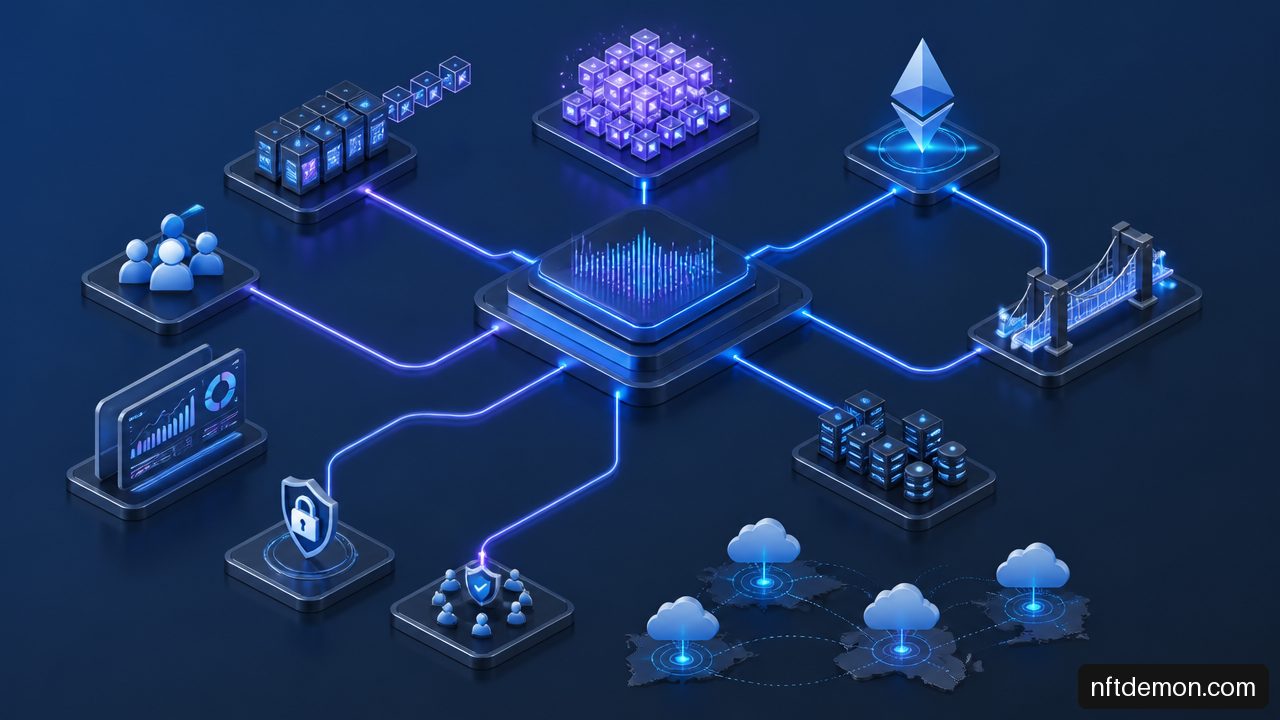
A production chain requires decisions on each of the following components:
-
Sequencer: Orders transactions and creates blocks. A centralized sequencer can simplify early operations, but it creates uptime and governance concentration. The design needs fallback behavior if it becomes unavailable.
-
Settlement layer: Usually Ethereum or another base chain. This determines how state commitments, proofs, and withdrawals are anchored.
-
Data availability layer: Determines where transaction data is published so that state can be reconstructed and verified. It affects cost, trust assumptions, and recovery options.
-
Bridge and messaging layer: Moves assets or instructions between the L2, the settlement chain, and potentially other networks. This is a high-risk surface.
-
RPC and indexing layer: Supports wallets, customer applications, analytics, block explorers, and internal reporting. It must scale with read traffic, not only transaction traffic.
-
Governance and upgrades: Defines who can pause contracts, upgrade components, rotate keys, or change fees. Multisig control, time delays, role separation, and documented emergency powers are essential.
Security, Identity, And Compliance Architecture
Security starts with a threat model. It should cover external attackers, compromised administrator credentials, bridge exploits, sequencer outages, flawed upgrades, abusive automated traffic, vendor failures, and legal access requests.
A minimum control set normally includes:
• Independent audits of critical smart contracts, bridge logic, and privileged administrative paths.
• Hardware-backed or institutional key management for high-value signing keys.
• Multisig approval with clearly separated operational, security, and governance roles.
• Monitoring for abnormal withdrawals, contract events, infrastructure latency, and node health.
• Incident runbooks covering pause authority, public communications, forensic preservation, and recovery.
• Replay protection and domain separation so signatures intended for one chain or environment cannot be reused elsewhere.
• Privacy design that keeps sensitive personal data off-chain where possible, using references, hashes, or permissioned systems when appropriate.
For multinational deployments, KYC and AML rules, consumer privacy obligations, data residency, and token classification are architecture constraints. They cannot be patched on after launch. A customer record held in a regional CRM may need to stay off-chain, while a cryptographic proof or permission flag can be recorded without exposing personal data publicly.
The broader principles behind this approach are covered in enterprise blockchain architecture, security, and scalability, particularly the relationship between network controls and business risk.
Operating Model, Risk, And Delivery Plan
A reliable L2 program needs a team that can build, operate, govern, and explain the network. Outsourcing development does not remove the brand’s accountability for customer assets, uptime, or regulatory obligations.
Minimum Practical Team Structure
| Role | Primary Responsibility |
|---|---|
| Product and program lead | Business scope, stakeholder alignment, roadmap, acceptance criteria |
| Protocol engineer | Rollup configuration, sequencing, settlement, upgrades |
| Smart contract engineer | Application contracts, access controls, testing, integrations |
| Security lead | Threat modeling, audit management, key policy, incident readiness |
| DevOps or SRE lead | Nodes, observability, deployment pipelines, reliability, recovery |
| Compliance and legal lead | KYC or AML requirements, privacy, token treatment, regional constraints |
| Integration engineer | CRM, ERP, payments, identity, analytics, and support systems |
| Operations and support lead | Customer workflows, incident communications, internal training |
Some roles can be provided by specialist vendors, especially during an early release. The responsibilities cannot be omitted.
A Safer Delivery Sequence
A staged approach reduces the chance that a public launch becomes a live stress test.
-
Discovery and decision gate: Define user flows, asset exposure, transaction forecasts, geographic scope, compliance obligations, and success metrics. Decide whether an existing L2 already meets the need.
-
Architecture and threat model: Select the stack, settlement model, data availability approach, bridge policy, upgrade authority, and service objectives.
-
Controlled pilot: Launch with limited users, capped asset value, narrow functionality, and strong monitoring. Test support processes as seriously as smart contracts.
-
Security hardening: Complete audits, remediate findings, run load tests, conduct incident simulations, and verify backup and restoration procedures.
-
Production rollout: Expand transaction limits, user access, partner integrations, and geographic availability only after operational metrics meet defined thresholds.
Failure Modes Worth Planning For
Chain abandonment is a real strategic risk. It happens when a company launches a network without a durable product reason for users or partners to remain. A technically functional L2 with no sustained transaction demand still carries infrastructure, security, and support costs.
Governance deadlock is another issue. If emergency authority is too centralized, stakeholders may question control. If authority is too fragmented, critical fixes can be delayed. The practical answer is not perfect decentralization on day one. It is explicit authority boundaries, timelocks where appropriate, multisig controls, and a documented path toward broader governance if the ecosystem warrants it.
Finally, avoid treating audits as a single purchase. Every meaningful upgrade, new bridge route, privileged role, or change in transaction logic can alter the attack surface. Security spending should be planned as an annual program rather than a launch checkbox.
Key Takeaways
• Build a custom application-specific L2 only when chain-level control over fees, sequencing, governance, compliance, or partner access produces measurable business value.
• Plan for a production budget that separates protocol engineering, application development, bridge security, integrations, launch readiness, and ongoing operations.
• Expect a serious global program to require hundreds of thousands of dollars at minimum, with multi-region, regulated, consumer-facing deployments potentially reaching several million dollars.
• Treat the sequencer, data availability layer, bridge, upgrade authority, and key management as core business systems, not infrastructure details.
• Define transaction peaks, latency, uptime, recovery, and data residency requirements before selecting OP Stack, Arbitrum Orbit, or a ZK-based framework.
• Start with a constrained pilot when possible. Limit asset exposure, measure actual demand, and expand only after security and support operations are proven.
FAQ
How Much Does It Cost To Build A Custom Application-Specific L2 For A Global Brand?
A limited pilot may begin in the low six figures, while a production L2 with enterprise integrations, security audits, high availability infrastructure, and multi-region compliance can range from roughly $500,000 to more than $3 million. The biggest variables are bridge scope, security requirements, integration complexity, operating model, and regulatory constraints.
What Is The Difference Between An App-Specific L2 And A General-Purpose L2?
A general-purpose L2 serves many unrelated applications under shared network rules. An app-specific L2 is configured around one product ecosystem or business domain. It can offer more control over fees, access, sequencing, governance, and user experience, but it also creates greater operating responsibility.
Which Is Better: OP Stack, Arbitrum Orbit, Or A ZK Framework?
The answer depends on the product’s constraints. OP Stack and Arbitrum Orbit are often practical for EVM-compatible applications that value mature developer tooling and configurable deployment paths. A ZK framework may fit use cases that prioritize validity proofs or particular finality characteristics, but specialized proving infrastructure and engineering can raise complexity. Select the stack after defining operational and compliance requirements, not before.
How Long Does A Custom L2 Take To Build?
A narrow proof of concept may be possible within a few months. A production deployment commonly takes longer because architecture reviews, integrations, audits, remediation, load testing, governance design, and launch operations cannot safely be compressed into a simple coding schedule. A staged rollout is usually more reliable than a single large launch.
How Much Should Security Auditing Cost?
Audit cost depends on contract complexity, bridge exposure, protocol modifications, and the number of release cycles. Directional market estimates cited by Blockchain App Factory place annual audits around $50,000 to $200,000, but a system with high-value bridges or extensive custom protocol work can require more. Budget for remediation and repeat reviews, not only the initial report.
What Ongoing Costs Apply After Launch?
Recurring costs include node hosting, RPC capacity, monitoring, indexers, block explorers, data storage, security reviews, key-management services, incident readiness, support, vendor contracts, and engineering for upgrades. Infrastructure alone may be a manageable line item; the larger long-term cost is maintaining secure, reliable operations and responding to product change.
How Do Compliance And Data Residency Affect The Architecture?
They can determine where services are hosted, what customer data remains off-chain, whether access must be permissioned, how identity verification works, and what records must be retained. For example, a brand may store personal data in a regional system while placing only a cryptographic reference or authorization state on the L2. This avoids exposing sensitive data while preserving verifiable transaction logic.
Sources And References
- Ethereum.org — Ethereum’s Layer 2 Ecosystem: https://institutions.ethereum.org/layer-2
- Blockchain App Factory — Layer 2 Blockchain Development Guide for Scalable Solutions 2026: https://www.blockchainappfactory.com/blog/layer-2-blockchain-development-guide-2026/
- Debut Infotech — Layer 2 Blockchain Solutions for Banks, Fintech & Payments: https://www.debutinfotech.com/blog/layer-2-blockchain-solutions-banks-fintech-payments
- Bitronix — How to Build a Blockchain in 2026: Complete Guide: https://bitronix.ai/blogs/how-to-build-a-blockchain
- siliconplex.com: https://siliconplex.com/services/layer2-blockchain-development
NFT Demon Holdings helps enterprises scope, evaluate, and build blockchain programs — start with a free evaluation call.
Talk through your use case
Free evaluation call — objective, constraints, and fit, before any proposal.