Cross chain liquidity solutions, a decision-maker's guide
By Jeremy Ryan, Founder & CEO · October 2026
Cross chain liquidity solutions make assets and trading depth usable across otherwise isolated blockchain networks. For decision-makers, the core issue is not simply whether tokens can move between chains. It is whether a user or institution can reach the intended asset, at a predictable price, with understandable settlement risk and a reliable recovery path if execution fails.

A polished interface can conceal a complicated process: source-chain confirmation, message verification, liquidity sourcing, destination-chain gas, inventory management, and final delivery. The right design depends on the asset, chain pair, transaction size, regulatory requirements, and tolerance for third-party trust.
- Why Liquidity Fragments Across Chains
- How Cross Chain Liquidity Solutions Work
- How To Compare Trust Models And Execution Designs
- How To Evaluate Cost, Finality, And Failure States
- Implementation Priorities For Enterprises
- Key Takeaways
- FAQ
Why Liquidity Fragments Across Chains
Liquidity fragmentation occurs because each blockchain maintains its own state, token contracts, decentralized exchanges (DEXs), validators, gas market, and settlement rules. A stablecoin on Ethereum, an equivalent balance on an L2, and a bridged representation on another network may look similar in a wallet, but they are not automatically interchangeable.
This distinction matters most when transaction size grows. A user may see a favorable quote for a cross-chain swap, yet encounter price impact because the destination pool is shallow. An institutional treasury may successfully bridge an asset but still face limited local liquidity when it needs to sell, borrow against, or deploy that asset on the destination chain.
Transfer, Swap, And Liquidity Relocation Are Different Operations
These operations are often grouped together, but they create different risks:
| Operation | What Happens | Primary Risk | Typical Decision Use |
|---|---|---|---|
| Asset transfer | The same asset or an equivalent representation moves between chains | Custody, message verification, settlement delay | Treasury movement or collateral placement |
| Cross-chain swap | An asset on one chain is exchanged for another asset on another chain | Quoted-price accuracy, solver performance, destination liquidity | User trading and payments |
| Liquidity relocation | Capital is moved to seed or rebalance a pool on another chain | Inventory imbalance, opportunity cost, withdrawal constraints | Market making and protocol operations |
A bridge primarily addresses transfer. A cross-chain DEX or aggregator may combine transfer and swap. A liquidity manager addresses the harder operational question: where should capital sit before demand arrives?
The important unit of analysis is the route, not the protocol brand. A route is defined by source chain, destination chain, asset representation, transaction size, time, and settlement method.
For example, moving canonical stablecoins from one supported chain to another can be structurally different from moving a wrapped token through a multisignature bridge and then swapping it in a thin pool. Both may appear as a single button in an application. Their risk profiles are not comparable.
Why Destination Inventory Can Break a Working Route
A protocol can be online while a route is economically unavailable. Liquidity providers, solvers, and pools must have sufficient destination-side inventory to deliver the requested asset. If flows become persistently one-directional, the destination inventory may be depleted.
Consider a route where users repeatedly exchange an Ethereum-based stablecoin for the same stablecoin on an L2. The protocol can settle early trades from its L2 reserves. Eventually, its inventory may become too low for later users. At that point, it must either raise the fee, offer a worse rate, delay fulfillment while rebalancing, or reject the route.
Some systems use single-asset pools and automated rebalancing to manage this pressure. Spark’s overview notes that cross-chain designs can include lock-and-mint bridges, native pools, aggregators, and intent-based swaps, while also describing rebalancing as a tool for reducing failed transactions through better inventory management. The category matters because each approach shifts the cost and risk to a different participant.
How Cross Chain Liquidity Solutions Work
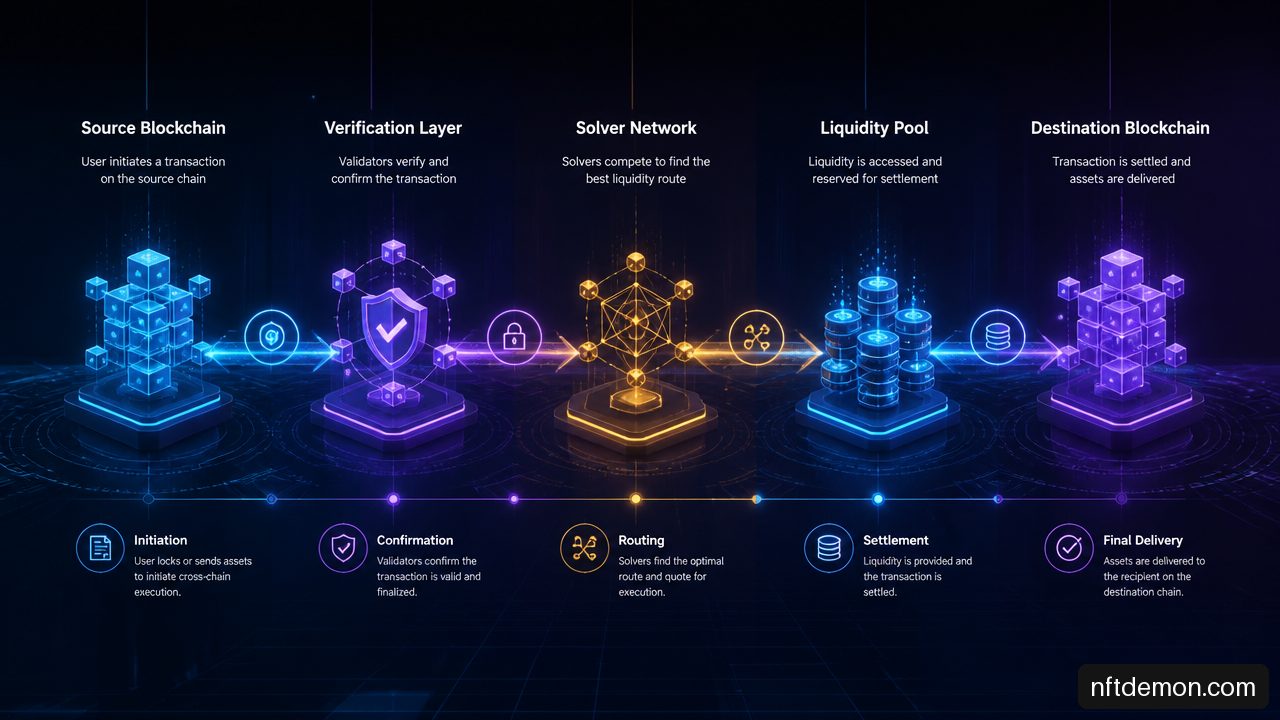
Cross chain liquidity solutions coordinate value across independent networks through one or more mechanisms: locked collateral, token issuance controls, pooled reserves, message passing, relayers, and competitive execution.
Lock-And-Mint And Wrapped-Asset Bridges
In a lock-and-mint design, an asset is locked on the source chain and a corresponding wrapped asset is issued on the destination. Redeeming the destination token generally requires burning it and releasing the original locked asset.
This model can make assets available where they did not previously exist. It also creates a concentrated dependency: the locked collateral, smart contracts, verification mechanism, and redemption process must all work correctly. A wrapped asset may trade efficiently on its destination network, but its value still depends on confidence in the bridge and the ability to redeem.
Use this approach when the destination ecosystem requires an asset that has no native issuance path. Avoid treating every wrapped token as equivalent to the original asset, especially for treasury collateral or high-value settlement.
Native Mint-And-Burn Transfers
Native mint-and-burn systems can remove the need to maintain a locked copy of the same asset on every route. Instead, the token is burned on the origin chain and minted on the destination chain under an authorized issuance model.
This can reduce representation sprawl. It does not eliminate trust assumptions; it changes them. The critical questions become who controls minting authority, how supply is reconciled, what chains are officially supported, and whether the resulting asset is broadly accepted in destination-chain markets.
A software comparison from F6S’s cross-chain liquidity listings illustrates the variety of available approaches, including burn-and-mint asset models, liquidity aggregation, and developer-facing APIs. That variety is precisely why architecture should be assessed by mechanism rather than chain count.
Liquidity Pools And Cross-Chain AMMs
A cross-chain automated market maker uses reserves to quote and fulfill swaps. Instead of waiting for a wrapped asset to be minted and sold locally, the protocol may deliver destination-side inventory from a liquidity pool.
The apparent speed can be attractive, but pool depth determines price impact. Large trades consume a meaningful portion of reserves and move the execution price. Liquidity providers earn fees for supplying inventory, but they bear risks that end users may not see:
• Inventory skew when demand drains one side of a route.
• Rebalancing cost when capital must be moved or hedged across chains.
• Adverse selection when informed traders use stale or favorable pricing.
• Withdrawal pressure during periods when providers want capital back at the same time.
A cross-chain pool is therefore not merely a passive reserve. It is an inventory business operating across separate settlement domains.
Intent-Based Swaps, Solvers, And Relayers
Intent-based execution changes the user request from “perform these technical steps” to “deliver this outcome.” A user might specify: send 10,000 units of a stablecoin from Chain A and deliver at least a defined amount of another asset on Chain B before a deadline.
Solvers compete to fulfill the intent. They may use their own inventory, existing DEX liquidity, bridges, or hedging systems. Relayers carry messages or submit transactions needed for completion. This can improve user experience because the route is abstracted away, but solver obligations need scrutiny: quote validity, collateral, settlement guarantees, timeout behavior, and dispute handling all matter.
Eco Support’s overview of solver-networked protocols notes that failed transfers may revert cleanly rather than leaving funds in bridge limbo. That is a useful property, but it should be confirmed route by route. A clean revert is not the same as an instant refund, and source-chain gas or approval costs may still be incurred.
How To Compare Trust Models And Execution Designs
The best cross chain liquidity solution is rarely the one with the longest list of supported chains. I recommend comparing systems through four questions: who can move value, who supplies destination liquidity, what proves the message, and what happens if a party fails?
A Practical Trust-Model Comparison
| Design | Value Delivery Method | Main Trust Assumption | Strength | Key Limitation |
|---|---|---|---|---|
| Lock-and-mint bridge | Locked collateral and wrapped issuance | Contract security and validator, signer, or oracle controls | Broad asset availability | Wrapped-asset and custody exposure |
| Native mint-and-burn | Burn on origin, mint on destination | Authorized issuer and supply controls | Cleaner canonical representation | Limited to supported assets and chains |
| Liquidity-pool route | Destination reserves fulfill the transfer or swap | Pool contracts and provider inventory | Potentially fast execution | Capacity declines when inventory is imbalanced |
| Intent and solver network | Solver delivers the requested outcome | Solver performance, settlement rules, and verification | Simplified user request and competitive routing | Quote, timeout, and default logic matter greatly |
| Shared-liquidity design | Cross-rollup state or coordinated liquidity | Shared settlement or interoperability design | May reduce dependence on standalone bridges | Still developing and not universally available |
No model is automatically custodial or non-custodial in the way marketing language sometimes suggests. Users may retain wallet control while still relying on smart contracts, validator sets, issuers, or market makers. Non-custodial wallet interaction does not eliminate counterparty and protocol risk.
For stablecoin transfers, canonical issuance and redemption authority deserve special attention. A canonical token with deep destination liquidity may be preferable to a wrapped alternative, but only if the asset, chain, and operational requirements are directly supported. A practitioner in an r/defi discussion reported using CCTP for cross-chain fund transfers. The post does not provide performance metrics, so it should be treated as an example of usage rather than evidence of universal cost or reliability.
Shared Liquidity Is Promising, Not Yet A Default Assumption
Some practitioners are discussing native cross-rollup and shared-liquidity approaches as alternatives to conventional bridges. Community discussion around shared-liquidity experimentation reflects interest in designs that coordinate liquidity or state more directly across rollups.
The appeal is clear: less duplicated capital, fewer wrapped representations, and fewer independent pools that must be rebalanced. Fair warning: emerging architecture should not be assumed to have the operational maturity, asset support, or incident history required for enterprise-scale use. Use it where its settlement model is understood and fallback paths exist.
How To Evaluate Cost, Finality, And Failure States
A quoted exchange rate is not total execution cost. Decision-makers should calculate the full route cost before comparing providers.
Calculate Total Execution Cost
Use this working formula:
Total cost = source gas + destination gas + protocol fee + bridge or messaging fee + solver or relayer spread + DEX price impact + approvals + expected recovery cost.
Expected recovery cost is often ignored. It includes the operational impact of a delayed transaction, support workload, hedge exposure, a second transaction to complete the route, and potentially a failed approval or gas payment. For retail-sized transfers, gas can dominate. For larger transactions, price impact and solver spread can matter more.
A useful benchmark records a fixed chain pair, asset pair, notional size, timestamp, quoted output, final output, completion time, and failure result. Run the same test across several sizes. A route that is excellent for $500 may become uncompetitive at $50,000 because its destination pool is shallow.
Finality Is Not The Same As Interface Completion
A user interface may display “complete” when the destination transaction is submitted, when a solver has fronted inventory, or when a message has been observed. These are different states.
- Source inclusion: The transaction appears in a source-chain block.
- Source finality: The source transaction reaches the protocol’s required confirmation threshold.
- Cross-chain verification: A verifier, attestation process, or solver recognizes the event.
- Destination execution: The destination transfer, mint, or swap is submitted and executed.
- Economic completion: The recipient receives the promised asset amount with no outstanding settlement condition.
For treasury and institutional workflows, define which state triggers accounting treatment, customer notification, and downstream business actions. Do not let a front-end label become the settlement policy.
Build For Failure States Before Production
Cross-chain transactions can fail in ways that ordinary single-chain transfers do not. The operational runbook should distinguish among these conditions:
• Pending: Source transaction is confirmed, but required verification or fulfillment has not occurred.
• Reverted: The transaction failed on-chain and assets remain under the original state, though gas was consumed.
• Underfunded: Destination gas, pool reserves, or solver inventory is insufficient.
• Partially completed: One stage executed, but a follow-up swap, delivery, or accounting event did not.
• Incorrectly routed: The wrong token representation, recipient, chain, or minimum-output setting was used.
Recovery design should include transaction identifiers across chains, ownership of customer communications, escalation deadlines, reconciliation jobs, and clearly tested timeout logic. If a protocol cannot expose enough status data to operate this process, it is a weak fit for critical flows.
Implementation Priorities For Enterprises
The technical decision should begin with business flow mapping, not with a widget or protocol selection. Ask whether the organization needs treasury mobility, customer swaps, multichain payments, collateral management, or liquidity provisioning. Each purpose has a different control environment.
A Production Selection Workflow
Define the chain-pair requirement. Specify source and destination networks, asset representations, expected transaction sizes, volume patterns, and urgency.
Set a trust threshold. Determine whether issuer controls, validator sets, bridge custody, solver exposure, or pooled liquidity meet the organization’s security policy.
Benchmark realistic routes. Capture total cost, destination amount, end-to-end time, failure behavior, and route capacity at multiple trade sizes.
Design recovery operations. Integrate status monitoring, alerts, reconciliation, exception queues, and escalation paths before opening production access.
Pilot with limits. Start with capped amounts, allowlisted routes, conservative slippage settings, and withdrawal controls.
This work connects directly to integrating blockchain with existing systems. Cross-chain execution needs to feed real operational systems: treasury records, ERP workflows, risk reporting, identity controls, customer support, and compliance review.
Architecture And Governance Controls
A sound blockchain integration architecture separates transaction initiation, key management, route selection, execution monitoring, and reconciliation. Do not give a routing layer unrestricted authority over treasury keys or customer balances merely because it provides convenient liquidity access.
Minimum governance controls should include:
• Approved asset and chain lists.
• Per-route and per-transaction exposure limits.
• Independent quote validation for material trades.
• Monitoring for unusual price impact, latency, and failed fulfillment.
• Contract upgrade and signer-change monitoring.
• An incident process that can halt new routes without blocking visibility into pending transfers.
Network selection also changes the integration plan. Before building a route between open DeFi venues and enterprise-controlled infrastructure, review choosing between public and permissioned blockchains. Permissioned systems can improve participant control, but they may introduce separate interoperability gateways and limit direct access to public liquidity.
Key Takeaways
• Cross chain liquidity solutions solve more than token movement. They coordinate transfer, swap execution, and destination-side liquidity across independent networks.
• Compare trust assumptions before comparing features. Assess issuer control, signer or validator design, smart contracts, solver obligations, and inventory sources.
• Benchmark exact routes. Asset, chain pair, transaction size, time, and destination liquidity determine real execution quality.
• Treat liquidity imbalance as an operational risk. A route can be technically online while destination-side reserves are insufficient or expensive.
• Use total execution cost. Include gas, fees, spread, price impact, approvals, and failure-recovery burden rather than relying on the displayed quote.
• Define finality in policy terms. Source confirmation, destination submission, and economic settlement are not interchangeable milestones.
FAQ
What Are Cross Chain Liquidity Solutions?
Cross chain liquidity solutions are systems that make assets, trading reserves, or swap execution available across multiple blockchain networks. They may use bridges, mint-and-burn mechanisms, liquidity pools, aggregators, relayers, or solver networks to fulfill a transfer or trade.
What Is The Difference Between A Bridge And A Cross-Chain Swap?
A bridge generally moves an asset or its representation from one chain to another. A cross-chain swap delivers a different asset on the destination chain and may combine DEX trading, bridge settlement, and liquidity-provider inventory in one user flow.
Are Cross Chain Liquidity Solutions Custodial Or Non-Custodial?
They can involve different forms of control. A user may retain control of a wallet while the route still depends on bridge contracts, issuer minting authority, validator or signer sets, pool liquidity, and solver performance. Evaluate the specific trust model rather than relying on a broad label.
How Do Intent-Based Cross-Chain Swaps Work?
The user specifies a desired result, such as receiving a minimum amount of an asset on a destination chain. A solver then constructs and fulfills the route, often using its own inventory or connected liquidity sources. The important safeguards are deadlines, minimum outputs, settlement verification, and clear behavior if fulfillment fails.
What Causes A Cross-Chain Transaction To Remain Pending?
Common causes include insufficient confirmations, message-verification delays, relayer outages, depleted destination liquidity, missing destination gas, solver failure, or an application waiting for a later stage of execution. A transaction identifier on the source chain alone may not explain the full state.
How Should Total Cross-Chain Transaction Costs Be Calculated?
Add source and destination gas, protocol and bridge fees, solver or relayer spread, DEX price impact, token-approval costs, and expected recovery costs. For larger trades, compare final delivered value rather than only nominal percentage fees.
Can Cross Chain Liquidity Work Without Wrapped Assets Or Third-Party Bridges?
Sometimes. Native mint-and-burn systems can move supported assets without a conventional wrapped representation, and shared-liquidity designs may reduce reliance on standalone bridges. However, support remains asset- and chain-specific, and every design still has settlement and governance assumptions.
Sources And References
• Eco Support — Top Cross-Chain Liquidity Protocols for 2026
• Spark — Cross-Chain Liquidity Glossary
• F6S — Best Cross-Chain Liquidity Software
• Reddit / r/defi — Cross chain liquidity solutions that actually work?
NFT Demon Holdings helps enterprises scope, evaluate, and build blockchain programs — start with a free evaluation call.
Talk through your use case
Free evaluation call — objective, constraints, and fit, before any proposal.