Cross border payments with CBDCs, what decision makers need to know
By Jeremy Ryan, Founder & CEO · October 2026

Cross border payments with CBDCs could reduce the number of intermediaries between a payer and a recipient, improve settlement speed, and make foreign exchange settlement safer. But a central bank digital currency does not remove the hard parts of international payments: access rules, FX liquidity, identity controls, sanctions screening, legal finality, and operational recovery still determine whether a payment arrangement works in practice.
For decision makers, the useful question is not whether CBDCs are faster than existing rails in a laboratory. It is whether a specific design improves a specific payment corridor without creating unacceptable liquidity, compliance, sovereignty, or resilience risks.
- Key Takeaways
- How Cross Border CBDC Payments Work
- Choosing A Cross Border CBDC Architecture
- What Pilots Have Demonstrated So Far
- Implementation Priorities And Failure Modes
- Frequently Asked Questions
Key Takeaways
• CBDC is a settlement asset, not a complete cross border payment solution. A viable arrangement must specify access, messaging, currency conversion, compliance, and settlement finality.
• Wholesale and retail use cases are fundamentally different. Wholesale designs focus on eligible financial institutions, intraday liquidity, and foreign exchange settlement. Retail designs add wallet eligibility, consumer protection, identity, and remittance pricing.
• Payment versus payment, or PvP, matters more than speed alone. It makes delivery of one currency conditional on delivery of the other, reducing the risk that one party pays but does not receive the agreed currency.
• Pilot success is evidence of technical feasibility, not proof of production readiness. Production requires durable legal agreements, participant incentives, liquidity providers, cyber resilience, and operating procedures across jurisdictions.
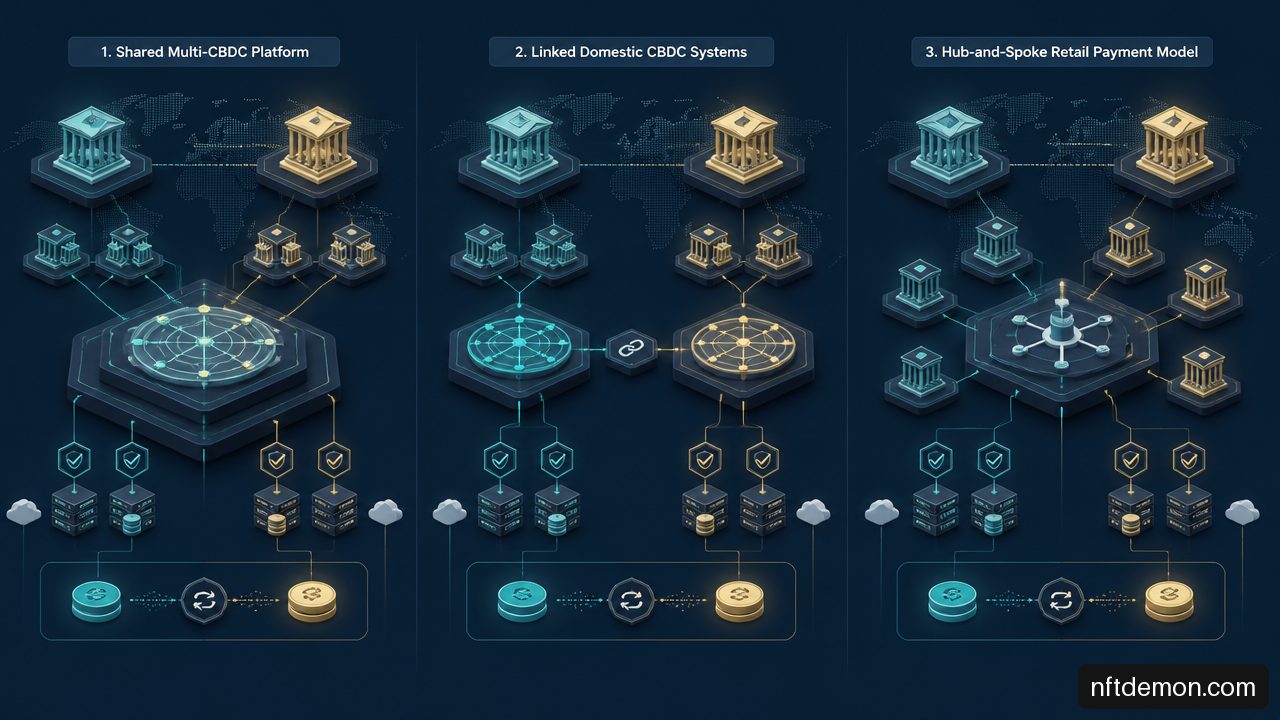
• Architecture should follow the corridor and policy objective. A shared platform can simplify direct settlement among a limited group. Linked domestic systems can preserve local control. A hub-and-spoke approach may fit retail remittances where domestic systems remain separate.
How Cross Border CBDC Payments Work
CBDCs Change The Settlement Path, Not The Need For Coordination
A central bank digital currency is digital central bank money denominated in a national fiat currency. In a cross border setting, it can be used by banks, payment providers, businesses, or consumers depending on the CBDC’s access rules.
Traditional correspondent banking commonly relies on chains of institutions holding accounts with one another. A payment may move through several banks before the recipient institution receives usable funds. Each participant can perform screening, reconciliation, liquidity management, and messaging. This model remains essential to global commerce, but multiple handoffs can add cost, time, and uncertainty.
A cross border CBDC arrangement may instead allow eligible participants to settle directly in central bank money on a shared platform or through interoperable domestic systems. That can reduce reconciliation and shorten the settlement chain. It does not mean every payment becomes instant, cheap, or universally accessible.
The strongest CBDC designs treat cross border payments as a coordinated policy, legal, liquidity, and technology problem rather than a ledger upgrade.
A payment can still qualify as a cross border CBDC payment when only one component uses CBDC. For example, a payer’s bank could use a wholesale CBDC for settlement while the recipient receives a conventional commercial bank deposit. This matters because adoption is likely to be incremental. Two countries do not need to deploy identical retail CBDCs before a corridor can test a CBDC settlement component.
The Five Problems Every Design Must Solve
We should assess any proposal through five separate questions. This framework prevents a common mistake: approving a technically impressive platform before defining who can use it and what happens when something goes wrong.
| Design Problem | Core Question | Practical Decision Test |
|---|---|---|
| Access | Who may hold, transfer, or redeem CBDC? | Are foreign banks, payment firms, and users eligible under clear rules? |
| Communication | How are payment instructions and status updates exchanged? | Can systems exchange trusted, standardized messages without manual repair? |
| Currency Conversion | Where does FX pricing and liquidity come from? | Is there a reliable market maker and enough liquidity at stressed times? |
| Compliance | Who performs identity, AML, sanctions, and monitoring controls? | Are responsibilities explicit across every jurisdiction? |
| Settlement | When is payment final and irrevocable? | Do legal rules recognize finality, including during insolvency or outage events? |
The sequence matters. Consider a manufacturer in Country A paying a supplier in Country B. The payer’s bank needs permission to access the relevant settlement arrangement. The payment instruction must reach the receiving side in a format both systems recognize. An FX provider must convert Currency A into Currency B at an executable rate. Both sides must complete required screening. Finally, the currencies must settle under legally recognized finality rules.
If the platform settles in seconds but FX liquidity is absent at the required time, the commercial payment is not complete. If the payment settles technically but a court in one jurisdiction disputes finality, the risk remains. This is why “faster ledger” is not a sufficient investment thesis.
Why Payment Versus Payment Changes The Risk Profile
Payment versus payment is often described as an FX feature. It is more precise to call it a risk-control mechanism. Under PvP, Currency A is delivered only if Currency B is delivered. Neither side should be left exposed to the principal amount because its counterparty failed after receiving funds.
Suppose a bank sells Thai baht for UAE dirhams. Without coordinated settlement, one leg might settle first while the other is delayed or rejected. The paying institution then carries principal risk. A properly designed PvP mechanism links both legs so they either settle together or neither settles.
That benefit depends on real conditions. The two CBDC balances must be available, the FX trade must be matched, each party must be eligible, and the platform must handle an interruption without releasing only one side. A system that describes itself as “atomic” should still be tested against timeout rules, participant suspension, disputed instructions, and partial network failure.
Wholesale And Retail CBDCs Serve Different Jobs
| Model | Typical Participants | Primary Objective | Main Constraints |
|---|---|---|---|
| Wholesale CBDC | Central banks, commercial banks, regulated financial institutions | Interbank settlement, trade payments, institutional FX | Liquidity, access policy, legal finality, operational resilience |
| Retail CBDC | Consumers, businesses, wallet providers, payment service providers | Consumer payments and remittances | Identity, privacy, foreign wallet access, consumer protection, fees |
| Multi CBDC Arrangement | Institutions from multiple jurisdictions | Direct multi currency settlement and FX | Governance, common rules, currency conversion, participant eligibility |
Wholesale pilots may offer the clearest early use cases because the number of participants is limited and institutions already manage regulated settlement accounts. Retail payments are harder. A worker sending a remittance should not need to understand correspondent banking, wallet interoperability, or FX prefunding. Yet the system behind that simple user experience must resolve identity assurance, recipient verification, charge disputes, data protection, and local consumer rules.
Choosing A Cross Border CBDC Architecture
Shared Platform, Linked Systems, Or A Hub
The central architecture choice is not simply DLT versus a conventional database. It is whether participating jurisdictions operate one common environment, connect separate domestic systems, or use an intermediary hub.
| Architecture | How It Works | Best Fit | Main Trade Off |
|---|---|---|---|
| Common platform | Multiple CBDCs are issued or represented on one shared arrangement | Limited group of central banks and eligible institutions | Shared governance and concentrated operational dependencies |
| Linked domestic systems | National CBDC systems exchange instructions and settlement data | Jurisdictions prioritizing domestic control | Complex interoperability and reconciliation requirements |
| Hub and spoke | Domestic systems connect through a routing or FX hub | Retail remittances and multi corridor access | Hub governance, data flows, and failure concentration |
A common platform can simplify direct multi currency settlement because participants work within one coordinated rulebook. It may be appropriate where central banks are willing to align on access, operating hours, data treatment, and dispute processes. The hard part is political and legal as much as technical: who operates the platform, who can change rules, and which jurisdiction governs a failure?
Linked domestic systems preserve greater national autonomy. Each central bank can retain its own ledger, domestic participant rules, and monetary controls. The price is interoperability work. Systems must consistently exchange payment messages, compliance information, status codes, and finality confirmations. For institutions evaluating blockchain platform selection for financial institutions, the relevant comparison is not only throughput. It is whether the platform supports the governance, permissions, auditability, and integration model required by the corridor.
A hub-and-spoke model can make sense for retail use cases. Domestic retail CBDC arrangements remain local, while a hub helps identify a route, coordinate FX offers, and connect providers. This can reduce the need for every country to build direct connections to every other country. Fair warning: the hub becomes a consequential point of governance and operational resilience. It needs transparent rules for participant onboarding, data minimization, service availability, and incident response.
Interoperability Is More Than APIs
Technical compatibility is necessary, but it is not interoperability by itself. Two systems can exchange messages perfectly and still fail commercially if they disagree on eligibility, transaction limits, data retention, or the meaning of settlement finality.
We should separate interoperability into four layers:
- Technical interoperability: Message formats, APIs, cryptographic controls, and network connectivity function together.
- Operational interoperability: Participants share timing rules, exception handling, support processes, and reconciliation procedures.
- Legal interoperability: Jurisdictions recognize rights, obligations, finality, and enforceability in compatible ways.
- Commercial interoperability: FX providers, banks, and payment firms have an economic reason to supply liquidity and service the corridor.
This is where enterprise implementation often becomes difficult. CBDC networks must interact with core banking systems, treasury platforms, sanctions engines, identity services, accounting systems, and customer channels. A detailed plan for integrating blockchain with enterprise systems is more valuable than a disconnected proof of concept because the payment record must flow into real financial operations.
Privacy Must Be Designed Alongside Compliance
Cross border payments create a tension between legitimate privacy expectations and lawful monitoring obligations. A retail CBDC design that exposes every transaction detail broadly may be unacceptable to users and foreign partners. A design that conceals all information may make AML, sanctions enforcement, and fraud investigation unworkable.
The practical answer is usually controlled disclosure rather than absolute secrecy or unrestricted visibility. Data access can be segmented by role, purpose, and jurisdiction. A payment provider might see information needed to serve its customer, while a central bank sees only the data needed for settlement and system oversight. Regulators may require access under defined legal processes.
The details matter. A payment routed through several jurisdictions can trigger conflicting privacy, bank secrecy, record retention, and disclosure rules. Before launch, participants should define which data is stored, where it is stored, who can decrypt it, how long it is retained, and how cross border access requests are handled.
What Pilots Have Demonstrated So Far
What Project mBridge Tested
Project mBridge is a major multi CBDC experiment focused on cross border payments and settlement. The 2022 pilot involved 20 commercial banks from four jurisdictions and completed 164 payment and FX transactions, as documented in the BIS report on the mBridge real value pilot.
The pilot ran for six weeks, from August 15 through September 23, 2022, and focused primarily on international trade and interbank group settlement. It demonstrated that regulated institutions could conduct real value transfers and FX transactions through a multi CBDC arrangement. The exercise reportedly placed more than US$12 million of CBDCs onto the platform, detailed in the BIS mBridge pilot report.
Those figures are meaningful, but they should be read precisely. A six week pilot involving a bounded participant group is evidence that core processes can work under test conditions. It is not evidence that a system has solved global participant onboarding, long term FX depth, retail dispute handling, or continuous recovery from real world disruptions.
Icebreaker And The Retail Question
Project Icebreaker explored a different direction: linking domestic retail CBDC systems through a hub-and-spoke model for international retail and remittance payments. That distinction matters. A wholesale bank settling a trade obligation has different identity, transaction size, and operational needs than an individual sending funds to family abroad.
For retail corridors, the intended benefits are straightforward: fewer intermediaries, more predictable fees, faster availability of funds, and clearer FX information. However, user protection becomes central. What happens if a recipient wallet is inaccessible? Can a mistaken payment be recalled? Who handles a fraud claim when the sender, wallet provider, hub, and recipient are in different jurisdictions?
There is not yet enough public evidence to claim that CBDCs have broadly reduced consumer remittance costs at scale. Decision makers should demand corridor specific evidence rather than assuming an institutional pilot translates directly to household outcomes.
Implementation Priorities And Failure Modes
Start With A Narrow Business Case
The strongest starting point is a specific payment problem with measurable pain: delayed trade settlement, high cost in a remittance corridor, FX principal risk, or trapped liquidity between affiliated banks. “Explore CBDCs” is not a business case.
A disciplined program can proceed in five stages:
- Define the corridor and users. Identify currencies, transaction volumes, transaction values, operating hours, and eligible participants.
- Specify the settlement model. State which asset settles each leg, when settlement becomes final, and whether PvP is required.
- Design the FX and liquidity model. Identify market makers, prefunding requirements, pricing rules, and stressed market procedures.
- Assign compliance responsibilities. Document identity verification, sanctions screening, monitoring, suspicious activity escalation, and data-sharing boundaries.
- Test disruption before scale. Simulate participant outages, corrupted messages, FX provider withdrawal, duplicate submissions, cyber incidents, and legal disputes.
A useful program scorecard should report settlement asset, FX model, participant eligibility, compliance responsibility, settlement finality, and failure handling separately. Combining them into a single “interoperable” label hides material risk.
Resilience And Recovery Cannot Be Afterthoughts
Cross border systems need to handle failures that domestic payment systems may not encounter in the same combination. One central bank system may be offline while another remains available. A sanctions update may arrive during an FX transaction. A participant may lose connectivity after one system accepts an instruction but before final confirmation is delivered elsewhere.
Designers need explicit recovery states. For each transaction, the platform should be able to determine whether it is pending, rejected, cancelled, settled, or in an exception queue. Ambiguous status is dangerous because banks may either release customer funds too early or hold them unnecessarily.
Security architecture should also be assessed as a system, not just as ledger cryptography. Identity controls, privileged access, key management, hardware security, monitoring, segmentation, audit trails, and incident response all matter. Decision makers can use enterprise blockchain architecture for security and scalability as a practical lens for evaluating those dependencies.
When To Proceed And When To Pause
Proceed when a defined corridor has committed policy stakeholders, credible liquidity providers, legal authority for the proposed settlement method, and a clear improvement over current arrangements. A wholesale trade corridor with a small number of regulated banks may be a sensible early candidate.
Pause when the project cannot answer basic questions about foreign access, FX liquidity, liability allocation, or data governance. A polished demonstration that excludes sanctions exceptions, failed FX matching, and customer disputes is not ready for consequential payments.
The near term value of CBDCs may be less about replacing every cross border payment rail and more about improving selected settlement points where today’s chain of intermediaries creates measurable friction. That is a narrower claim, but it is also more credible.
Frequently Asked Questions
What Are Cross Border Payments With CBDCs?
They are international payments in which at least one payment component uses a central bank digital currency. The CBDC may serve as a wholesale settlement asset between institutions, a retail payment instrument, or one leg of a multi currency FX transaction.
Are CBDC Cross Border Payments Faster Or Cheaper?
They can be, particularly when direct settlement reduces intermediary steps and reconciliation. Results depend on access arrangements, FX liquidity, compliance processing, and operational design. A CBDC network cannot eliminate cost if participants still need multiple manual checks or expensive currency conversion.
Do Both Countries Need CBDCs For A Cross Border Payment?
No. A cross border payment can involve CBDC on one component while another component uses commercial bank money or another settlement arrangement. Multi CBDC settlement becomes possible only when the relevant currencies and access arrangements are available.
What Is The Difference Between Wholesale And Retail CBDC Use?
Wholesale CBDC is generally limited to regulated institutions and supports interbank settlement, trade payments, and institutional FX. Retail CBDC is intended for consumers and businesses, creating additional requirements around wallets, identity, privacy, consumer support, and foreign user access.
How Does Payment Versus Payment Reduce FX Risk?
PvP makes the release of one currency conditional on the release of the other. If either leg cannot settle, neither should complete. This reduces principal risk, but it requires available liquidity, matched instructions, and robust exception handling.
Are CBDC Pilots Ready For Commercial Production?
Not automatically. Pilots can prove that real value transfers and FX processes are technically possible. Production readiness requires sustained commercial demand, legal certainty, liquidity arrangements, governance, cybersecurity controls, operational support, and tested recovery procedures.
Can CBDCs Improve Consumer Remittances?
Potentially, especially where current corridors involve high fees, slow availability, or limited competition. Yet consumer outcomes depend on wallet access, FX pricing, identity requirements, consumer protection, and whether providers pass lower operating costs to users. Large scale evidence remains limited.
Sources And References
• bis.org: https://www.bis.org/media-releases/20221026-bis-and-four-central-banks-complete-successful-pilot-real-value-transactions-cross-border-cbdc
• bis.org: https://www.bis.org/publ/othp59.pdf
NFT Demon Holdings helps enterprises scope, evaluate, and build blockchain programs — start with a free evaluation call.
Talk through your use case
Free evaluation call — objective, constraints, and fit, before any proposal.