CBDC implementation strategies that move beyond pilots
By Jeremy Ryan, Founder & CEO · October 2026
CBDC implementation strategies succeed when they are treated as institutional change programs rather than software deployments. A Central Bank Digital Currency affects money issuance, payment competition, bank incentives, consumer trust, privacy expectations, and national infrastructure. I recommend beginning with a narrow public objective, then building only the ecosystem, rules, and technical capabilities needed to prove that objective.

- Choose The Right CBDC Strategy
- Design The Technology And Control Model
- Use Stage Gates Instead Of Open Ended Pilots
- Build A Minimum Viable Ecosystem
- Frequently Asked Questions
- Sources / References
Choose The Right CBDC Strategy
A CBDC is digital central bank money designed for a defined payment or settlement purpose. The implementation question is not simply whether to use blockchain, distributed ledger technology, or a centralized database. The harder question is what problem public money in digital form is expected to solve better than existing cash, bank deposits, instant payments, or card networks.
I would not approve a program based on a vague goal such as “modernization.” A credible program should identify one or two measurable public objectives: improving payment resilience, supporting targeted government disbursements, expanding access to safe digital payments, improving wholesale settlement, or reducing friction in a specific cross border corridor. Each objective implies a different design, operating model, and risk appetite.
Start With The Payment Problem, Not The Technology
Retail CBDCs are intended for households and businesses. They raise questions about wallets, merchant acceptance, consumer protection, accessibility, privacy, and the possible movement of deposits away from commercial banks. Wholesale CBDCs are intended primarily for regulated financial institutions and may focus on interbank settlement, securities settlement, or programmable settlement workflows.
The strategic distinction matters because a wholesale CBDC can often be tested within a smaller group of supervised participants. A retail CBDC must work in ordinary conditions: a consumer with a basic phone, a merchant with a legacy terminal, an elderly user needing assisted registration, and a support desk handling disputed transactions.
| Decision Area | Retail CBDC | Wholesale CBDC |
|---|---|---|
| Primary users | Households, merchants, government agencies | Banks, clearing firms, financial market infrastructures |
| Core objective | Payment access, resilience, inclusion, retail competition | Settlement efficiency, delivery versus payment, liquidity management |
| Adoption challenge | Trust, usability, merchant acceptance, wallet access | Institutional integration, legal certainty, liquidity incentives |
| Main operational risk | Support failures, fraud, privacy concerns, digital exclusion | Settlement disruption, interoperability failures, concentration risk |
| Sensible early use case | Government to person transfers or transit payments | Interbank settlement or tokenized asset settlement |
A direct retail model, where the central bank manages customer relationships, may offer tighter control but creates large operational obligations. The central bank would need to run onboarding, identity checks, customer support, dispute handling, fraud monitoring, and potentially transaction screening at consumer scale.
An intermediated model generally assigns customer facing services to banks or licensed payment providers while the central bank remains responsible for issuance and core settlement. I would favor this approach when the jurisdiction already has capable regulated intermediaries and policymakers want to avoid making the central bank a retail financial services provider. It is less suitable if those intermediaries have little incentive or limited capacity to serve excluded populations.
Select The Model With Explicit Trade Offs
The account based versus token based distinction should also be practical rather than ideological. Account based systems authenticate the account holder or authorized institution. Token based systems focus more directly on validating the payment instrument. Many real designs will combine elements of both.
| Model Choice | When To Choose It | When To Be Cautious |
|---|---|---|
| Direct distribution | Few existing payment providers can meet public access requirements | Central bank lacks consumer operations, support, and compliance capacity |
| Intermediated distribution | Banks and payment firms can deliver wallets and merchant services | Providers may avoid low income, rural, or low volume users without service obligations |
| Account based access | Strong digital identity, account infrastructure, and recoverable credentials exist | Large populations lack formal identity or reliable digital access |
| Token oriented access | Offline use, device transferability, or cash like user experience is a priority | Recovery, loss handling, and double spending controls remain unresolved |
| Wholesale first | The policy need is institutional settlement rather than mass consumer payments | Officials expect wholesale success to automatically prove retail demand |
Technology selection follows these choices. A permissioned distributed ledger may help coordinate validated records across multiple institutions, but it is not automatically more resilient, private, or efficient than a well designed centralized platform. Decision makers evaluating blockchain platform selection for financial institutions should require evidence on governance, finality, throughput, operational recovery, identity integration, and vendor exit options before choosing an architecture.
Design The Technology And Control Model
A production CBDC must connect policy intent to system controls. If the objective is inclusion, the design needs assisted enrollment, accessible devices, and realistic identity alternatives. If the objective is resilience, it needs recoverable offline processes and geographically separated operations. Statements of principle do not create those capabilities.
Treat Interoperability As A Migration Constraint
Interoperability is often described as an API problem. It is broader than that. A CBDC must fit into settlement procedures, merchant checkout flows, reconciliation files, fraud operations, customer support, dispute workflows, identity services, and accounting processes.
A merchant may technically accept a CBDC payment through a QR code but still reject it if daily reconciliation requires a new manual process or if refunds cannot be handled through its existing point of sale system. The practical goal is to reduce the number of new actions required at checkout, in back office operations, and during exception handling.
I would map interoperability across four layers before procurement:
• Payment acceptance: wallet interfaces, QR standards, card terminals, online checkout, and refund workflows.
• Settlement and reconciliation: transaction finality, ledger posting, liquidity timing, reporting files, and merchant statements.
• Identity and compliance: e KYC, physical registration, risk tiering, sanctions screening, and consent management.
• Operations: customer support, transaction disputes, fraud escalation, incident communications, and supervisory reporting.
This is where enterprise blockchain architecture in regulated industries becomes relevant. The design needs clear separation between public policy controls, intermediary operations, identity data, transaction processing, and audit functions. Combining every function in one platform may simplify an early prototype but can make accountability and incident containment harder later.
Build Privacy And Resilience Into The Operating Design
Privacy is not a single switch between anonymity and surveillance. A practical CBDC can use tiered access and transaction limits. For example, a low value wallet might permit simplified registration and limited balances, while larger balances or higher risk activity trigger stronger verification. The legal framework must define what data is collected, who can access it, how long it is retained, and what due process governs disclosure.
The difficult balance is that excessive data collection can reduce trust, while insufficient controls can undermine anti money laundering and counter terrorism financing obligations. There is no universal setting. A country with robust digital identity infrastructure may take a different path than one where many residents lack formal documents.
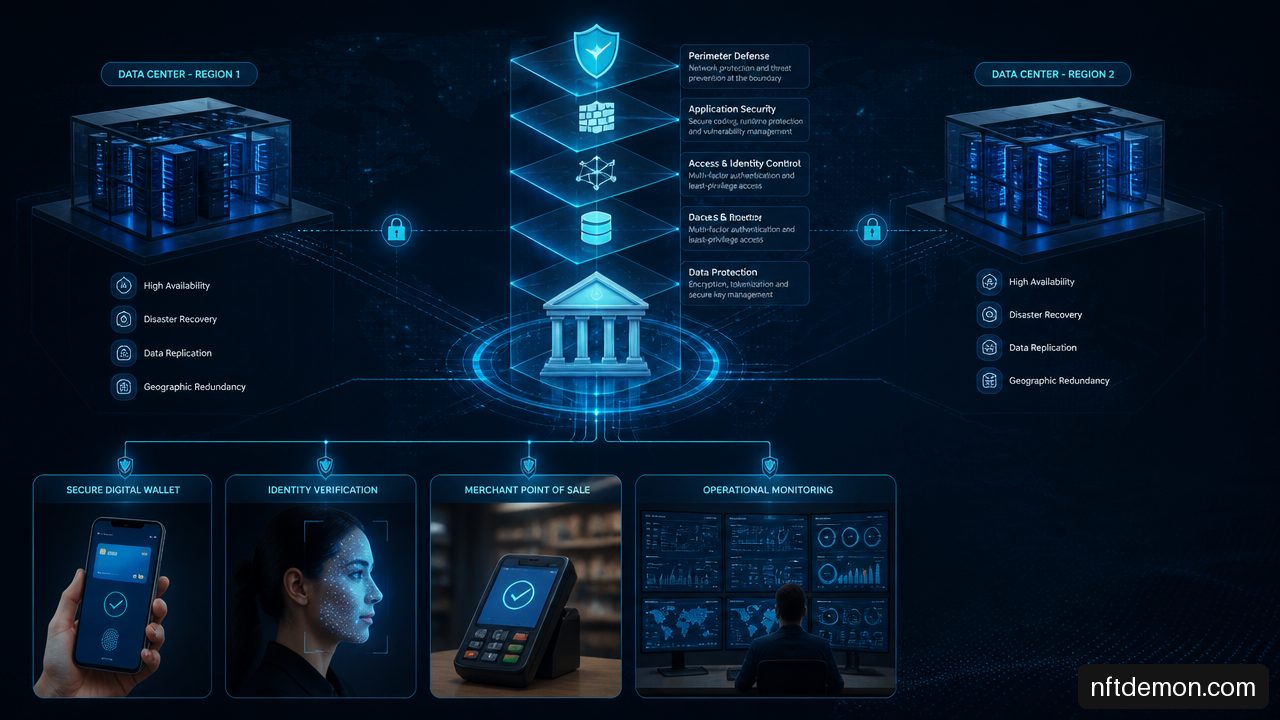
Security architecture should assume that failures will occur. I would make the following requirements contractual from the beginning rather than adding them shortly before launch:
- Geographic redundancy across separate facilities, with tested failover rather than paper recovery plans.
- Compartmentalization so that compromise of a wallet service, merchant interface, or analytics environment does not expose the core ledger.
- Least privilege access for administrators, operators, vendors, and support personnel.
- Cryptographic key governance with separation of duties, rotation procedures, hardware protections, and recovery authority.
- Observable recovery through rehearsed incident response, immutable logs where appropriate, and independent audit trails.
Offline payment capability deserves special caution. It may improve continuity during network outages and help users with unreliable connectivity. Yet it also raises difficult questions about value stored on devices, device loss, delayed fraud detection, spending limits, and double spending recovery. I would treat offline functionality as a constrained service with explicit limits and recovery rules, not as a feature that can be promised without operational testing.
Use Stage Gates Instead Of Open Ended Pilots
A CBDC program should have permission to pause, redesign, or stop. Without stage gates, a proof of concept can become an expensive demonstration that never resolves the core policy question.
The IMF describes a progression from preparation through proof of concept, prototype, pilot, and production. Its guidance notes that iterative pilot programs can assess feasibility, benefits, risks, onboarding, operational readiness, and quality assurance before launch. A related IMF publication similarly explains that controlled pilots help test stakeholder participation and operational readiness before production.
Define Exit Criteria Before Building
The distinction between stages is not how polished the interface looks. It is the question being answered and the decision that follows.
| Stage | Question Being Tested | Exit Decision |
|---|---|---|
| Preparation | Is there a legal mandate, public objective, capability base, and risk case? | Proceed only if policy value exceeds identified institutional and financial risks |
| Proof Of Concept | Can the critical technical function work under controlled conditions? | Stop if the core mechanism is infeasible or requires unacceptable compromises |
| Prototype | Can the architecture integrate with identity, payment, and intermediary systems? | Redesign if integration creates unmanageable cost, delay, or control gaps |
| Pilot | Can a complete ecosystem operate safely with real participants? | Expand, redesign, pause, or withdraw based on predefined evidence |
| Production | Can the service meet continuing public obligations at scale? | Maintain only with ongoing resilience, inclusion, and governance performance |
A useful pilot scorecard separates three categories that are often confused:
• Adoption metrics: active users, repeat transactions, merchant acceptance, and intermediary participation.
• Public value metrics: successful access by underserved groups, payment completion during disruption, user comprehension, affordability, and trust.
• System readiness metrics: incident recovery time, fraud response, reconciliation accuracy, service availability, support resolution, and audit findings.
High transaction volume alone is weak evidence. Consider a pilot where government transfers create thousands of wallet transactions on a single day, but recipients cash out immediately, merchants do not accept payments, and support requests remain unresolved. The program may have processed volume without creating durable payment utility.
Design Pilots To Find Failure
I would structure pilots around adverse conditions, not polished demonstrations. Test a regional connectivity outage, a surge in transaction attempts, a compromised intermediary credential, an inaccessible registration journey, duplicate payment claims, and a merchant refund. Each test should have a named owner, time limit, decision threshold, and customer communication plan.
The smallest credible test is a minimum viable ecosystem, not a minimum viable wallet. It includes the central bank, selected intermediaries, merchants, identity or registration services, settlement functions, customer support, fraud operations, and a representative user group. A transit wallet pilot, for instance, is not credible if it only proves that a commuter can tap a phone. It must also prove merchant reconciliation, lost device recovery, help desk escalation, and service continuity when connectivity drops.
Build A Minimum Viable Ecosystem
A CBDC launch depends on the willingness and ability of institutions to participate. Banks need a viable operating role. Merchants need low friction acceptance. Government agencies need reliable disbursement and reconciliation. Consumers need a reason to keep value in the system after an initial incentive ends.
IMF adoption work frames the task as a combination of regulation, education and communication, design and deployment choices, and incentives. The IMF’s corresponding online analysis of CBDC adoption strategy reinforces that these levers must work together rather than as isolated launch campaigns.
Match Incentives To The Actual Bottleneck
Incentives should solve a diagnosed constraint. A consumer reward may increase downloads but will not fix merchant acceptance. A merchant subsidy may increase terminal integration but will not help if settlement is slow or refunds are difficult. A bank participation payment may attract providers but can create dependency if it does not lead to a sustainable operating model.
| Bottleneck | Better Response | Weak Response |
|---|---|---|
| Low merchant acceptance | Reuse existing payment rails, simplify reconciliation, offer targeted integration support | Broad consumer wallet giveaway |
| Low consumer trust | Clear privacy rules, reliable support, transparent dispute processes | Advertising without operational proof |
| Exclusion during onboarding | Physical registration plus proportionate e KYC routes | Smartphone only identity flow |
| Limited intermediary participation | Defined service standards, viable fees, clear liability allocation | Assuming participation is automatic |
| Poor repeat use | Focus on a recurring payment use case such as transit or government receipts | One time promotional incentives |
There is limited standardized evidence on which incentive produces durable CBDC adoption across jurisdictions. I would therefore tie every subsidy or fee change to a specific KPI and expiry date. If a targeted merchant payment does not improve active acceptance after the agreed measurement period, redesign the integration or retire the incentive rather than extend it indefinitely.
Prepare The Operating Model Before Public Launch
Governance should identify who owns each decision: monetary policy implications, platform operations, cybersecurity, consumer protection, intermediary supervision, communications, and incident authority. This is not bureaucratic overhead. During an outage or fraud event, unclear authority can become the dominant failure.
A practical operating model should define:
• Who authorizes issuance, redemption, balance limits, and emergency controls.
• How intermediaries are licensed, monitored, compensated, and removed.
• How transaction disputes, lost credentials, mistaken payments, and fraud claims are handled.
• How public communications work during service degradation or policy changes.
• How vendors are audited, replaced, and prevented from becoming irreplaceable infrastructure dependencies.
Decision makers can apply the same discipline used in creating an enterprise blockchain operating model: assign accountable owners, specify control boundaries, measure service quality, and test escalation paths before scale makes errors systemic.
Key Takeaways
The practical answer is simple, even if execution is not: choose a narrow policy objective, build an interoperable operating ecosystem around it, and make every stage earn the right to continue.
• Select retail or wholesale scope based on the payment problem, not technology preference.
• Prefer an intermediated retail model when regulated providers can support access, service quality, and consumer protection.
• Measure adoption, public value, and system readiness separately so transaction volume does not hide weak inclusion or resilience.
• Treat interoperability as a migration and operations challenge involving merchants, reconciliation, identity, support, and settlement.
• Test failure scenarios deliberately, including outages, fraud, accessibility barriers, refund exceptions, and recovery procedures.
• Define pause, redesign, and withdrawal decisions before a pilot begins.
Frequently Asked Questions
What Is The Most Practical Implementation Strategy For A Retail CBDC?
The most practical strategy is usually a phased, intermediated model with one high frequency use case and a limited geographic or user segment. Start with a payment problem that can be measured, such as government disbursements, transit, or merchant payments in an underserved area. Avoid nationwide release until onboarding, acceptance, support, fraud controls, and recovery have been tested together.
Should A CBDC Be Issued Directly By The Central Bank Or Through Intermediaries?
An intermediated model is generally more practical where banks and payment providers already serve consumers and merchants. It preserves a role for private sector distribution while allowing the central bank to control issuance and core settlement. A direct model may be considered where the existing market cannot reliably provide access or where public policy requires stronger central delivery, but it expands the central bank’s consumer operations burden substantially.
Which Use Cases Should A CBDC Pilot Test First?
Choose a use case with repeated transactions, clear participant incentives, and manageable risk. Government to person payments can test enrollment and disbursement. Transit can test low value, high frequency merchant acceptance. Wholesale settlement can test institutional integration. Cross border remittances may offer value but add legal, foreign exchange, identity, and correspondent banking complexity, so they are usually harder to isolate in an early pilot.
How Can A CBDC Work With Existing Bank Accounts And Payment Terminals?
Use shared standards and integration layers that allow CBDC wallets or accounts to interact with existing merchant acceptance, bank reporting, identity, and settlement processes. The key test is operational: can a merchant accept payment, issue a refund, reconcile the day, and resolve a dispute without creating an expensive parallel workflow? If not, technical connectivity is not enough.
How Should Privacy Be Balanced With Anti Money Laundering Controls?
Use proportionate controls. Lower risk, lower value transactions may support simplified onboarding and narrower data collection, while larger or riskier activity can require stronger identity checks and monitoring. The legal framework should clearly state data access, retention, oversight, and redress rights. The right balance depends on local law, financial crime risk, identity coverage, and public expectations.
What Should Count As A Successful CBDC Pilot?
Success should mean more than a functioning wallet or a high transaction count. A successful pilot demonstrates that users can register and transact, merchants can accept and reconcile payments, intermediaries can meet service standards, security controls work under stress, and excluded groups are not systematically left behind. It should also produce a credible decision: expand, redesign, pause, or stop.
When Should A Central Bank Pause Or Redesign A CBDC Program?
Pause when the policy objective is unclear, legal authority is incomplete, core participants cannot sustain their role, or serious resilience and inclusion gaps remain unresolved. Redesign when a pilot reveals a fixable mismatch, such as a poor registration process or merchant integration burden. Stopping can be responsible when the public value case does not justify the continuing operational, financial, or institutional risk.
Sources / References
elibrary.imf.org — https://www.elibrary.imf.org/downloadpdf/view/journals/007/2024/052/007.2024.issue-052-en.pdf
imf.org — https://www.imf.org/-/media/files/publications/ftn063/2024/english/ftnea2024005.pdf
elibrary.imf.org — https://www.elibrary.imf.org/view/journals/007/2024/052/article-A001-en.xml
imf.org — https://www.imf.org/-/media/files/publications/ftn063/2023/english/ftnea2023007.pdf
NFT Demon Holdings helps enterprises scope, evaluate, and build blockchain programs — start with a free evaluation call.
Talk through your use case
Free evaluation call — objective, constraints, and fit, before any proposal.