Building automated smart contract exploit detection and front running prevention mechanisms
By Jeremy Ryan, Founder & CEO · September 2026
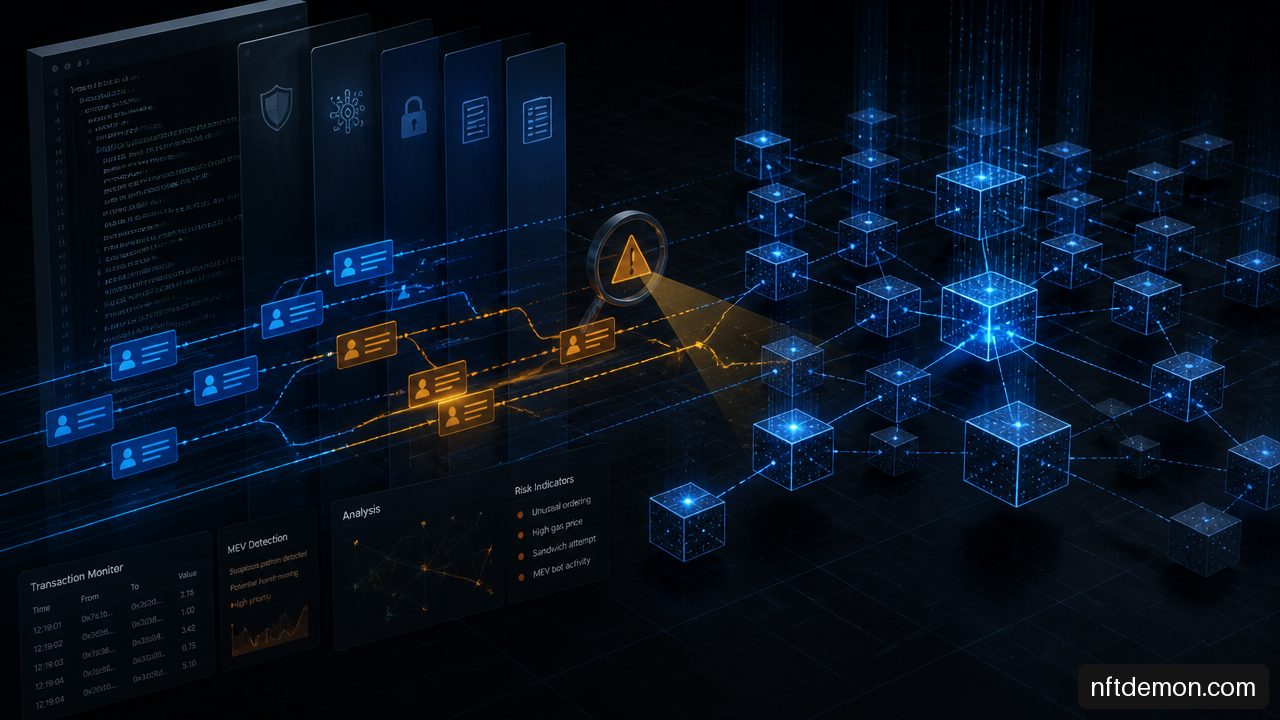
Building automated smart contract exploit detection and front-running prevention mechanisms requires more than adding a scanner to a continuous integration pipeline. A dependable program combines code analysis, transaction-state validation, exploitability testing, runtime monitoring, and transaction-ordering controls. The objective is not to produce more alerts. It is to identify the few conditions that can realistically cause loss, manipulation, or protocol failure.
Design the Detection Architecture
Start With an Exploitability Model, Not a Tool List
I recommend treating exploit detection as a risk decision system. A finding matters when an attacker can satisfy the required conditions, reach the vulnerable state, and obtain a meaningful outcome before a protocol control stops the attempt. That definition is stricter than identifying a code smell.
For decision makers, this distinction has direct budget implications. A static scanner may identify a public function that changes an asset price, but that alone does not prove front-running. The team must determine whether a pending transaction exposes a profitable ordering opportunity, whether the attacker can insert or reorder transactions, and whether slippage, access control, deadlines, or settlement rules remove the profit.
The practical target is verified exploitability: a reproducible path from contract state and attacker action to an unauthorized or economically harmful result.
A strong architecture separates detection layers by their job:
| Layer | Primary Job | Best Use Case | Main Limitation |
|---|---|---|---|
| Static analysis | Find dangerous code patterns and data flows | Broad predeployment scanning | Can produce false positives without state context |
| Symbolic execution | Prove feasible paths under constraints | High-risk contracts and complex authorization logic | Computationally expensive on large path spaces |
| Transaction replay | Recreate state-dependent behavior | Validating incidents and suspected exploits | Depends on accurate state and transaction ordering |
| Exploit synthesis | Confirm whether a finding can be weaponized | Final validation of severe findings | Must remain sandboxed and tightly controlled |
| Runtime monitoring | Detect suspicious behavior after deployment | Protocols exposed to changing market conditions | Usually detects risk after exposure begins |
This layered approach is particularly relevant for DeFi systems that rely on price-sensitive functions, liquidation logic, auctions, governance execution, bridges, and settlement mechanisms. Those systems are not merely executing functions. They are operating within an adversarial transaction-ordering environment.
Choose Analysis Methods by Stage and Risk
Static analysis should be the default early-stage control because it is fast enough to run on every pull request. Use it to identify unrestricted external calls, inconsistent access checks, arithmetic assumptions, state updates after interactions, oracle dependencies, and transaction-order-sensitive writes.
Symbolic execution belongs later in the process, after triage has reduced the candidate set. It is most useful when a suspected vulnerability depends on several constraints at once. For example, a liquidation function may only be exploitable if collateral values, debt thresholds, stale oracle data, and transaction order align. Pattern matching alone cannot reliably establish that chain.
For front-running specifically, research summarized in HKUST’s Nyx repository entry describes a two-stage process that uses Datalog-based pruning before symbolic validation. The design lesson is straightforward: perform inexpensive logic filtering first, then reserve SMT solver capacity for paths that may actually be exploitable.
Runtime monitoring is necessary when the protocol’s risk depends on conditions unavailable at compile time. This includes volatile prices, rapidly changing liquidity, sequencer conditions, governance voting activity, or repeated failed transactions that may signal probing. It should not replace preventive controls. It should provide a final detection layer and trigger an incident response path.
Treat Transaction Ordering as a First-Class Threat Assumption
Front-running is not one generic weakness. It is a family of failures caused by transaction ordering, insertion, censorship, or visibility. The relevant adversary may be a searcher observing public pending transactions, a sophisticated MEV operation, or a participant exploiting predictable ordering inside a protocol workflow.
The design question is therefore not simply, “Is the mempool public?” It is: What information becomes actionable before settlement, and can an attacker alter the result by acting first or acting around the victim?
A swap is exposed differently from a governance vote. A liquidation race has different incentives from a commit-reveal auction. Each needs separate detection rules, separate mitigations, and separate validation scenarios.
For systems expected to process significant activity, detection infrastructure also has to scale with deployment architecture. Designing blockchain applications for high transaction volumes is relevant here because high throughput increases the number of paths, transaction combinations, and state transitions the security pipeline must evaluate.
Build an Exploitability Validation Pipeline
Separate Triage From Proof
The most common failure in automated security programs is collapsing detection and validation into one step. A scanner finds a suspicious path, labels it critical, and sends it to engineering. That approach creates alert fatigue, delays releases, and eventually causes teams to ignore meaningful warnings.
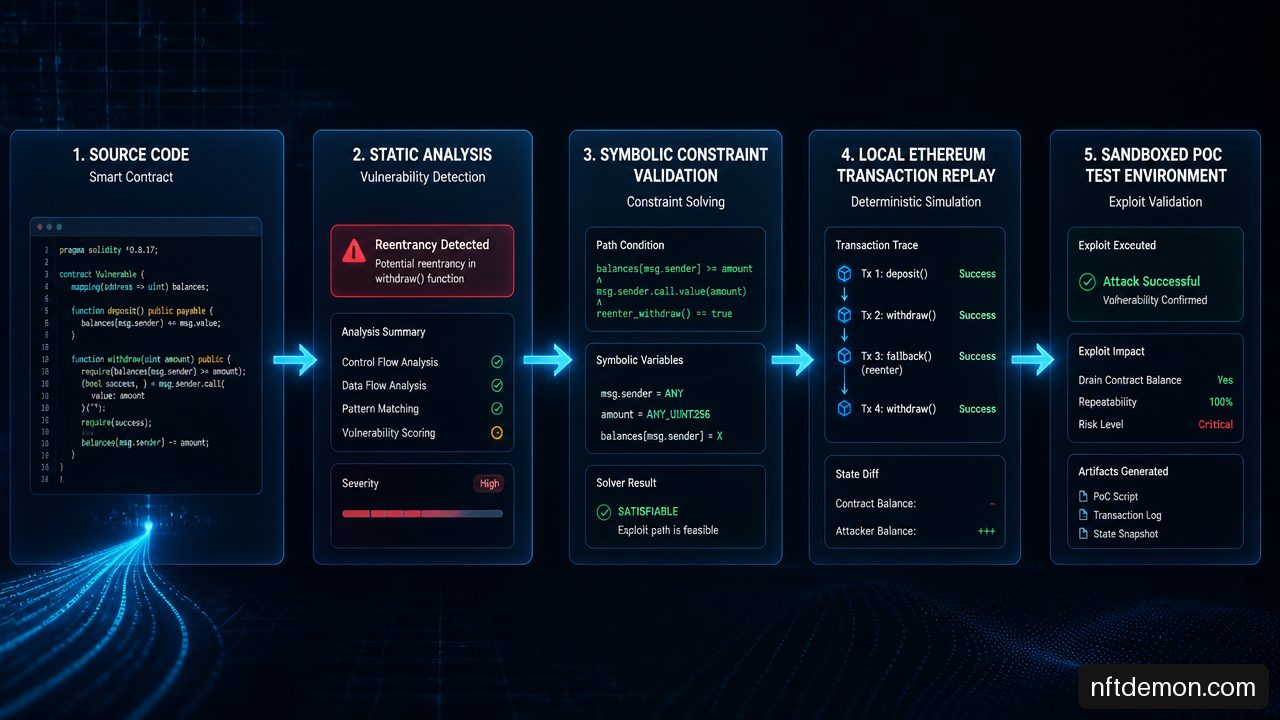
A better process uses a gated pipeline:
- Ingest and normalize source artifacts. Compile contracts, resolve dependencies, identify proxy patterns, and map privileged roles.
- Run broad static rules. Detect known vulnerability classes, external call patterns, storage writes, price-sensitive functions, and ordering-dependent state transitions.
- Build a behavioral graph. Map callers, state variables, value flows, oracle reads, token transfers, and cross-contract dependencies.
- Apply exploitability triage. Rank findings by reachability, attacker control, value at risk, transaction visibility, and required assumptions.
- Validate high-risk paths symbolically. Use an SMT solver to test whether constraints can be satisfied under an attacker model.
- Replay relevant state locally. Fork or reconstruct the target chain state, then execute candidate transactions in varying order.
- Generate a safe proof of concept. Confirm whether an attacker can achieve the claimed outcome in a sandbox without interacting with production systems.
- Create an actionable remediation record. Include the vulnerable invariant, reproducible test, proposed patch, residual risk, and monitoring rule.
This is not procedural overhead. It is how a program distinguishes “potentially dangerous code” from a condition that can drain funds, distort a price, bypass a rule, or lock protocol operations.
Use State Replay to Eliminate False Confidence
State is often the missing variable in security claims. A function can appear exploitable in isolation but become harmless because an earlier transaction changes a reserve, updates a checkpoint, consumes a nonce, or invalidates a price.
Consider a suspected sandwich attack against an automated market maker. A detector sees a swap that accepts a user-controlled minimum output of zero. That is a meaningful alert, but exploitability depends on pool liquidity, the victim trade size, current reserves, gas costs, and whether the attacker can reliably bracket the transaction. Transaction replay lets the system test the exact prestate and simulate attacker-victim-attacker ordering.
The EVMbench benchmark description is useful because it evaluates detection, patching, and exploit tasks with transaction replay and on-chain verification. The broader operational lesson is that a detector should be evaluated against behavior, not just labeled source code.
Use Exploit Generation as a Verification Layer
Safe exploit synthesis can improve precision because it forces a finding to survive execution. If the tool cannot construct inputs, ordering, funding, approvals, or state conditions needed to reproduce the issue, the finding may still deserve review, but it should not be treated as confirmed exploitation.
The Automated Exploit Generation for Smart Contracts paper describes an end-to-end approach connected to Foundry for compilation, execution, and proof-of-concept validation. Foundry-based testing is practical because it supports local execution, state manipulation in controlled tests, and assertions about balances, invariants, and revert conditions.
Fair warning: a proof of concept should be designed to demonstrate the minimum harmful capability. It should not be built as a reusable production attack tool. Restrict execution to local forks, simulator environments, or isolated test networks; remove real keys; cap test balances; and log each action for review.
Research organizations have made this boundary explicit. Anthropic’s smart contract exploit research states that exploit validation was performed only in blockchain simulators. That is an appropriate operating model for automated validation systems.
Map Front-Running Defenses to Attack Patterns
Detect Ordering Risk by Economic Effect
A front-running detector should identify the economic effect of ordering, not merely note that two functions write to the same state variable. The following matrix connects observable code and transaction behavior to preventive controls.
| Attack Pattern | Detection Signal | Primary Prevention | Important Limitation |
|---|---|---|---|
| Sandwich attack | Public swap, weak slippage bounds, predictable price impact | User slippage limits, deadlines, private submission routes | Private routing does not fix unsafe swap parameters |
| Liquidation race | First-caller reward, public unhealthy position, predictable eligibility | Bounded incentives, batch auctions, keeper design | Some competition is intentional and cannot be eliminated fully |
| Governance race | Vote or execution outcome changes before a known deadline | Snapshot voting, timelocks, commit-reveal where appropriate | Timelocks do not prevent all vote-buying or off-chain coordination |
| Auction bid front-run | Bid value visible before close | Commit-reveal bidding, sealed bids | Reveal windows and non-reveals require carefully designed penalties |
| Oracle update manipulation | Transaction uses predictable stale or delayed price state | Freshness checks, confidence bounds, settlement delays | More checks can reduce availability during volatility |
A useful automated rule identifies a potential sandwich vulnerability when all of the following are present:
• A user-submitted transaction changes a market price or reserve ratio.
• The user permits execution within a broad price range or supplies no meaningful minimum output.
• The attacker can trade the same asset pair immediately before and after the victim.
• The expected margin remains positive after fees, slippage, and gas.
That final condition matters. Without it, the detector is identifying an ordering possibility, not necessarily an exploitable opportunity.
Use the Right Prevention Mechanism for the Right Failure
Private transaction submission can reduce exposure to public mempool observers, but it is not a universal front-running defense. It may reduce sandwich risk for a particular transaction, yet it does not correct a contract that rewards the first caller excessively, permits arbitrary price movement, or exposes a governance action before execution.
Commit-reveal schemes work best when intent must remain hidden until a defined reveal phase. They can protect auctions, certain governance workflows, and value-sensitive submissions. They are a poor fit when users need immediate execution, because the added phases create latency and introduce abandonment risk. A participant may commit but fail to reveal, whether by error, lost key material, or strategic choice.
Slippage protection is essential for swap users and aggregators, but it must be calibrated. A zero or overly tight tolerance can cause transactions to fail during normal market movement. A broad tolerance may allow harmful execution. The detector should therefore examine not only whether a parameter exists, but whether product defaults, interface constraints, and routing logic allow unsafe values.
For governance, time delays and snapshot rules are often more relevant than private routing. For liquidations, a protocol may choose to manage competition through fixed rewards, batch settlement, or designated keeper mechanisms. No consensus exists on one best design because the right trade-off depends on decentralization goals, liquidity needs, and acceptable execution delay.
Build Rules Around Invariants
The strongest preventive control is often an invariant rather than a transaction routing tactic. Examples include:
• A swap must never execute below the user’s stated minimum output.
• A liquidation reward must remain bounded relative to the debt repaid and collateral received.
• A proposal cannot execute before its review and challenge windows close.
• A reveal cannot be accepted without a valid earlier commitment.
• A settlement price must satisfy defined freshness and confidence conditions.
These rules should exist in three places: contract code, predeployment tests, and runtime monitoring. Repetition is deliberate. A bug in one layer should not silently disable every layer.
Operate, Measure, and Improve the System
Measure What the Program Actually Needs
Raw finding volume is not a security metric. It may simply measure how noisy the scanner is. I would report metrics that connect detection to verified risk and remediation performance.
| Metric | What It Answers | Desired Direction |
|---|---|---|
| Confirmed exploitability rate | How many high-severity findings reproduce in a sandbox? | Higher precision |
| Front-running recall | How many known ordering flaws does the system identify? | Higher coverage |
| False-positive rate | How much engineering time is spent on nonissues? | Lower noise |
| Mean time to validate | How quickly can the team confirm or reject a severe alert? | Faster response |
| Mean time to remediate | How long does confirmed risk remain exposed? | Shorter exposure |
| Invariant test coverage | How many critical economic rules are continuously tested? | Broader coverage |
The need for front-running-specific measurement is not theoretical. In Combatting Front-Running in Smart Contracts, seven state-of-the-art vulnerability detection techniques achieved recall as low as 6.04% on front-running vulnerabilities. That result does not mean automation is ineffective. It means a generic detector can miss a large share of ordering-sensitive exploits if it lacks explicit economic and transaction-order reasoning.
Make Runtime Monitoring Actionable
Runtime monitoring should observe events that precede loss, not merely report loss after the fact. Useful signals include repeated reverted transactions against a high-value function, unusual bursts of calls around price updates, sudden changes in slippage distributions, unexpected governance transaction sequences, and clustered transactions that repeatedly interact with the same pool or position.
Each alert needs a predetermined response. For a suspected oracle or sandwich attack, that may mean raising required confirmations, pausing a narrow function, tightening circuit-breaker thresholds, or requiring multisignature review for an emergency parameter change. Broad pauses should be used carefully because they can create their own market and reputational damage.
Security operations also need to reflect platform architecture. Teams evaluating security and scalability in enterprise blockchain architecture should account for data pipelines, RPC dependencies, key management, monitoring permissions, and incident authority. A detector that cannot access reliable traces or cannot trigger a governed response is only partially operational.
Plan for Detector Failure
Every automated mechanism will fail under some conditions. Obfuscated logic, proxy upgrades, incomplete source verification, novel economic attacks, cross-chain dependencies, and rapidly changing market behavior all reduce confidence.
The recovery plan should include:
- A severity model that distinguishes suspected, validated, and actively exploited issues.
- A local replay environment that can reconstruct critical state quickly.
- Preapproved emergency controls with documented authority boundaries.
- A patch process that includes regression tests for the original exploit path.
- A post-incident rule update so the detection system learns from the event.
The goal is continuous improvement, not an unrealistic promise of perfect prevention. A mature program treats every validated exploit and every high-quality false positive as input for better rules, better models, and better threat assumptions.
Key Takeaways
The Operating Principles That Matter
• Build a layered system: static analysis for coverage, symbolic validation for precision, replay for state accuracy, exploit synthesis for confirmation, and monitoring for live risk.
• Separate suspicious code from verified exploitability. A finding should be prioritized by reachability, attacker control, economic impact, and reproducibility.
• Model sandwiching, liquidation races, governance races, and auction front-running separately. They do not share one universal defense.
• Validate severe findings in local or simulator environments. Safe proof-of-concept generation should demonstrate minimal impact without touching production systems.
• Measure front-running recall and confirmed exploitability rate, not just scanner output volume.
• Put critical invariants into contracts, tests, and monitoring rules so one failed control does not become a single point of failure.
FAQ
What Is the Best Architecture for Automated Smart Contract Exploit Detection?
The best architecture is hybrid. Use static analysis for broad coverage, symbolic execution for high-risk paths, transaction replay for state-dependent validation, controlled exploit synthesis for confirmation, and runtime monitoring for postdeployment conditions. A single method will either miss attacks or overwhelm the team with unverified alerts.
How Do You Detect Front-Running Vulnerabilities Automatically?
Detect functions where transaction order changes user outcomes or attacker profit. The system should trace shared state changes, price-sensitive actions, public pending transaction exposure, weak slippage constraints, first-caller rewards, and predictable execution windows. It should then simulate alternative transaction orderings to determine whether the effect is economically exploitable.
What Is the Difference Between Ordinary Ordering Risk and Exploitable Front-Running?
Ordinary ordering risk means results can differ when transactions execute in a different sequence. Exploitable front-running requires more: an attacker must be able to observe or predict the opportunity, alter ordering or insert transactions, and gain enough value to justify execution costs and risk.
Should Detection Be Static, Dynamic, Symbolic, or Hybrid?
Choose hybrid for production systems. Static analysis is appropriate for every code change. Symbolic validation is appropriate for high-value or complex findings. Dynamic replay is necessary when state, liquidity, or transaction ordering determines the outcome. Runtime monitoring is necessary when conditions evolve after deployment.
How Do You Reduce False Positives in Smart Contract Vulnerability Scanners?
Add exploitability gates. Confirm caller access, path reachability, state prerequisites, economic incentives, and reproducibility in a local environment. Rank results by value at risk and attacker control. A finding that cannot survive replay and constraint solving should not receive the same urgency as a reproducible loss path.
What Defenses Actually Prevent Front-Running in Production?
The defense depends on the attack. Slippage limits and deadlines reduce sandwich exposure. Commit-reveal reduces information leakage in staged workflows. Timelocks and snapshots help governance processes. Bounded rewards and batch mechanisms can reduce liquidation races. Private submission can reduce public mempool visibility, but it should supplement contract-level protections rather than replace them.
How Can LLMs Help Without Creating Too Many False Alarms?
LLMs can help summarize code, generate candidate rules, explain data flows, and prioritize suspicious paths. They should not be the final authority on exploitability. Require deterministic checks, symbolic constraints, transaction replay, and regression tests before treating an LLM-generated finding as confirmed.
Sources/References
• arXiv — Combatting Front-Running in Smart Contracts: https://arxiv.org/abs/2212.12110
• HKUST Repository — Nyx: Detecting Exploitable Front-Running Vulnerabilities in Smart Contracts: https://repository.hkust.edu.hk/ir/Record/1783.1-137171
• OpenAI — Introducing EVMbench: https://openai.com/index/introducing-evmbench/
• Anthropic — AI agents find smart contract exploits: https://www.anthropic.com/research/smart-contracts
• arXiv — Automated Exploit Generation for Smart Contracts: https://arxiv.org/abs/2508.01371
NFT Demon Holdings helps enterprises scope, evaluate, and build blockchain programs — start with a free evaluation call.
Talk through your use case
Free evaluation call — objective, constraints, and fit, before any proposal.