Benefits of tokenizing illiquid assets
By Jeremy Ryan, Founder & CEO · October 2026

The benefits of tokenizing illiquid assets are real, but they are often described too broadly. Tokenization can make an asset easier to divide, administer, distribute, and potentially trade. It does not, by itself, create buyers, reliable prices, or legally enforceable ownership rights.
For decision makers, that distinction is the starting point. A tokenized real estate interest, private-credit position, artwork, or infrastructure project can improve capital access and reduce operational friction. Yet the project still needs a sound legal structure, credible valuation, compliant investor onboarding, custody, and a market design that gives qualified buyers a reason to participate.
The practical value of tokenization is not that an illiquid asset becomes liquid overnight. It is that ownership, compliance, settlement, and administration can be redesigned around smaller, programmable, transferable units.
Main Topics
- Key Takeaways
- What Tokenization Changes for Illiquid Assets
- Where the Business Benefits Actually Come From
- How to Design a Tokenization Program That Holds Up
- Frequently Asked Questions
- Sources and References
Decision Lens
Before approving a tokenization initiative, we should ask four direct questions:
- What legal right does each token represent?
- Which existing process becomes cheaper, faster, or less error prone?
- Who is expected to buy, hold, and potentially resell the token?
- What happens when the underlying asset needs a human decision rather than an automated one?
Key Takeaways
Tokenization Improves Market Plumbing Before It Improves Liquidity
Tokenization is the digital representation of rights associated with an asset. Those rights may include economic interests, revenue distributions, debt claims, voting rights, redemption rights, or ownership interests held through a legal entity. The token is not necessarily the asset itself. In many structures, it represents a contractual or legal claim connected to the asset.
That distinction matters because an illiquid asset is illiquid for reasons that often sit outside the ledger: uncertain valuation, limited buyer demand, transfer restrictions, long due diligence cycles, regulatory rules, and complicated title. A blockchain record can improve transfer coordination, but it cannot cure every one of those constraints.
Fractional Ownership Broadens Access, but It Raises Governance Demands
Fractional ownership can reduce high investment minimums. An investor may be able to purchase a smaller interest in a property, private fund, collectible, or private-credit pool rather than acquiring the entire asset or meeting a large minimum subscription amount. The OECD notes that fractional ownership can lower investment barriers for assets that are difficult to divide or previously unaffordable.
Broader access is useful only if investor protections scale with it. Smaller ticket sizes can mean more holders, more disclosures, more communications, more tax records, and more eligibility checks. The issuer needs governance that works for hundreds or thousands of holders, not just a small group of sophisticated counterparties.
What Tokenization Changes for Illiquid Assets
It Converts a Large, Static Interest Into Smaller Transferable Units
A conventional illiquid asset frequently has a single ownership document, a limited partnership interest, a private share register, or a manual transfer process. Selling an interest can involve legal review, signed documents, transfer-agent updates, payment instructions, and approval from the issuer or manager.
Tokenization can represent those interests as digital assets on a distributed ledger. Each token can correspond to a defined portion of the economic interest, subject to the legal documents governing the offering. A smart contract may enforce rules about who can receive tokens, whether transfers require approval, and how distributions are calculated.
Consider a commercial building held through a special-purpose entity. Tokenization does not mean every token holder receives a deed to one square foot of the building. More commonly, holders own interests in the entity that owns the building, with rights defined by operating agreements, offering documents, and applicable securities law. The ledger can track token ownership efficiently, but the legal agreements determine what ownership means.
It Separates Capital Formation From Secondary-Market Liquidity
This is one of the most important distinctions in the category.
Primary-market financing occurs when an issuer sells tokens to raise capital. A developer might issue tokenized interests to fund a property acquisition. A private company might issue tokenized debt instruments. An art investment vehicle might sell fractional interests in a collection.
Secondary-market liquidity occurs later, when existing holders can sell to new buyers. The second outcome requires more than token issuance. It needs a compliant venue or transfer mechanism, investor demand, price discovery, custody support, and enough transaction activity to make quotes meaningful.
GARP makes the point clearly: fractional tokens may broaden the potential investor pool, but broader participation alone does not establish a liquid secondary market. A project can successfully raise capital and still have thin or nonexistent resale activity.
| Question | Primary Capital Formation | Secondary-Market Liquidity |
|---|---|---|
| Core objective | Fund an issuer or asset | Allow existing holders to exit or rebalance |
| Primary buyer | Initial subscriber | New qualified buyer |
| Critical requirement | Clear offering and use of proceeds | Recurring demand and compliant transfer venue |
| Main risk | Failure to raise target capital | Sparse trading and unreliable price discovery |
| Tokenization value | Streamlined issuance and ownership records | Potentially easier transfer and settlement |
It Creates a Better Administrative Record, Not Automatic Valuation Certainty
Distributed ledgers can provide a synchronized history of token issuance, ownership changes, and programmed events. That can reduce reconciliation among administrators, custodians, issuers, and approved trading venues. It can also provide a cleaner audit trail for transfers, distributions, and compliance actions.
Still, transaction history is not the same as valuation accuracy. A tokenized private-credit position remains dependent on borrower performance, collateral quality, payment history, and credit analysis. A tokenized building remains dependent on lease income, occupancy, comparable sales, and property condition.
Where trading is limited, a displayed token price may reflect the last small transaction rather than the economic value of the full asset. Decision makers should establish a valuation policy before launch: independent appraisal, net asset value methodology, periodic pricing committee review, or another documented approach appropriate to the asset class.
Where the Business Benefits Actually Come From
Lower Friction in Issuance, Transfers, and Settlement
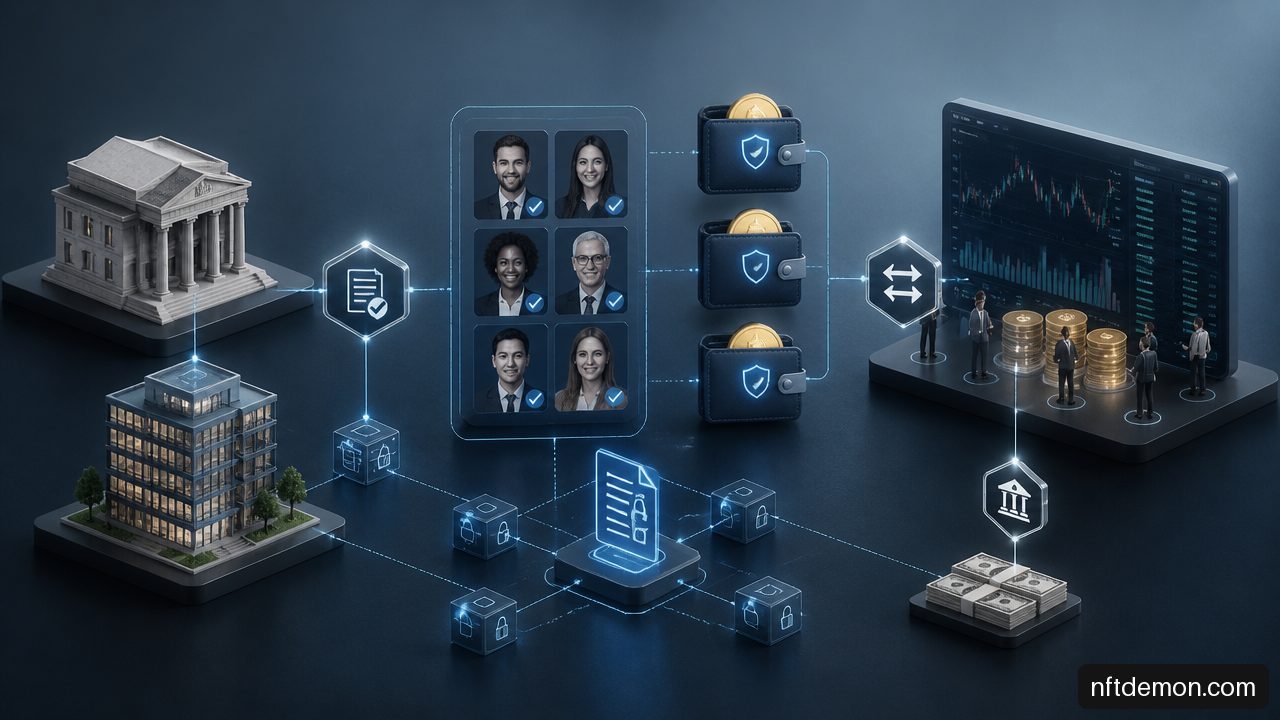
The most credible efficiency case is not “blockchain removes all intermediaries.” It is more specific: tokenization can reduce duplicated data entry, manual reconciliation, fragmented ownership records, and repetitive approval steps.
For example, an issuer may combine identity verification, investor eligibility, transfer restrictions, payment instructions, cap-table updates, and distribution records into a controlled digital workflow. Some intermediaries remain essential, including legal counsel, regulated custodians, administrators, auditors, tax professionals, and valuation specialists. The question is whether their data and approvals can be coordinated more effectively.
Smart contracts can automate selected actions when specified conditions are met. For a tokenized revenue-sharing asset, that could mean calculating each holder’s pro rata distribution once a verified payment amount is available. For a restricted security token, it may mean blocking transfers to wallets that are not associated with eligible, verified investors.
A smart contract is only as reliable as the rules and data it receives. If a borrower defaults, a property is damaged, or a regulator changes a transfer condition, the event begins outside the blockchain. An oracle, administrator, or authorized party must provide the relevant information. Good systems make that responsibility visible rather than pretending code can replace judgment.
For financial modeling, a blockchain business case template for cost savings can help separate genuine process savings from technology costs that have merely been relocated.
Broader Distribution and More Flexible Investment Sizes
Tokenization can make it operationally easier to offer smaller investment units to a broader group of eligible investors. That may be especially relevant when the underlying asset has a high purchase price but understandable economics, such as stabilized income-producing real estate or a diversified private-credit portfolio.
The potential advantages include:
• Lower minimum investment sizes for qualifying investors.
• More precise allocation of ownership interests.
• Potential access to investors across multiple jurisdictions, subject to local rules.
• More flexible portfolio construction for investors who do not want concentrated exposure.
• A potentially larger addressable pool of capital for asset owners.
However, global distribution is not the same as global eligibility. Securities, collective-investment, consumer-protection, anti-money-laundering, sanctions, tax, and marketing rules can limit who may buy or receive a token. Transfer restrictions should be designed into the legal and technical architecture from the start.
Better Workflow Interoperability Can Be More Valuable Than Trading
Many organizations focus first on continuous trading. In practice, the stronger near-term use case may be operational interoperability.
An asset manager might use tokenization to maintain a synchronized investor register, permit controlled wallet-to-wallet transfers, automate distribution calculations, and provide administrators with a single source of ownership data. That may create measurable value even if tokens trade only occasionally.
This is especially relevant for assets with naturally long holding periods. A renewable-energy project, a private-credit facility, or a development-stage property may not need daily trading to benefit from improved servicing and reporting. The more relevant metric may be reduced reconciliation time, fewer manual exceptions, faster investor onboarding, or cleaner audit evidence.
For consumer and membership programs, the same design discipline applies to NFTs and other digital assets. An enterprise NFT strategy with measurable outcomes should define the holder rights, operating workflow, and business metric before selecting the token format.
Asset Suitability Determines Whether the Model Is Worth Building
Not every illiquid asset benefits equally. The best candidates have definable rights, credible servicing processes, a reasonable valuation method, and a plausible investor audience.
| Asset Type | Strong Tokenization Fit When | Primary Constraint |
|---|---|---|
| Income-producing real estate | Cash flows, entity ownership, and reporting are clearly defined | Title, valuation, and securities compliance complexity |
| Private credit | Loan terms, payment schedules, and servicing data are structured | Credit risk, borrower confidentiality, and transfer limits |
| Infrastructure or project finance | Revenue rights and governance are contractually clear | Long timelines and operational-event complexity |
| Art and collectibles | Authenticity, custody, and fractional legal rights are well documented | Subjective valuation and thin buyer demand |
| Venture or private-company interests | Transfer rights and shareholder approvals can be managed | Corporate restrictions and uncertain exit timing |
Avoid tokenization when the ownership right is unclear, the asset cannot be valued credibly, transfers are legally impractical, or there is no plausible distribution strategy. A digital wrapper around an uninvestable asset does not solve the underlying investment problem.
How to Design a Tokenization Program That Holds Up
Start With Rights, Restrictions, and the Operating Model
We should begin with the legal and commercial model, not the chain selection. Define exactly what a token holder receives and what they do not receive. Is the token a direct ownership interest, a debt claim, a beneficial interest in a trust, a contractual participation right, or access to revenue distributions?
Then document the lifecycle:
- Asset acquisition or origination.
- Issuance and investor onboarding.
- Custody and wallet controls.
- Transfer approval and compliance screening.
- Valuation and reporting.
- Cash distributions, voting, redemptions, or maturity events.
- Default, dispute, wind-down, or asset sale procedures.
The hard cases belong in the initial design. What if a holder loses access to a wallet? What if a sanctions screen changes after issuance? What if an investor dies, a custodian fails, or an asset manager needs to correct an administrative error? A robust program defines authorized intervention, dispute resolution, and recordkeeping requirements before capital is raised.
Build Liquidity Deliberately Rather Than Advertising It
A tokenized asset needs a market structure. Potential elements include approved investor lists, licensed or compliant trading venues where required, bilateral transfer workflows, periodic auction windows, liquidity providers, issuer repurchase policies, and transparent valuation disclosures.
Each method has trade-offs. A continuous market may sound attractive but requires dependable participation. Periodic auctions can concentrate demand into specific windows, which may improve price discovery for infrequently traded assets. A controlled transfer process may be slower, but it can fit highly regulated or institutionally held assets better than unrestricted trading.
Fair warning: promising instant exits against a multi-year underlying investment creates a liquidity mismatch. If token holders expect daily redemption while the issuer holds long-dated, hard-to-sell assets, stress can emerge when many holders want to sell at once. The structure needs clear expectations about transferability, redemption rights, and pricing during periods of low demand.
Measure Success Against the Original Business Problem
A tokenization project should have metrics that correspond to the stated purpose. If the purpose is capital formation, measure qualified investor conversion, capital raised, time to close, and distribution reach. If the purpose is operations, measure reconciliation exceptions, administrative time, settlement failures, and audit effort. If the purpose is liquidity, track active holders, transfer volume, bid-ask spreads where available, transaction frequency, and time to complete a compliant sale.
The appropriate benchmark may be a fund structure, securitization, a conventional private placement, or a traditional transfer-agent workflow. Tokenization is not automatically superior to these alternatives. It is stronger where programmable ownership and shared records replace genuinely costly friction.
Decision makers can use how executives measure blockchain ROI to connect technical activity with financial and operational outcomes rather than relying on token issuance as the success metric.
Frequently Asked Questions
Ownership, Access, and Liquidity
What Does It Mean to Tokenize an Illiquid Asset?
It means representing defined legal or economic rights associated with an asset as digital tokens. The token may represent equity, debt, beneficial ownership, revenue participation, or another contractual claim. The governing documents, not the token label alone, determine the holder’s enforceable rights.
Does Tokenization Guarantee That an Asset Will Become Liquid?
No. Tokenization can make interests easier to divide and transfer, but liquidity requires interested buyers, acceptable pricing, compliant market access, and sufficient trading activity. A token with no buyers remains illiquid, even if it can technically move between wallets.
How Does Fractional Ownership Improve Access to Private Assets?
Fractional ownership can lower the amount required to participate. Instead of purchasing an entire asset or meeting a large minimum subscription, qualified investors may purchase smaller units. That can improve diversification, but issuers must still manage suitability, disclosures, transfer restrictions, and investor servicing.
Operations, Trading, and Compliance
Can Tokenized Assets Be Traded 24/7?
A blockchain may operate continuously, but legal and operational trading availability is conditional. Investor eligibility checks, venue hours, payment rails, custody controls, local regulations, and network conditions can all limit when a compliant transfer settles. A continuously available ledger is not the same as a continuously active market.
How Do Smart Contracts Improve Administration?
Smart contracts can automate defined actions, such as applying transfer restrictions, recording ownership changes, calculating distributions, or releasing funds after approved conditions are met. They work best when the required data is structured and trustworthy. Events such as appraisal changes, defaults, and title disputes still require verified off-chain inputs and responsible human oversight.
What Legal Rights Does a Token Holder Actually Receive?
That depends on the offering and legal structure. A holder may receive voting rights, cash-flow rights, redemption rights, or only a contractual claim against an issuer. Before investing or issuing, review the governing agreements, risk disclosures, custody arrangement, transfer rules, and applicable securities or investment regulations.
Which Assets Are Best Suited to Tokenization?
Assets with clear rights, repeatable administration, credible valuation methods, and identifiable investor demand are generally stronger candidates. Stabilized real estate, structured private credit, and defined project-revenue interests may fit better than assets with disputed title, irregular data, or no realistic buyer base.
Sources and References
oecd.org
- https://www.oecd.org/content/dam/oecd/en/publications/reports/2021/11/understanding-the-tokenisation-of-assets-in-financial-markets_2e657111/c033401a-en.pdf
garp.org
- https://www.garp.org/risk-intelligence/technology/tokenization-benefits-risks-250124
NFT Demon Holdings helps enterprises scope, evaluate, and build blockchain programs — start with a free evaluation call.
Talk through your use case
Free evaluation call — objective, constraints, and fit, before any proposal.