Asset tokenization platforms enterprise buyers should evaluate
By Jeremy Ryan, Founder & CEO · October 2026
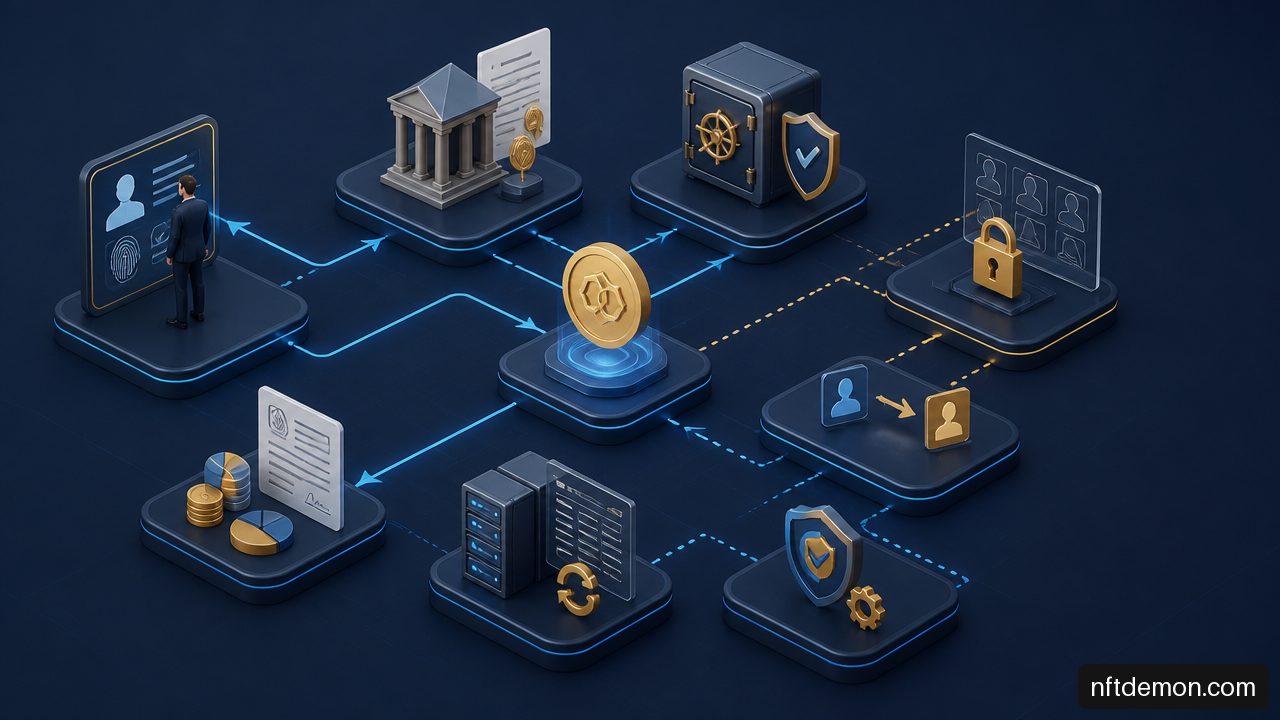
Asset tokenization platforms enterprise buyers should evaluate are not simply token-minting tools. They are operating systems for representing legally defined rights, controlling who can hold them, administering the asset through its lifecycle, and reconciling blockchain activity with existing financial and legal records.

For decision makers, the central question is not, “Which platform can create a token?” Nearly any capable development stack can do that. The harder question is whether the platform can support enforceable ownership, investor eligibility, custody, servicing, accounting, privacy, recovery, and distribution without creating a second, disconnected set of books.
- Key Takeaways
- Evaluate the Full Asset Lifecycle
- Choose the Right Enterprise Architecture
- Build Compliance, Recovery, and Reconciliation Controls
- Use a Weighted Procurement Framework
- Frequently Asked Questions
Key Takeaways
• Token issuance is only one workflow. An enterprise platform should support the full path from legal structuring and investor onboarding through transfers, distributions, redemptions, reporting, and reconciliation.
• A token does not automatically create liquidity. Secondary-market access, eligible counterparties, trading venue rules, market makers, settlement arrangements, and transfer restrictions determine whether a token can realistically trade.
• Legal rights must drive the technical design. A token may represent a security, fund interest, debt claim, beneficial interest, or contractual right. The governing documents, jurisdiction, investor class, and register of ownership must align with the token logic.
• Reconciliation is a first-class requirement. On-chain ownership records must be routinely matched with the transfer agent, custodian, fund administrator, accounting platform, bank records, and legal register where applicable.
• Recovery controls matter as much as cryptography. Lost keys, revoked investor eligibility, mistaken transfers, smart-contract upgrades, and network outages need documented operating procedures before production deployment.
The strongest enterprise tokenization program is not the one with the most blockchain features. It is the one that can prove who owns what, under which legal terms, and how exceptions are handled.
Evaluate The Full Asset Lifecycle
Separate the Platform From the Infrastructure Around It
Enterprise buyers often compare fundamentally different products as though they were interchangeable. They are not. A tokenization application may manage issuance and investor workflows. A custodian may protect keys and enforce approval policies. A trading venue may provide market access. A blockchain network supplies the ledger and transaction execution environment. An oracle may deliver external data such as reference rates, reserve information, valuations, or corporate-action inputs.
Guideflow’s comparison of tokenization providers distinguishes categories that include regulated issuer platforms, standards-focused infrastructure, trading, custody, settlement, and oracle services. That distinction is useful because these provider categories serve different roles in a tokenized asset stack rather than representing equivalent products.
| Layer | Primary Function | Enterprise Decision Question | Common Failure If Overlooked |
|---|---|---|---|
| Legal and asset layer | Defines the underlying rights, issuer obligations, and investor terms | What exactly does the token represent? | Token ownership does not clearly map to enforceable rights |
| Tokenization application | Issues, administers, restricts, and redeems tokens | Can it manage the asset through maturity or exit? | A functional token exists, but servicing remains manual |
| Custody and wallet layer | Controls keys, transaction approvals, and recovery | Who can authorize movement of assets? | Key loss or weak approval design interrupts operations |
| Network layer | Records transactions and runs smart contracts | Does it meet privacy, finality, and interoperability needs? | The selected chain conflicts with compliance or data needs |
| Market and settlement layer | Supports transfers, trading, and payment settlement | Who can buy, sell, and settle the asset? | “Liquidity” is marketed without practical market access |
| Data and integration layer | Connects records, pricing, banking, and reporting | Can records remain synchronized? | On-chain and off-chain books diverge |
Some providers package several layers together. For example, Fireblocks describes an institutional platform spanning issuance, custody, distribution, and management of tokenized assets. That can reduce coordination work, but a bundled model should still be tested against an organization’s existing custody, banking, identity, and fund-administration arrangements.
Assess the Lifecycle, Not the Minting Screen
A credible platform review starts with the asset lifecycle. Consider a private-credit note. The issuer must define the note terms, qualify investors, accept subscriptions, issue tokens, calculate interest, distribute payments, process transfers under eligibility rules, handle defaults or amendments, and redeem the tokens at maturity. The token is present throughout, but it is not the entire operating model.
I recommend documenting the following lifecycle events before selecting technology:
- Asset origination and legal structuring.
- Investor identification, KYC, AML, accreditation, suitability, and sanctions screening where required.
- Subscription, payment collection, allocation, and issuance.
- Custody, wallet provisioning, and transaction authorization.
- Transfer controls, investor eligibility updates, and secondary-transfer review.
- Distributions, interest, redemptions, voting, reporting, and corporate actions.
- Exception handling, dispute escalation, record correction, and wind-down.
A platform can look polished during issuance but become operationally weak when it encounters an investor death, a sanctioned wallet, a rejected subscription payment, an amended fund document, or an early redemption request. Those are not edge cases in a mature financial workflow. They are normal operating conditions.
Treat Liquidity as a Market-Structure Question
Fractional ownership can lower the minimum investment amount, but it does not by itself create buyers. Liquidity requires a venue or lawful transfer mechanism, a population of eligible investors, clear price discovery, reliable settlement, and enough trading interest to support transactions at reasonable spreads.
For example, a tokenized real-estate interest may have 500 eligible holders and still trade rarely if transfers require issuer approval, buyers lack financing options, or no venue accepts the asset. Conversely, a tightly controlled private-market instrument may benefit from tokenization even without frequent trading because the system can improve ownership records, automate transfer checks, and reduce manual reconciliation.
The practical test is simple: ask the provider to describe the exact path a holder follows to sell, who may purchase, what checks occur, where cash settles, when settlement becomes final, and what happens if a transfer fails. If the answer stops at “secondary marketplace,” the commercial model needs more diligence.
Choose The Right Enterprise Architecture
Public, Permissioned, and Hybrid Networks
A public Ethereum-compatible network can offer broad developer tooling, established standards, and potential interoperability. Yet public visibility may be unsuitable for sensitive investor data, transaction patterns, or asset terms unless the design limits on-chain disclosure and uses carefully managed privacy techniques.
Permissioned networks can restrict participation, improve confidentiality, and provide more direct governance. Their trade-off is narrower external reach and possible dependence on a smaller group of network operators. A hybrid architecture can keep sensitive records and business logic in controlled systems while settling selected proofs, token movements, or collateral events on a shared network.
| Architecture Model | Choose It When | Avoid It When | Core Trade-Off |
|---|---|---|---|
| Public Ethereum-compatible network | Interoperability and ecosystem access are strategic priorities | Transaction metadata or broad public observability is unacceptable | Greater openness can increase privacy and compliance design work |
| Permissioned network | Participant control, confidentiality, and governed access are central | Broad external distribution is a near-term objective | Stronger control may reduce portability and market reach |
| Hybrid architecture | Existing systems must remain authoritative while selected workflows are tokenized | The organization cannot operate integration and reconciliation controls | Flexibility comes with more operational components |
The network decision should follow the asset and operating model. A regulated money-market fund, a bilateral collateral workflow, and a consumer-facing fractional asset offering may require very different designs even if each uses blockchain technology.
When reviewing enterprise blockchain architecture in regulated industries, decision makers should focus on data classification, legal accountability, node governance, audit access, and how identity controls work across organizational boundaries.
Interoperability Is More Than Token Transfer
Token standards can make token behavior more predictable. ERC-3643, for example, is associated with permissioned transfers and identity-aware compliance controls. That can help make rules more consistent across wallets and applications, but it does not guarantee that identity records, transfer-agent responsibilities, recovery processes, or legal recognition will move seamlessly between platforms.
Portability has at least four separate dimensions:
• Token portability: Can the token contract or token balance move to another compatible environment?
• Identity portability: Can a verified investor identity and eligibility status be recognized elsewhere without repeating onboarding?
• Operational portability: Can the new provider ingest servicing history, transaction records, distributions, and exception logs?
• Legal portability: Do contracts and governing documents permit the transition, and who becomes responsible for maintaining the official register?
Fair warning: a technically transferable token can still be operationally stranded. Consider an issuer that changes custody providers. If the original investor allowlist, recovery policy, and transaction history cannot be migrated in an auditable way, the move may require a managed reissuance process rather than a simple wallet transfer.
Design for Enterprise Transaction Patterns
Capacity is not only about transactions per second. An enterprise system may have low daily transfer volume but high peaks around subscriptions, distributions, redemptions, or month-end reporting. It may also need multi-party approvals, document generation, audit trails, and integration calls for each token movement.
That is why designing blockchain applications for enterprise should begin with event patterns and operational dependencies, not a generic throughput benchmark. Define the peak event, required completion window, approval sequence, error path, and downstream systems that must receive a confirmed record.
Build Compliance, Recovery, And Reconciliation Controls
Make Legal Enforceability Part of the Product Requirements
Compliance is not a toggle labeled “KYC/AML.” It is the combination of legal documentation, investor classification, jurisdictional requirements, wallet controls, transfer rules, supervisory workflows, and evidence retention.
For a regulated asset, the token smart contract may enforce a whitelist so that only approved wallet addresses can receive tokens. Under the hood, the platform checks whether the receiving wallet maps to an eligible investor identity. If eligibility expires, the system should define whether transfers are blocked, holdings remain frozen, or remediation is initiated. Each outcome must be consistent with the legal terms and applicable rules.
I would require legal and compliance teams to approve the following design choices before code is finalized:
- The exact legal right represented by each token.
- The authoritative ownership record in the event of a discrepancy.
- Eligible investor categories and jurisdictional restrictions.
- Transfer approval, rejection, suspension, and forced-transfer authority.
- Disclosure, reporting, retention, and audit requirements.
- Procedures for redemptions, insolvency, disputes, and corporate actions.
Reconcile On-Chain and Off-Chain Records
The blockchain ledger is not automatically the only record that matters. In many structures, legal registers, transfer agents, fund administrators, custodians, accounting systems, and banks retain critical roles. A robust platform needs a reconciliation process that identifies differences, assigns ownership for resolution, preserves evidence, and prevents silent drift.
Consider a distribution event. The platform determines eligible token holders at a record date, calculates payment amounts, sends payment instructions, and records completion. The fund administrator and accounting platform must confirm the same entitlements and totals. If an investor changed wallets shortly before the record date, the system needs a rule for which record controls, how the exception is reviewed, and whether payment is paused.
This is where integrating blockchain with enterprise systems becomes a control issue rather than a technical afterthought. Interfaces should use stable identifiers, timestamped event logs, idempotent processing, exception queues, and clear ownership for resolving mismatches.
Test Failure and Recovery Before Production
Enterprise diligence should include operational scenarios that are uncomfortable but realistic. A platform should demonstrate what happens when a key is lost, a wallet is compromised, an investor becomes ineligible, a transfer is sent in error, or smart-contract logic must be upgraded.
| Failure Scenario | Required Control | Decision Maker Question |
|---|---|---|
| Lost investor key | Identity verification and governed wallet replacement | Can the holder regain access without weakening ownership safeguards? |
| Compromised institutional wallet | Multi-party approvals, policy controls, emergency suspension | Who can halt movement, and under what authority? |
| Incorrect transfer | Defined reversal, escrow, or legal remediation process | Is a technical reversal possible, and is it legally permitted? |
| Contract upgrade | Change governance, testing, audit trail, and rollback plan | Who approves changes to token behavior after issuance? |
| Network interruption | Queueing, reconciliation, and alternative communication procedures | How are pending obligations tracked until service resumes? |
A proof of concept should test these scenarios, not merely show a successful token issuance. Demonstrations are easy. Controlled failure handling is where operating maturity becomes visible.
Use A Weighted Procurement Framework
Score Platforms Against Your Actual Operating Model
There is no universal “best” enterprise tokenization platform. A bank issuing tokenized deposits, an asset manager offering private funds, and a real-estate sponsor managing fractional interests have different legal, custody, privacy, and distribution requirements.
Use a weighted scorecard based on the asset, jurisdiction, and target operating model. The example below is a starting point, not a fixed formula.
| Evaluation Area | Suggested Weight | What to Test |
|---|---|---|
| Legal and compliance controls | 25% | Eligibility rules, transfer restrictions, audit evidence, jurisdictional flexibility |
| Asset servicing | 20% | Distributions, redemptions, reporting, corporate actions, lifecycle exceptions |
| Integration and reconciliation | 20% | APIs, identity links, accounting exports, banking connections, exception management |
| Custody and security | 15% | Key management, approvals, segregation, recovery, incident response |
| Privacy and network design | 10% | Data exposure, permissions, governance, transaction finality |
| Distribution and market access | 10% | Onboarding, eligible investor reach, transfer process, settlement workflow |
The weights should change where risk changes. A closed institutional network may place more emphasis on privacy and integration. A retail-facing regulated offering may assign greater weight to onboarding, disclosures, wallet recovery, and investor support.
Calculate Total Cost Beyond Licensing
Platform licensing is rarely the full cost. Total cost includes legal structuring, smart-contract development or configuration, custody, identity verification, integration work, cloud infrastructure, security review, operational staffing, audits, investor support, and ongoing servicing.
Published vendor materials do not consistently provide independently verifiable implementation costs, deployment timelines, throughput, or realized secondary-market liquidity. That uncertainty should shape procurement. Require commercial proposals to separate one-time implementation fees, recurring software fees, transaction charges, custody expenses, support tiers, integration assumptions, and costs triggered by new asset classes or jurisdictions.
A sensible procurement sequence is:
- Define the asset, legal structure, jurisdiction, investor population, and lifecycle events.
- Map existing systems of record and identify required integrations.
- Build a weighted scorecard with compliance and recovery requirements included.
- Run a limited proof of concept using a real workflow and controlled exception scenarios.
- Review legal enforceability, security, reconciliation, and operating procedures before expanding distribution.
Frequently Asked Questions
What Is an Enterprise Asset Tokenization Platform?
It is software and supporting services that represent defined asset rights or economic interests as digital tokens and manage their lifecycle. Enterprise platforms typically need more than token creation: investor onboarding, transfer controls, custody coordination, servicing, reporting, integration, and auditability are central requirements.
Which Platforms Support Regulated Securities Rather Than Only NFTs or Cryptocurrencies?
Look for platforms designed for regulated digital securities, funds, debt instruments, or other controlled financial interests. The deciding evidence is not marketing language. Verify support for investor eligibility, transfer restrictions, audit records, legal documentation, custody arrangements, and jurisdiction-specific workflows.
Which Platform Is Best for Tokenized Funds, Bonds, Private Credit, or Real Estate?
The best fit depends on the asset’s legal structure and operating model. Funds may prioritize subscriptions, NAV-related reporting, redemptions, and fund-administrator integration. Bonds and private credit may require payment schedules, covenants, maturity handling, and collateral workflows. Real estate may require entity-level ownership records, distribution waterfalls, and transfer approvals.
How Do Platforms Handle KYC, AML, Investor Eligibility, and Transfer Restrictions?
Many systems connect verified investor identities to approved wallet addresses. Smart contracts can then block transfers to wallets that are not eligible. However, the organization must define how identity is verified, when it expires, who can override or freeze transfers, and how the retained evidence meets legal and compliance obligations.
Should an Institution Choose a Permissioned Blockchain or a Public Ethereum-Compatible Network?
Choose a permissioned network when controlled participation, confidentiality, and governed access outweigh broad interoperability. Consider a public Ethereum-compatible environment when external composability, established tooling, or wider settlement access are strategic priorities. Hybrid designs can work when sensitive operational data must remain controlled while selected transactions or proofs use a shared ledger.
Do Enterprise Tokenization Platforms Provide Real Secondary-Market Liquidity?
Not necessarily. A secondary-transfer feature or marketplace connection does not prove active demand, narrow spreads, reliable settlement, or a sufficient number of eligible buyers. Evaluate the actual buyer journey, venue access, transfer approval process, cash settlement method, and any evidence of sustained trading activity.
Does ERC-3643 Make Tokenized Assets Portable Between Platforms?
It can improve technical consistency for permissioned token behavior and identity-linked transfer controls. It does not automatically move investor records, legal responsibilities, historical servicing data, recovery policies, or regulatory approvals between providers. Treat portability as a contractual, operational, and technical requirement.
What Should an Enterprise Test in a Tokenization Proof of Concept?
Test one real asset workflow from onboarding through issuance and a lifecycle event such as a distribution or redemption. Then test exceptions: rejected investors, lost keys, expired eligibility, failed transfers, reconciliation mismatches, and contract-change approvals. A proof of concept that tests only minting is incomplete.
Sources And References
• Fireblocks — Tokenization: https://www.fireblocks.com/products/tokenization
• Guideflow Blog — 8 Best Asset Tokenization Platforms for 2026: https://www.guideflow.com/blog/asset-tokenization-platform
NFT Demon Holdings helps enterprises scope, evaluate, and build blockchain programs — start with a free evaluation call.
Talk through your use case
Free evaluation call — objective, constraints, and fit, before any proposal.