Alternative asset tokenization market, what actually matters
By Jeremy Ryan, Founder & CEO · October 2026

The alternative asset tokenization market is moving beyond the simple idea of putting ownership records on a blockchain. For decision makers, the real question is not whether a token can be issued. It is whether the token creates a legally enforceable claim, fits the asset’s servicing model, reaches eligible investors, and can be transferred or redeemed under real market conditions.
Alternative assets include private credit, real estate, commodities, private funds, hedge fund interests, art, and collectibles. These assets often have long holding periods, limited investor access, complex administration, and fragmented records. Tokenization can improve parts of that infrastructure. It does not remove the economic, legal, or operational constraints that made an asset illiquid in the first place.
- Key Takeaways
- How The Alternative Asset Tokenization Market Works
- Designing A Tokenized Alternative Asset Product
- FAQ: Alternative Asset Tokenization Market
- Sources And References
Key Takeaways
• Tokenization is an infrastructure and distribution decision, not merely a blockchain decision. The legal rights, investor eligibility rules, servicing process, custody model, and transfer controls determine whether a product is viable.
• A token may represent very different things. It can represent direct ownership of an asset, a beneficial interest in a special purpose vehicle, a fund interest, a note, or a contractual claim on future cash flows. Those structures have materially different risks.
• Liquidity must be measured, not assumed. A token can be technically transferable while still having no reliable buyers, wide spreads, restricted transfer windows, or redemption limits.
• Private credit and fund interests are often practical early candidates because their cash flows, investor reporting, and eligibility controls can be more structured than those of highly bespoke physical assets.
• Onchain records do not independently prove offchain facts. A blockchain can show token ownership, but it cannot by itself verify property title, loan performance, insurance status, liens, asset valuation, or the quality of servicing.
• The best network is usually the network that fits the operating model. Compliance tooling, custody, wallet recovery, integration, privacy, and investor access often matter more than raw transaction speed.
How The Alternative Asset Tokenization Market Works
Tokenization Converts Rights Into Transferable Digital Records
At its core, tokenization uses blockchain based records and smart contracts to represent an interest in an asset or investment vehicle. The token can carry transfer restrictions, payment instructions, voting rights, redemption rules, and investor eligibility requirements.
The key word is represent. A token does not automatically become the asset itself.
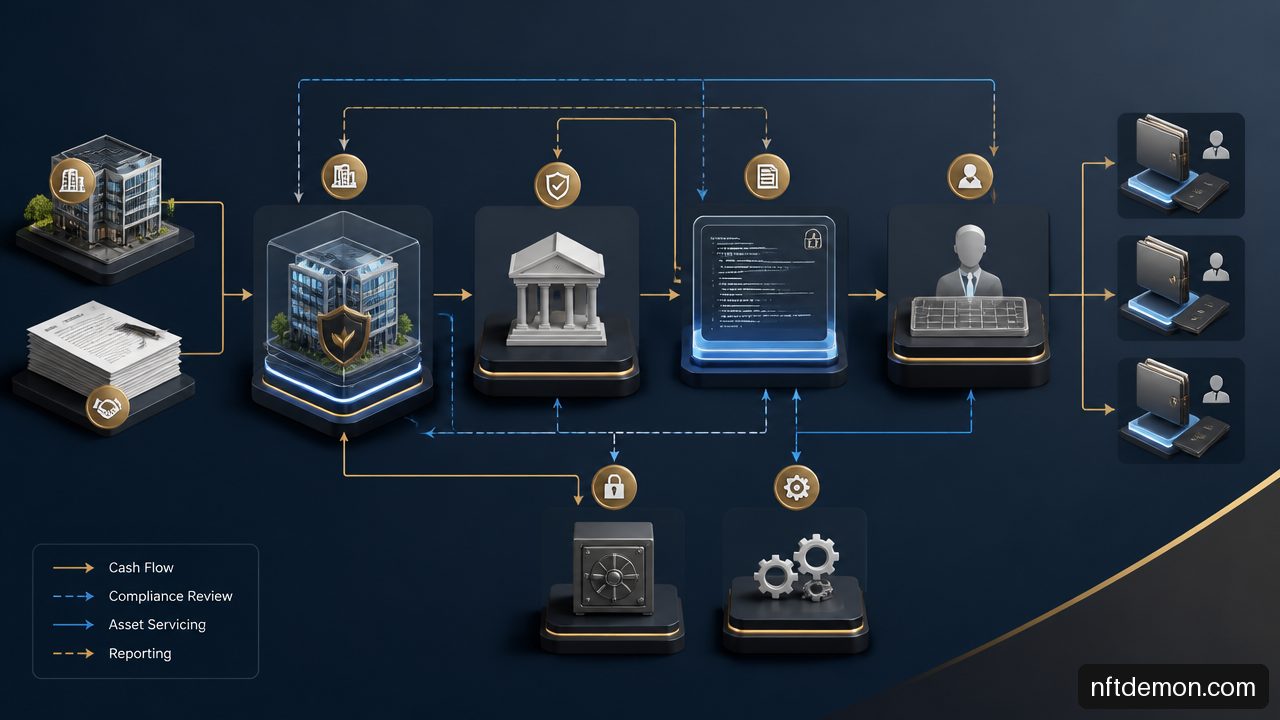
Consider a commercial real estate transaction. An issuer might place a building inside a special purpose vehicle, then issue tokens representing beneficial interests in that vehicle. In that case, token holders may own an interest in the entity that owns the building, rather than direct title to the building. If the property generates rental income, distributions may flow from tenants to the property entity, then to the issuer or administrator, and finally to approved token holders.
That chain needs to be explicit:
- The underlying asset must be identified and legally held.
- The issuer or investment vehicle must have authority to issue the token.
- The offering documents must define holder rights and risks.
- The token smart contract must reflect applicable transfer and payment rules.
- A transfer agent, administrator, or equivalent recordkeeper must reconcile legal ownership records with blockchain balances.
This is where many tokenization discussions become too abstract. The blockchain ledger may improve the record of token movements, but it does not replace contracts, title records, fund documents, loan agreements, tax reporting, or investor communications.
Direct Asset Tokens And Fund Tokens Solve Different Problems
Alternative investment managers generally face two broad design choices: tokenize a specific underlying asset or tokenize an interest in a pooled fund. The distinction affects governance, reporting, liquidity expectations, and administrative workload.
| Structure | What The Token Usually Represents | Best Fit | Operational Tradeoff |
|---|---|---|---|
| Direct asset token | A direct or beneficial interest in a specific asset, deal, or special purpose vehicle | Single properties, co investments, defined private credit facilities | Requires asset specific valuation, servicing, disclosures, and governance |
| Fund token | An interest in a pooled fund that owns multiple investments | Private credit funds, real estate funds, diversified alternative strategies | Simplifies investor exposure but retains fund administration, valuation, and redemption complexity |
| Tokenized note or payment claim | A contractual right to payments linked to an asset or portfolio | Financing structures and income products | May provide no direct ownership rights in the underlying asset |
A direct asset structure can make sense when investors want visibility into a defined transaction. For example, a group of eligible investors may want exposure to a particular credit facility or development project without subscribing to a broad blind pool fund.
A tokenized fund interest can be more efficient when the manager already has a functioning fund structure, administrator, valuation policy, and investor reporting framework. Rather than rebuilding every asset level process onchain, the manager can digitize subscription, transfer, ownership, and servicing workflows around the existing vehicle.
For consumer facing digital ownership programs, the planning discipline used in NFT strategy consulting for global brands also applies: define the holder’s rights before selecting the token standard, marketplace, or blockchain.
Market Size Requires Careful Definitions
There is no single authoritative number for the alternative asset tokenization market because market reports often measure different things. One figure may include tokenized Treasuries, commodity tokens, stablecoins, tokenized deposits, or publicly traded securities. Another may count issued value rather than current market value or active trading volume.
A useful market assessment separates at least four measurements:
| Metric | What It Measures | Why It Can Mislead |
|---|---|---|
| Issued value | Total face value or nominal value of tokens created | Tokens may be issued but inactive, locked, redeemed, or thinly distributed |
| Assets under management | Value of underlying assets managed through a tokenized vehicle | Does not indicate that token holders can trade easily |
| Circulating token value | Estimated value of tokens currently outstanding | Depends on valuation methodology and may not reflect realizable sale value |
| Secondary market volume | Tokens actually exchanged over a period | Can be low even when issued value is substantial |
One academic analysis of tokenized real world assets estimated roughly $24 billion to $25 billion in tokenized assets excluding stablecoins in mid 2025, while emphasizing that issuance growth does not establish functional liquidity. The central question remains whether tokenized assets can actually be sold in a meaningful market, as explored in this research on tokenized RWA liquidity.
We should therefore resist treating a broad real world asset total as a precise estimate of alternative asset demand. A market dominated by tokenized gold or government securities tells us little about the secondary market depth for a tokenized private real estate fund or a private credit portfolio.
Designing A Tokenized Alternative Asset Product
Legal Rights Are The Product
The token is only one layer of the product. The legal rights chain is the actual product.
Before launch, issuers should be able to answer a simple but demanding question: What exactly does the holder own or have the right to receive?
Possible answers include:
• Equity or beneficial interests in a special purpose vehicle
• Limited partnership or limited liability company interests in a fund
• A debt instrument issued by the sponsor or vehicle
• A contractual right to a share of defined cash flows
• A participation interest in a loan, portfolio, or co investment
Each answer changes the regulatory analysis. It also changes what happens if the issuer fails, the custodian loses access, an investor dies, a wallet is compromised, or the underlying asset is sold.
For example, a token linked to a property may sound like fractional real estate ownership. But if the holder only owns a contractual revenue share from an operating company, the holder’s position in an insolvency scenario could differ sharply from that of an equity holder in the property owning entity. Fair warning: these distinctions should not be buried in technical documentation or marketing language.
Compliance Must Be Built Into Transferability
In regulated alternative assets, unrestricted token transfers are often impractical. A compliant design may need to enforce investor and jurisdiction requirements each time a token moves.
That can involve:
• Identity verification and investor onboarding
• Accredited or professional investor validation where required
• Jurisdiction based restrictions
• Sanctions and anti money laundering screening
• Whitelisted wallet addresses
• Holding periods and lockups
• Transfer agent approval workflows
• Wallet recovery and inheritance procedures
A smart contract can prevent transfers to wallets that are not on an approved allowlist. That is useful, but it is not a substitute for the underlying compliance process. The issuer must define who approves investors, how often eligibility is refreshed, what happens when an investor moves jurisdictions, and how disputes are handled.
A practical edge case illustrates the point. An eligible investor may lose control of a self custody wallet. If the token is bound permanently to that address, the investor may lose access even though their legal ownership remains valid. A recoverable design needs documented procedures for identity revalidation, address replacement, transfer agent reconciliation, and smart contract permissions. Security and customer support are part of the securities infrastructure here, not optional add ons.
This is also why Enterprise NFT strategy with measurable outcomes should begin with measurable operating requirements rather than a launch date. A token program needs controls that can survive real exceptions.
Liquidity Is A Market Structure Problem
Tokenization can reduce some friction in ownership records, settlement, and investor onboarding. It does not manufacture demand for an illiquid asset.
A tokenized private credit position may still be difficult to sell if potential buyers lack information about loan performance, cannot meet eligibility requirements, distrust the valuation, or prefer to buy directly from the manager. Similarly, a tokenized real estate interest may have a blockchain price quote without reliable depth behind it.
We should evaluate liquidity through observable conditions:
| Liquidity Factor | What To Ask | Why It Matters |
|---|---|---|
| Investor base | Who is eligible and actively seeking this exposure? | More eligible wallets do not necessarily mean more qualified buyers |
| Transfer venue | Is there an approved venue, broker, bulletin board, or bilateral process? | A token without a route to counterparties remains hard to sell |
| Market making | Is anyone committed to quoting bids and offers? | Listings alone rarely create dependable price discovery |
| Pricing policy | How often is net asset value or asset value updated? | Stale values can make bids, redemptions, and fair dealing difficult |
| Redemption terms | Can holders redeem, and under what gates or notice periods? | Redemption rights may be more valuable than secondary trading access |
| Transfer restrictions | Which buyers are legally permitted to receive the token? | Restrictions can sharply reduce the available buyer pool |
The strongest liquidity strategy may not be continuous trading. For some private funds, scheduled transfer windows, periodic repurchase programs, or manager controlled redemptions may better match the asset’s valuation and settlement cycle. The point is to disclose the model honestly rather than implying public market liquidity where none exists.
A community discussion in r/fintech identifies private credit and fund tokenization for institutional investors as credible current applications, though the discussion is anecdotal rather than validated market evidence. The perspective is useful because it points to a practical pattern: institutional private credit and fund tokenization are often viewed as nearer term use cases than unrestricted retail trading of complex private assets.
Asset Verification And Token Accounting Are Separate Controls
A blockchain can provide a transparent history of token issuance and movement. It cannot independently confirm that a warehouse holds a commodity, that a property has no undisclosed lien, that a borrower made a payment, or that a collectible is authentic and insured.
That requires an evidence system outside the blockchain. Depending on the asset class, it may include audited financial statements, third party valuations, title records, custody attestations, loan servicing reports, insurance certificates, appraisal reports, and periodic investor disclosures.
For private credit, the core question is often cash flow integrity: are principal and interest payments being received, reconciled, and passed through according to the governing documents? For real estate, it may be title, occupancy, debt seniority, insurance, and property level expenses. For collectibles, provenance, condition, physical custody, and insurance may matter more than token transfer speed.
The practical architecture should connect these evidence sources to investor reporting without pretending that an oracle or dashboard converts every offchain claim into certainty.
Choose Technology After The Operating Model
There is no universal best blockchain for alternative asset tokenization. Public and permissioned networks can both support issuance, transfers, and smart contract based controls. The right choice depends on the issuer’s regulatory model and operational requirements.
Choose a more open network when broad interoperability, existing wallet support, and ecosystem connectivity are valuable. Choose a permissioned or tightly controlled environment when privacy, controlled participation, and enterprise integration outweigh open distribution.
The minimum technology review should cover:
- Smart contract auditability and upgrade controls.
- Identity, whitelisting, and transfer restriction capabilities.
- Custody options for institutional and self custody users.
- Wallet recovery, key rotation, and incident response processes.
- Integration with fund administrators, transfer agents, banks, and tax reporting systems.
- Data privacy, reporting, and record retention requirements.
- Business continuity if a vendor, custodian, or blockchain service provider fails.
For a new issuance, How to plan an NFT project offers a useful planning principle: sequence the legal, commercial, technical, and distribution decisions so the token is not built before its operating rules are known.
FAQ: Alternative Asset Tokenization Market
What Is The Alternative Asset Tokenization Market?
The alternative asset tokenization market consists of products, platforms, service providers, and investment structures that represent rights in alternative assets through blockchain based tokens. It includes tokenized private credit, real estate, commodities, private funds, hedge fund interests, art, and collectibles. The market is broader than technology vendors because it also depends on issuers, legal counsel, custodians, administrators, transfer agents, brokers, and eligible investors.
Which Alternative Assets Are Best Suited To Tokenization?
Assets with defined ownership, recurring cash flows, established valuation methods, and clear investor demand are generally more suitable. Private credit, fund interests, income producing real estate, and standardized commodity exposure may be easier to structure than rare collectibles or highly bespoke development projects. That does not mean every standardized asset should be tokenized; the administrative savings and distribution benefits must exceed implementation costs.
Does Tokenization Create Liquidity For Private Assets?
No. Tokenization can make transfers more efficient and broaden distribution, but liquidity requires willing buyers, compliant transfer routes, credible valuations, and clear settlement procedures. A product may have active issuance and little secondary trading. Investors should review turnover, bid and offer depth, redemption policies, settlement times, and transfer restrictions rather than relying on a token’s existence as evidence of liquidity.
What Rights Does A Token Holder Receive?
The answer depends on the legal documents. A holder may receive direct ownership rights, beneficial interests in an entity, fund units, debt repayment rights, voting rights, or only a contractual claim on cash flows. Investors should identify the issuer, underlying asset owner, governing law, priority of claims, redemption terms, and procedures if the issuer or service provider fails.
Which Investors Can Buy Tokenized Private Credit Or Real Estate?
Eligibility depends on the jurisdiction, offering structure, investor classification, and transfer restrictions. Many tokenized private asset products are designed for accredited, professional, qualified, or institutional investors rather than the unrestricted public. Whitelisting and identity verification can enforce those limits at the wallet level, but the legal framework determines the rule.
How Are Tokenized Alternative Assets Valued And Verified?
Valuation should follow the same disciplined process expected for the underlying asset, such as administrator calculated net asset value, independent appraisal, loan level reporting, market pricing, or third party valuation. Verification should address asset existence, ownership, liens, custody, cash flows, and servicing. Onchain balances show token accounting; they do not independently validate the asset behind the token.
What Are The Main Costs Of Launching A Tokenized Product?
Costs commonly include legal structuring, securities or fund compliance, smart contract development and audits, identity systems, custody, transfer agency, administration, tax reporting, investor communications, asset servicing, and liquidity or distribution arrangements. A smaller issuance can be uneconomic if these fixed costs exceed expected operational savings or fundraising benefits.
Sources And References
• arXiv — Tokenize Everything, But Can You Sell It? RWA Liquidity: https://arxiv.org/html/2508.11651v1
• Reddit, r/fintech — Is tokenization actually disrupting traditional finance or just hype?: https://www.reddit.com/r/fintech/comments/1qqc75o/is_tokenization_actually_disrupting_traditional/
NFT Demon Holdings helps enterprises scope, evaluate, and build blockchain programs — start with a free evaluation call.
Talk through your use case
Free evaluation call — objective, constraints, and fit, before any proposal.