Achieving seamless asset transfer without losing control
By Jeremy Ryan, Founder & CEO · October 2026

Achieving seamless asset transfer is not simply a matter of moving a record, token, account, file, or physical item from one location to another. A transfer is seamless only when the receiving party can prove the asset arrived intact, the correct owner holds the correct rights, operations continue, and the evidence survives audit, dispute, or regulatory review.
For decision makers, the central challenge is control. Assets can move technically while remaining incomplete legally. They can appear in a destination platform while carrying stale permissions, broken metadata, missing tax records, or conflicting ownership claims. I recommend treating every transfer as a controlled state transition rather than a one time handoff.
- Key Takeaways
- Define What “Seamless” Actually Means
- Build The Transfer Control Framework
- Use Blockchain, Smart Contracts, Liquidity, And Interoperability Carefully
- Execute, Reconcile, And Recover From Exceptions
- Frequently Asked Questions
- Sources And References
Key Takeaways
A Seamless Transfer Requires Proof, Not Just Movement
The destination should not be considered complete merely because an asset appears there. Completion requires verified identity, ownership, rights, valuation or status, timestamps, and evidence that the receiving party accepted responsibility.
A successful transfer preserves the asset’s economic value, legal standing, operational usability, and historical evidence at the same time.
The Most Important Decisions Happen Before Cutover
The highest risk usually sits in unresolved edge cases: duplicate records, restricted assets, conflicting beneficiary instructions, incompatible destination fields, and assets whose rights cannot be represented in the target system. These records need an exception queue with accountable owners and explicit decisions.
Blockchain Can Improve Evidence, But It Does Not Replace Governance
Blockchain can provide tamper evident records, programmable settlement, and shared visibility across parties. It does not independently establish legal title, solve inaccurate source data, or make an illiquid asset liquid. Smart contracts execute defined rules; they cannot repair rules that were poorly designed.
Use Parallel Operations When Reversal Would Be Difficult
For high value, regulated, or operationally critical assets, a parallel run is often safer than a direct cutover. The source and destination processes operate together for a defined period while records, rights, valuations, and reports are compared. This approach adds cost and complexity, but may reduce the risk of irreversible mistakes.
Define What “Seamless” Actually Means
Separate Technical Completion From Legal Completion
A transfer can be technically complete while legally incomplete. Consider a tokenized private asset moved from one wallet environment to another. The token may settle on chain, but the transfer may still fail if the buyer was not eligible, the issuer register was not updated, a contractual restriction was breached, or required disclosures were missing.
The same distinction applies outside blockchain. A digital media library may be copied into a new digital asset management system while license rights remain unclear. A securities account may be moved to a new custodian while cost basis data or beneficiary records are missing. A physical asset may arrive at a warehouse while insurance, title, and condition records remain unresolved.
A practical acceptance model should include both dimensions:
| Completion Area | What Must Be Confirmed | Typical Failure If Ignored |
|---|---|---|
| Technical completion | Asset record, identifier, location, status, and integrity match the source | Missing files, broken token references, failed settlement |
| Legal completion | Title, beneficiary, contract terms, tax treatment, and restrictions are valid | Ownership disputes, invalid transfers, tax exposure |
| Operational completion | Authorized users can access, administer, value, and report on the asset | Service disruption and manual workarounds |
| Evidence completion | Audit trail, approvals, timestamps, and acceptance records are retained | Inability to prove what happened later |
Define Acceptance Criteria Before Anyone Moves Assets
I recommend setting measurable entry, handoff, and completion gates before migration begins. This turns “seamless” from a subjective aspiration into an operating standard.
A transfer should not enter execution until the source population is frozen or otherwise version controlled, the destination can represent required fields, and accountable owners have approved the handling of exceptions. It should not close until reconciliations are complete and legal, technical, and operational acceptance criteria are signed off.
A minimum reconciliation record should connect the following fields:
• Source identifier and destination identifier
• Asset type, description, and current status
• Legal owner, beneficial owner, and authorized administrator where relevant
• Rights, restrictions, permissions, or transfer eligibility
• Valuation, quantity, or condition at the transfer point
• Transfer timestamp, approval evidence, and receiving party acceptance
• Exception status and final resolution, if the record required manual review
This is more demanding than comparing asset counts. Counts reveal whether 10,000 records became 9,999 records. They do not reveal whether one of those 9,999 records now belongs to the wrong entity or lacks the rights required for use.
Preserve Lineage Across Fragmented Systems
Complex transfers rarely have a single authoritative source. Asset servicers may need to reconcile fragmented data held across custodians, transfer agents, legacy systems, investor records, and transaction histories. KPMG’s analysis of asset servicer migration constraints notes that AML and KYC records, carried interest calculations, NAV events, regulatory deadlines, and investor distributions may all need to remain accurate during the transition.
That has a direct design implication: preserve lineage rather than overwriting history. The destination should retain a clear relationship between an incoming record and the source record, including transformations performed during mapping. If an old account number becomes a new account number, the link between them should remain queryable.
This matters especially when calculations depend on historical sequences. A carried interest calculation may span ten to fifteen years of transactions. Rebuilding only the latest balance could produce a record that looks correct at a glance but fails when prior allocations, fees, or distributions are tested.
Build The Transfer Control Framework
Design The Transfer Around States And Gates
A reliable program uses distinct states, each with its own evidence requirement. This is more useful than a broad “before, during, and after” checklist because it defines what must be true before the next action can occur.
| Transfer State | Decision Gate | Evidence Required |
|---|---|---|
| Ready for transfer | Is the asset eligible and accurately represented? | Identity, ownership, rights, source snapshot |
| In flight | Has the transfer instruction been authorized and recorded? | Approval, transaction reference, custody chain |
| Received | Did the destination receive the intended asset without alteration? | Destination record, integrity check, receipt |
| Accepted | Can the destination administer the asset under valid rights? | Permissions, legal review, operational signoff |
| Closed | Are exceptions resolved and source responsibilities retired? | Reconciliation, audit record, closure approval |
For tokenized assets, the “in flight” state may be a blockchain transaction awaiting finality. For a custodian migration, it may be a batch instruction awaiting settlement. For physical equipment, it may include a documented chain of custody and condition check. The framework remains similar because the control question is the same: what evidence proves the asset is safe to advance?
Establish An Exception Queue Instead Of Forcing Automation
Automated transfers should not silently accept ambiguity. Records that fail validation need to enter a governed exception queue. Each exception should have a category, severity, accountable owner, due date, and disposition.
Common categories include:
• Duplicate assets with unclear authoritative records
• Missing title, beneficiary, or ownership documentation
• Restricted securities, sanctioned parties, or transfer lockups
• Metadata that cannot be mapped to the destination taxonomy
• Rights or permissions that do not carry over automatically
• Destination systems that cannot represent fractional interests, liens, or multi party ownership
• Failed blockchain transactions, wallet address errors, or smart contract reverts
The governing principle is simple: do not convert an unresolved issue into a hidden destination defect. A manual review queue may feel slower, but it prevents a faster transfer from becoming a longer remediation program.
Build A Rollback Plan Before Irreversible Actions
Rollback is not always a literal reversal. On a public blockchain, a confirmed transaction generally cannot simply be undone. A rollback plan may instead require compensating transactions, temporary freezes, escrow controls, or contractual correction procedures.
For conventional systems, rollback may mean restoring a validated source snapshot, reopening the source record, or preventing the destination from becoming the operational system of record until reconciliation is complete.
Choose a direct cutover when all of the following are true:
• Assets are standardized and low risk
• The destination represents all required rights and attributes
• The source can be restored quickly
• A short service interruption is acceptable
Choose a parallel run when valuation, settlement, regulatory reporting, or client service cannot pause. Parallel operation is particularly useful around NAV strikes, distributions, reporting deadlines, or scheduled corporate actions. It adds reconciliation effort, so it should be reserved for transfers where a failed cutover would cost more than the overlap.
Use Blockchain, Smart Contracts, Liquidity, And Interoperability Carefully
Match The Technology To The Transfer Problem
Blockchain is useful when multiple parties need a shared, tamper evident transaction record without relying entirely on one party’s internal database. It can also support tokenization, programmable transfer rules, and near real time settlement flows. The right architecture depends on the asset, governance model, privacy requirements, and regulatory obligations.
For enterprise programs, integrating blockchain with existing enterprise systems is usually more important than creating a separate ledger in isolation. Asset records often need to synchronize with enterprise resource planning platforms, custodial systems, customer databases, compliance screening tools, accounting workflows, and document repositories.
A blockchain record should therefore be treated as one part of a broader evidence chain. It may confirm that a token moved from Wallet A to Wallet B, while off chain systems confirm whether Wallet B belongs to an eligible holder and whether the transfer aligns with a legal agreement.
Use Smart Contracts For Rules That Can Be Expressed Clearly
Smart contracts can reduce manual intervention by applying pre defined transfer conditions. Examples include allowlists for eligible investors, holding period restrictions, jurisdiction limits, royalty distributions, collateral triggers, or approval requirements for high value movements.
The tradeoff is rigidity. A smart contract will execute the encoded rule, not the policy someone intended but failed to define. Before deploying one, decision makers should answer:
- Which rules are objective enough to automate?
- Who can update the rules if regulations, contracts, or operating needs change?
- What happens if an external data feed is unavailable or incorrect?
- Can the contract pause transfers during an investigation or security event?
- Is there a legally documented process for resolving an on chain outcome that conflicts with an off chain obligation?
The architecture also needs to withstand growth, permission changes, and threats. Enterprise blockchain architecture for security and scalability should address key management, role based access, transaction monitoring, privacy boundaries, and the capacity required for expected transfer volumes.
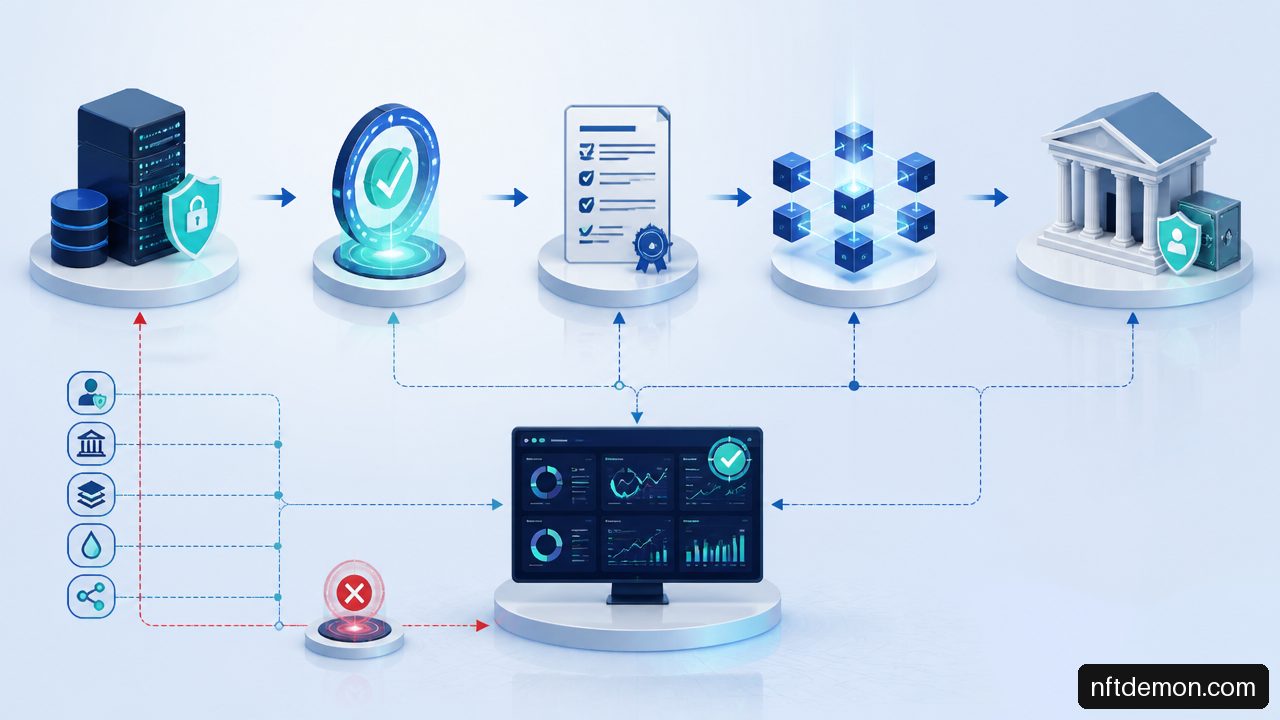
Liquidity And Interoperability Are Different Problems
Liquidity means there are credible buyers, sellers, market makers, or redemption mechanisms capable of supporting transactions at workable prices. Interoperability means assets and their associated data can move or be recognized across systems, networks, custodians, or marketplaces.
A tokenized asset may be interoperable but illiquid. It can travel between approved wallets yet have no active market. Conversely, an asset may have substantial market demand but remain difficult to transfer because systems do not share identifiers, eligibility data, or settlement standards.
Decision makers should test both dimensions:
| Question | Liquidity Test | Interoperability Test |
|---|---|---|
| Can the asset be transferred? | Is there an available buyer, seller, or redemption route? | Can the destination recognize and administer it? |
| Can value be realized? | Are pricing, settlement, and exit mechanisms credible? | Can ownership, rights, and history move with the record? |
| What can break? | Thin markets, valuation gaps, concentration risk | Mapping errors, incompatible standards, lost permissions |
Interoperability is also organizational. A technically compatible network does little good if compliance, legal, operations, and custody teams use conflicting definitions of ownership or transfer completion.
Execute, Reconcile, And Recover From Exceptions
Run A Controlled Transfer Sequence
The execution plan should identify an accountable owner for each approval, data set, exception category, and rollback decision. This is where many programs become vague. “Operations owns the migration” is not enough when legal title, cybersecurity, tax treatment, and client communications each have distinct decision rights.
A practical sequence is:
- Create a source snapshot and confirm the in scope asset population.
- Validate destination readiness, including data fields, permissions, reporting, and integration dependencies.
- Categorize exceptions before cutover and determine whether each item will transfer, pause, or receive a manual treatment.
- Execute a pilot batch where possible and test reconciliation logic before moving the full population.
- Move approved assets under controlled authorization and capture transfer evidence in real time.
- Reconcile identity, rights, valuation or status, and transaction history between source and destination.
- Obtain technical, legal, and operational acceptance before retiring the source process.
This sequence is not a promise of universal timing or cost. Available evidence does not establish a reliable industry wide benchmark for seamless asset transfer duration, expense, or failure rates. The correct timetable depends on asset complexity, regulatory exposure, volume, integration depth, and the number of unresolved exceptions.
Reconcile Rights Alongside Asset Identity
An identity reconciliation asks: “Did Asset 7842 arrive?” A rights reconciliation asks: “Can the correct party access, use, sell, license, pledge, or administer Asset 7842 under the same valid conditions?” Both are necessary.
Digital asset migration illustrates the issue clearly. Large repositories can contain inconsistent metadata, differing taxonomies, unclear duplicate ownership, and rights structures that need remapping. Bynder’s guidance on digital asset management migration identifies these as recurring migration concerns. The practical lesson is that a file hash or filename is not enough; usage rights, expiration dates, permissions, and ownership fields must be validated too.
The same logic applies to financial and tokenized assets. A destination record should retain restrictions, beneficial ownership, lien status, transfer eligibility, and administrator authority where relevant.
Coordinate The Operating Model, Not Just The Technology
A transfer program fails when no one owns the handoffs between business functions. The operating model should define who approves transfer eligibility, who resolves data issues, who monitors transactions, who can pause activity, and who signs final acceptance.
For organizations building repeatable tokenization or digital asset processes, creating an enterprise blockchain operating model helps connect governance, technical controls, compliance workflows, and escalation paths.
Cross border transfers require added caution. Ownership, tax obligations, wills, and family wealth arrangements can operate differently after a change of country. J.P. Morgan Private Bank’s discussion of cross border family wealth challenges highlights how relocation can alter these arrangements. A blockchain settlement record does not override local inheritance rules, tax rules, or legal recognition requirements.
For physical assets, the controls change but the discipline remains. Physical asset migration planning considerations include inventory, valuation, destination planning, logistics, packaging, insurance, repairs, and cost. In that setting, condition reports and custody evidence play roles similar to transaction logs and metadata in digital transfers.
Frequently Asked Questions
What Does Seamless Asset Transfer Actually Mean?
It means the asset reaches its intended destination with verified identity, ownership, rights, status, and evidence of acceptance, while required operations continue. It does not mean the transfer has no human review or no exceptions.
Which Assets Should Be Inventoried Before A Transfer Begins?
Inventory every in scope asset and related control record: identifiers, owners, beneficial owners, locations, valuations, restrictions, permissions, linked contracts, transaction history, and supporting documentation. Include dormant, archived, disputed, and restricted items because they often become the exceptions that delay closure.
What Is The Safest Way To Transfer Assets Between Platforms Or Custodians?
Use a documented transfer protocol with source snapshots, destination readiness testing, authorization controls, real time evidence capture, and post transfer reconciliation. Use a pilot batch when the asset population is large or the mapping is new. Use a parallel run where business interruption or inaccurate valuation would be difficult to recover from.
When Should A Parallel Run Be Used Instead Of A Direct Cutover?
Use it when the transfer affects high value assets, regulated reporting, NAV calculations, distributions, customer access, or irreversible settlement. Avoid it when the population is simple, the destination is proven, operational overlap creates more risk than value, and a tested rollback is available.
How Do Digital Asset Metadata And Permissions Affect Transfer Success?
Metadata determines how assets are identified, discovered, classified, and governed. Permissions determine who can access or use them. If taxonomies differ or permissions are not mapped, assets may arrive but become undiscoverable, inaccessible, incorrectly exposed, or unusable for their intended purpose.
What Records Prove That An Asset Transfer Was Completed Correctly?
The strongest record links the source identifier, destination identifier, owner, rights, valuation or status, timestamp, authorization, transaction or custody evidence, and final acceptance. For blockchain transfers, include the transaction reference and the off chain records that establish the receiving wallet or entity is authorized.
What Should Happen If The Destination Cannot Represent The Source Asset Accurately?
Do not force the record into a simplified format without approval. Place it in an exception queue, define the missing capability, and choose among extending the destination model, retaining a linked source record, using a different destination, or delaying transfer. A partial representation can create a misleading appearance of completion.
How Can A Rollback Plan Avoid Duplicate Ownership Or Records?
Define the source and destination system of record for every state, freeze or clearly mark superseded records, and require a reconciliation before reopening the source. For irreversible blockchain activity, use a documented compensating action and legal correction process rather than assuming technical reversal is possible.
Sources And References
• KPMG — Transforming migration economics for asset servicers: https://kpmg.com/lu/en/insights/operations/transforming-migration-economics-asset-servicers.html
• Bynder — DAM Migration: 3-Step Process: https://www.bynder.com/en/blog/3-steps-digital-asset-management-migration/
• J.P. Morgan Private Bank — Four challenges wealthy families can face when moving country: https://privatebank.jpmorgan.com/eur/en/insights/markets-and-investing/ideas-and-insights/four-challenges-wealthy-families-can-face-when-moving-country
• FasterCapital — Factors To Consider Before Asset Migration: https://fastercapital.com/topics/factors-to-consider-before-asset-migration.html
NFT Demon Holdings helps enterprises scope, evaluate, and build blockchain programs — start with a free evaluation call.
Talk through your use case
Free evaluation call — objective, constraints, and fit, before any proposal.